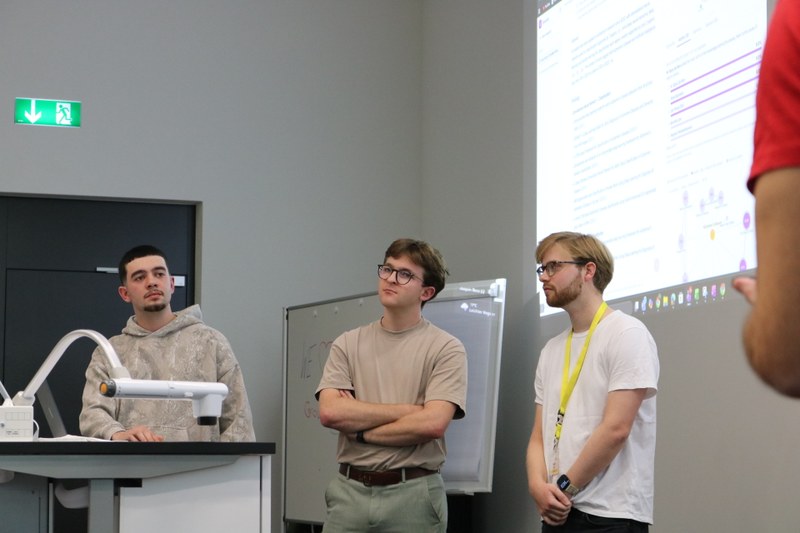
Around 80 students, industry experts, technology partners and mentors gathered at FHNW Campus Olten for MAKEathon 2026, where teams developed 13 working AI prototypes to address eight real-world business challenges in just one and a half days.
Now in its seventh edition, MAKEathon has evolved alongside advances in artificial intelligence. Since becoming a module in the BSc Business Artificial Intelligence programme in 2024, the event has increasingly focused on agentic AI, exploring how AI agents can work independently or alongside people within organisations.
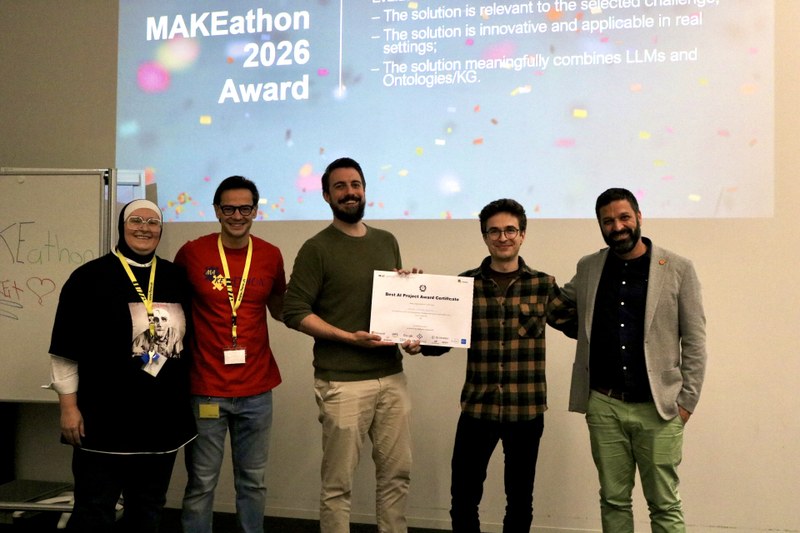
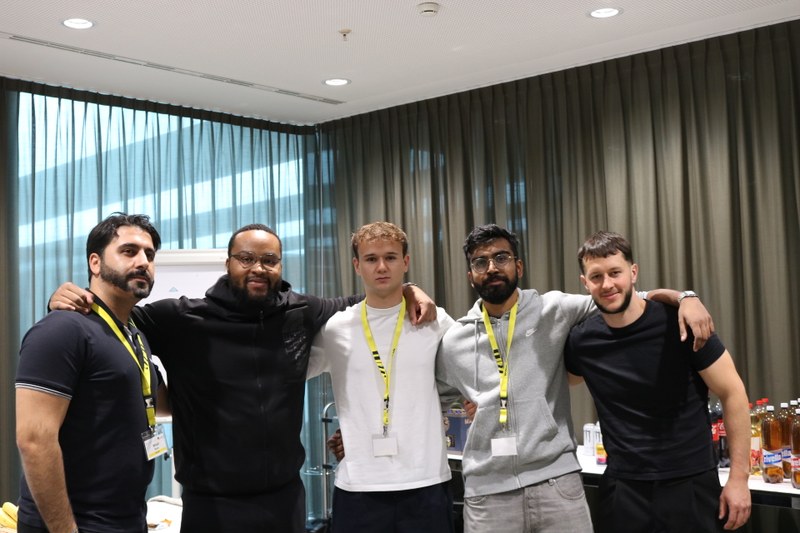
This year's challenge invited participants to combine large language models with ontologies and knowledge graphs to solve practical business problems. The event was open to students from FHNW and other universities.
Preparation began well before the competition weekend. In early October, representatives from seven major technology companies delivered a series of technical tutorials moderated by Dr Emanuele Laurenzi, Chair of MAKEathon. The sessions introduced participants to the technologies and approaches they would later apply during the event.
From Regulatory Monitoring to AI-Powered Decision Support
The participating teams tackled challenges across a wide range of sectors and demonstrated how AI can deliver practical value in real-world business settings.
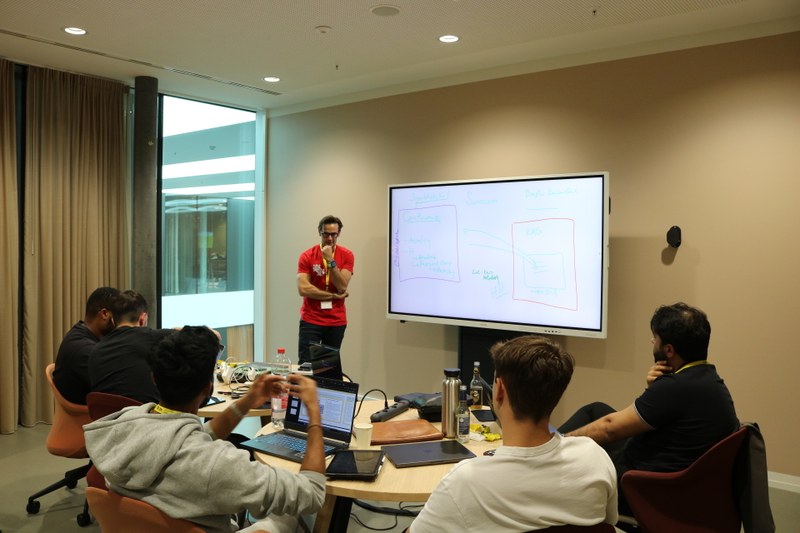
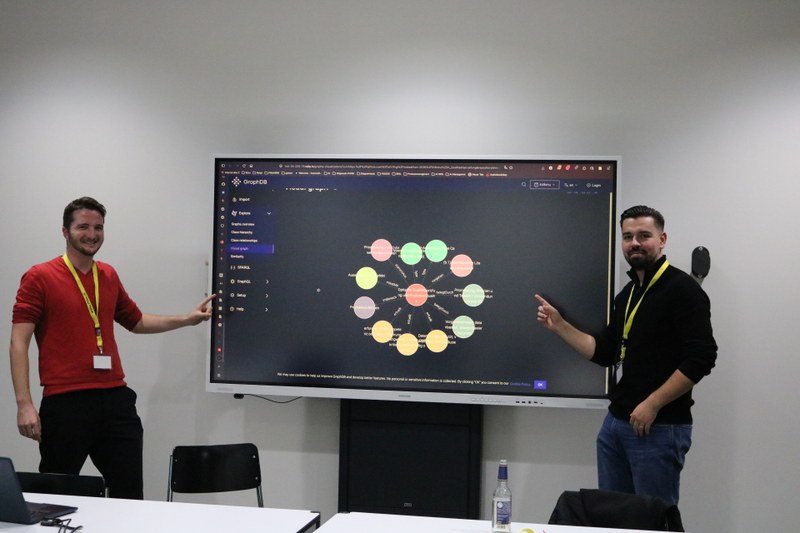
For Swiss energy company Eniwa AG, teams developed solutions to support regulatory monitoring. One prototype, Neovex, successfully identified all 40 previously unseen legal changes during testing, while another solution, RegRadar, reduced token costs by up to 92 per cent.
Working on a challenge provided by KI-ZENTRUM, students built AI assistants designed to support small and medium-sized enterprises. One solution, JustMAKEIt, has already been made available online, while another, Pythia, used a network of seven AI agents and reached the same recommendation as FHNW experts for a real company case.
Teams working with Swiss open-weight AI provider Apertus achieved notable improvements in model performance. One group doubled the number of correct responses by enhancing the model with an ontology, while another increased the accuracy of permit-office decisions from 32.5 per cent to 92.5 per cent.
Other projects addressed challenges in healthcare, banking, task management and research. Solutions included systems capable of detecting fever and dental pain in cats, converting client emails into approved trading orders, automatically routing tasks to the appropriate teams, and generating answers with every claim linked to a verifiable source.
Learning Through Real-World Experience
A defining feature of MAKEathon is its emphasis on practical application. Rather than working on theoretical case studies, students collaborate directly with companies and industry experts to develop solutions for genuine business challenges.
Throughout the weekend, teams received support from mentors, domain specialists and technology partners, including IBM, AWS, Microsoft, Google, Databricks and Graphwise. At the end of the event, participants presented their prototypes to a jury comprising academic and industry professionals.

Inspiring the Next Generation
The event also included MAKEathon Youth, which welcomed 11 participants aged 11 to 16 to the Olten campus on Saturday afternoon. The young attendees developed AI applications for face augmentation, object detection and tracking, and trained their own machine-learning models.
A Collaborative Effort
The organisers thanked sponsors Graphwise, Databricks, TD SYNNEX and metaphactory, as well as technology partners IBM, AWS, Microsoft and Google. Recognition was also given to the challenge providers, mentors and jury members whose contributions helped make the event possible.
After seven editions, MAKEathon continues to demonstrate the value of learning by doing, bringing together students, academia and industry to transform emerging AI technologies into practical solutions for real-world challenges.
Contact
Dr. Maja Spahic
- Phone
- +41 62 957 27 34
- maja.spahic@fhnw.ch