Data Stories: Exploring Societal Challenges
3 ECTS
| Monday | 31.08.2026 | 13-17 | Muttenz |
| Tuesday | 01.09.2026 | 9-17 | Muttenz |
| Wednesday | 02.09.2026 | 9-17 | Muttenz |
| Thursday | 03.09.2026 | 9-17 | Brugg-Windisch |
| Friday | 04.09.2026 | 9-12 | Brugg-Windisch |
What to expect:
In this module, you will explore how to develop a story based on (scientific) evidence. Working in teams, you will investigate a self-defined question, explore data that helps you answer (or attempt to answer) your question, and present your findings in a creative format of your choice, such as a podcast, digital story, interactive webpage, or short film. We strive to create an open-minded, hackathon-like atmosphere that fosters an exciting and creative environment.
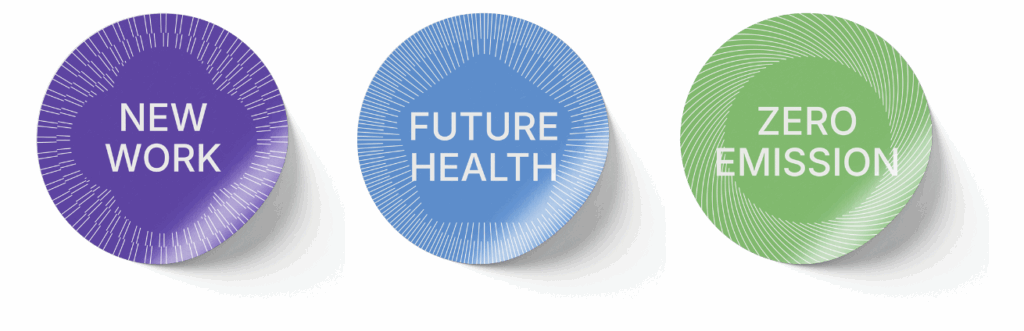
You will independently define a question that interests you related to the topics New Work, Future Health, or Zero Emission and investigate it as part of an interdisciplinary team. The project work focuses on researching, assessing, and interpreting various sources of data, that you will use to construct a coherent, evidence-based story. Particular attention is given to engaging critically with sources, understanding the limits and uncertainties of data, and reflecting on how knowledge is produced and communicated.
In an age where scientific evidence and facts are increasingly contested, you will learn how to work with different types of data and explore its possibilities and limitations. You will also develop skills in translating complex content into accessible and engaging forms suited to different audiences. Throughout the module, you will practice collaboration across disciplinary perspectives, creative problem-solving, and independent project management. The final product demonstrates not only your honed analytical and technical competencies, but also creativity, communication skills, and a deeper understanding of real-world issues connected to FHNW’s future topics.
The lecturers will provide targeted inputs on topics such as storytelling and working with data, and provide practical help and technical support (e.g., infrastructure to record a Podcast). The module may also include an excursion to connect your projects with real-world contexts.
Language:
English
Requirements:
Students of all levels and disciplines are welcome.
Comments:
Moodle course and preparatory tasks will be made available two weeks before the start of the course.
Transcript of records:
Module with compulsory attendance (Attendance on four out of five days is required to pass the module.)
The assessment consists of both group and individual components. While the course is conducted in English, language proficiency will not be part of the evaluation; the focus is on content, creativity, and collaboration.
Group work:
- Final project in a format chosen by the group (e.g., podcast, video, written paper, interactive website)
- Presentation of intermediate results at the end of the course.
Individual contributions:
- Individual research question contributing to the group project (documented as an individual section within the final group product)
- Individual learning portfolio
Due date: The final group project is to be submitted two or three weeks after the end of the course week.
Module evaluation:
pass/ fail (2-point scale)
You will acquire the following skills:
Data Literacy and Critical Evaluation
Students are able to critically assess information sources and datasets, reflecting on their reliability, scope and limitations, and to apply basic skills in data collection, analysis and visualisation.
Interdisciplinary Problem-Solving
Students are able to explore and integrate interdisciplinary approaches to address complex societal challenges.
Communication and Collaboration
Students are able to structure and communicate data-driven insights creatively (e.g., mini-exhibitions, podcasts, short documentaries) and to collaborate effectively in interdisciplinary teams.
Lecturers:
Emily Raubach, Martin Sterchi