Workshop: Getting along on the road
Ocassion
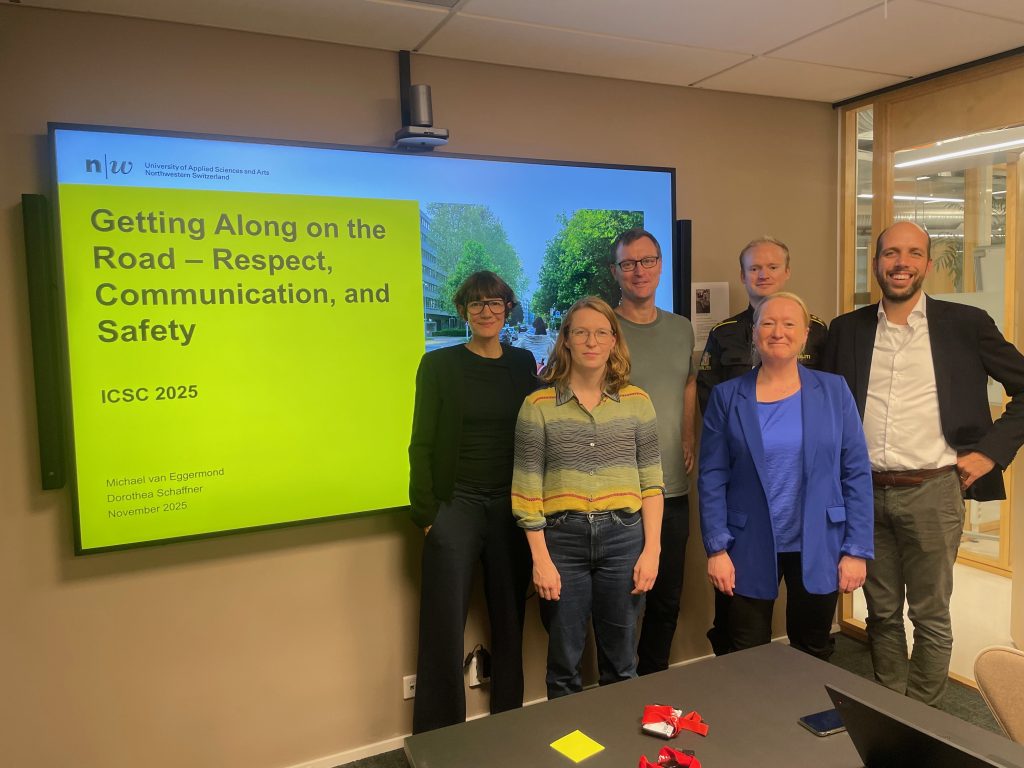
From November 4 to 6, 2025, the International Cycling Safety Conference (ICSC) took place in Oslo, Norway. As part of the pre-conference program, Dorothea Schaffner and I had the pleasure of organizing two workshops titled ‘Getting Along on the Road – Respect, Communication, and Safety’.
Background
During the development and evaluation of the training program «Level Up Your Ride» for cyclists and its predecessor «Digital aufs Pedal» two themes emerged
Early in the development of the training program, cycling instructors and experiment repeatedly measured the necessity getting along and accepting each other on the road – yielding way, even if not necessary; keeping sufficient distance when overtaking; and communicating using eye contact and hand signals.
At the same time, self-reported data show a trend: several reports mention increasing levels of anger, aggression, and conflict in traffic – for instance as mentioned in surveys by the Automobile Association of America, ADAC in Germany – and the BBC dedicated a podcast to the road wars in Paris, that outlines the escalation of violence on the road in Paris that culminated in a fatal confrontation in which a car driver killed a cyclist.
We believe that one way to reduce conflict and anger is to promote mutual understanding and respect:
- How do we understand interactions and conflicts through different lenses?
- How can we act to prevent conflict and promote mutual respect among all road users?
Inputs from different perspectives
We set ourselves the goal of finding speakers who could represent different perspectives – and we were lucky and honoured to welcome experts from the Norwegian Cyclists‘ Association (Syklistforeningen), the Oslo Municipal Police Department, the Norwegian Public Roads Administration (Statens Vegvesen), the Municipality of Oslo, and Rül von Stulpnagel of the University of Freiburg. Additionally, we as hosts covered topics such as anger and aggression among road users, their psychological roots, and interventions to promote mutual understanding.
Different perception of safety
What came forward is that cyclists and drivers have different perceptions of safety of the same situation – which can already lead to misunderstanding and tension. While cyclists often perceive a narrow cycling lane as unsafe, drivers may consider it safe, meaning that even a narrow passing distance can already trigger anger or frustration among cyclists.
Rules
Rule-breaking occurs for several reasons, ranging from rules being placed in odd or impractical locations to breaking a rule deliberately for safety reasons. Enforcement of rules is easier when they make sense – at the same, impractical rules should be enforced, otherwise abiding to rules becomes subject to interpretation.
The missing link
Important to note is that a one-to-one causality between conflict, anger, aggressive driving and accident risk is lacking. While it is known which situations can trigger anger – for example, narrow passing distances can frustrate cyclists where as rule-breaking can anger drivers – it is not yet clear whether these directly lead to aggressive driving behaviour.
Interventions
To promote understanding and prevent frustration among different road users, humorous campaigns – addressed to all groups of road users – and showing different perspectives – can help and are well received. Fear-mongering on other hand, is not the way forward. Other effective approaches include improving communication, encouraging social contact, collective actions, such as car-free days, creating super-ordinate goals, supporting negotiation and participation, promoting perspective-taking, and building mutual respect.
Break-out sessions
To put the insights into practice, the 30-minute break-out sessions focused on two case studies. The first case dealt with an incident of road rage in Oslo, while the second explored a street in Oslo pedestrians – including primary school children – need to cross a street with a high-volume of cyclists.
Solutions varied from :
- Campaigns to inform cyclists about upcoming roadworks, and installing clear informational signs in construction areas;
- Rebranding certain streets as “school streets” to emphasize safety and shared responsibility;
- Infrastructural measures, such as LED strips, to guide and alert road users.


What’s next?
During the preparation for the workshop — through literature reviews and, most importantly, the exchanges with our speakers before and during the session — many new ideas for future research emerged.
Building on the frameworks proposed by Shinar (1998) and described in detail by Uhr (2014) and Meunier et al. (2018), who additionally examined the links between conflicts, anger, aggression, and accident risk, we aim to extend this approach to:
- Include subjective safety as perceived by others, and how it may be influenced by conflicts, anger and aggression on the road
- Integrate psychological concepts to better understand the emergence and escalation of conflicts
- Develop interventions rooted in psychological concepts that promote acceptance, mutual respect, and ultimately reduce conflict among road users
The first step will be a scoping review — more to follow soon!
About Oslo
Oslo itself offered a great backdrop for the conference. Cycling started increasingly only recently, and different generation of cycling infrastructure can be found – varying from painted bike lanes, elevated bike lanes and a newly introduced cycling street. Combined with traffic calming and reduction measures in the downtown area, cycling is becoming more attractive. Nevertheless, cycling remains challenging due to a lack of continuity of infrastructure – especially at intersections – and there still is work to be done in the future. Having said that, the mobility department is keen on promoting cycling – and the increasing mode share for cycling shows a promising future for cycling indeed.


References
Fruhen, L. S., & Flin, R. (2015). Car driver attitudes, perceptions of social norms and aggressive driving behaviour towards cyclists. Accident Analysis & Prevention, 83, 162–170. https://doi.org/10.1016/j.aap.2015.07.003
Huemer, A. K., Oehl, M., & Brandenburg, S. (2018). Influences on anger in German urban cyclists. Transportation Research Part F: Traffic Psychology and Behaviour, 58, 969–979. https://doi.org/10.1016/j.trf.2018.07.026
Meunier, J.-C., Schinckus, L., & Kaiser, S. (n.d.). Themadossier Verkeersveiligheid nr. 20 – Risicobereidheid en agressie (No. 20; Themadossier Verkeersveiligheid). Vias Institute – Kenniscentrum Verkeersveiligheid.
Parker, D., Lajunen, T., & Summala, H. (2002). Anger and aggression among drivers in three European countries. Accident Analysis & Prevention, 34(2), 229–235. https://doi.org/10.1016/S0001-4575(01)00018-5
Rissel, C., Campbell, F., Ashley, B., & Jackson, L. (2002). Driver Road Rule Knowledge and Attitudes towards Cyclists. Australian Journal of Primary Health, 8(2), 66. https://doi.org/10.1071/PY02029 Uhr, A. (2014). Aggression und Emotionen im Strassenverkehr (No. 12; bfu-Faktenblatt). bfu.
von Stülpnagel, R., & Rintelen, H. (2024). A matter of space and perspective – Cyclists’, car drivers’, and pedestrians’ assumptions about subjective safety in shared traffic situations. Transportation Research Part A: Policy and Practice, 179, 103941. https://doi.org/10.1016/j.tra.2023.103941
Kommentare
Keine Kommentare erfasst zu Workshop: Getting along on the road