Teaching Trust in the Age of AI: SwissAfricaCySec at the Third DataPro Hybrid Conference in Berlin
On 1 July 2026, Prof. Dr. Bettina Schneider, presented the SwissAfricaCySec Community at the Third DataPro Hybrid Conference “Educating for the Future of Data” in Berlin. The conference, organised by the University of Education Freiburg as part of the international DataPro project, brought together educators, experts and project partners to discuss data protection, digital awareness and new challenges arising from digitalisation and artificial intelligence.

Her presentation, “Teaching Trust in the Age of AI: Deepfakes, Social Engineering & the New Misinformation Challenge,” explored how education can respond to an increasingly complex digital environment. A central focus was the SwissAfricaCySec Community’s approach to joint teaching as a best practice, bringing together expertise and perspectives across institutions and countries to strengthen cybersecurity awareness and digital trust.
Can You Spot Misinformation?
The topic is particularly relevant to Business Information Technology, where technology and business are closely interconnected. Digital technologies do not operate in isolation: they shape how organisations communicate, make decisions, manage information and interact with customers, employees and partners. As AI-generated content, deepfakes, social engineering and misinformation become more sophisticated, future business IT professionals need not only technical skills, but also the ability to assess information critically, recognise manipulation and understand the human and organisational dimensions of cybersecurity.
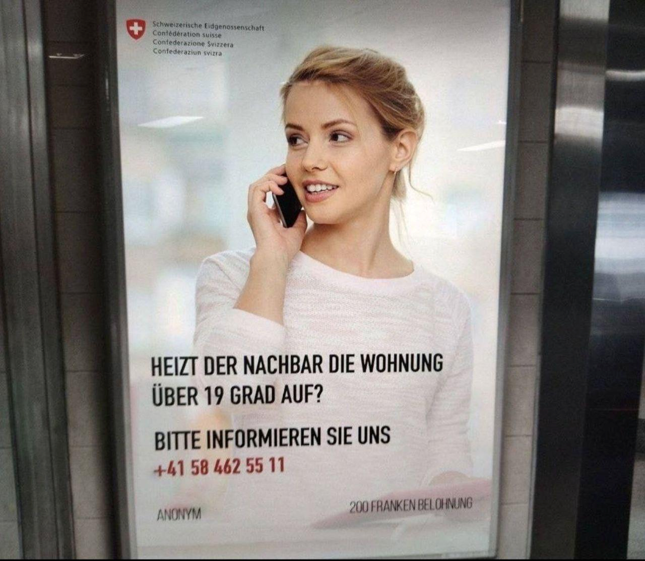
The Young Generation as Extremely Exposed
- 2 in 5 people use AI to create content, texts, and images.
- About 4 in 5 15 – 24-year-olds have used generative AI to create content.
- People’s encounter with fake news on social media keeps going up:
- 2021: 45%; 2023: 51%; 2025: 58%
News verification
- 38% say they don’t check because they already know it is false
- 15% admit not having the skill to verify the truthfulness of the information.
Source: Federal Statistical Office, 2025
Possible Approaches to Increase Threat Awareness
- Situation monitoring and early detection
- Federal bodies (Security Core Group and Security Committee of the Federal Council) assess the overall security situation, coordinate cross-departmental responses, and propose actions at the federal level
- Federal Intelligence Service (FIS) monitors foreign influence activities related to Swiss authority.
- Swiss military monitors threats to members of the military before and during service
- Collaboration with universities, e.g., the threat potential posed by AI-generated images and the detection of influence bubbles, and the plausibility of trends in social networks.
- Resilience through Awareness and Media Literacy
- Communication
- Debunking Misinformation
- Informing the public
- e.g., crisis-proof Bundesrat app (A new Bundesrat app to protect against disinformation – News – SRF)
- Regulations
- A law for fair and more transparent communication platforms and search engines.
- In line with the EU’s Digital Services Act
- Fact-checking websites
- Health fact-check: https://www.re-check.ch/fr/
- Swiss Info
- https://belux.edmo.eu/fact-checking/our-approach/
- https://www.srf.ch/news/srf-faktenchecks
There are a selection of existing tools for detecting AI-generated content.
- For checking content
- GPTZero
- Originality AI
- Copyleaks
- and many more…
- For verifying images & videos
- Truth Scan
- Authentiq Scan (Apple App) also verifies text
At FHNW’s Competence Center Digital Trust, we teach awareness through
Knowledge & Thinking, Relationships, and Culture.
- Design Elements: Make education personal, taught in relationship, addressing culture explicitly
- Role of AI: AI as topic – yet embedded in real-world examples across continents
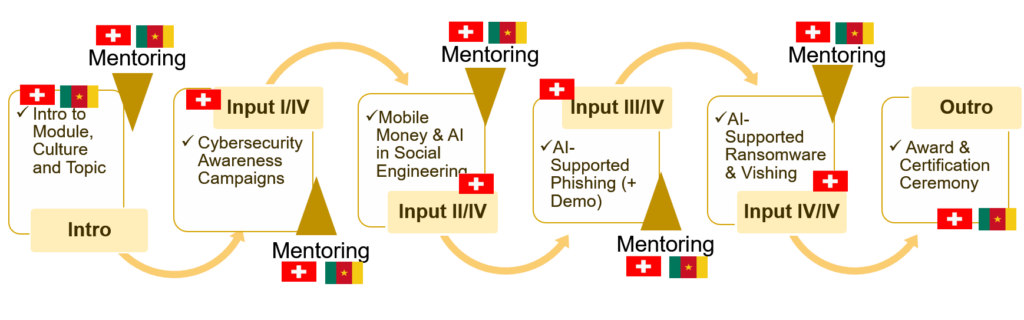
- Offering with SwissLink University in Cameroon: COIL SocialEngineering: Business | FHNW
Example Module Structure From FHNW
- Opening with explicit introduction to the topic of culture – in particular Swiss & Cameroonian culture
- Lecture input on (AI-related) topics in social engineering – contextualized to Europa & Africa
- Student group sessions resulting in a joint awareness poster & video – contextualized across regions
- Overall reflection & lessons learned – with regard to technology & culture
Joint Lectures on Cybersecurity & Cryptography at the University of Namibia (UNAM) – Competence Center (selected lecture content)
Swiss-Africa Cybersecurity Community (SwissAfricaCySec)
The SwissAfricaCySec Community connects cybersecurity education with practical and international perspectives, including the development of skills for understanding cybersecurity risks in different contexts.