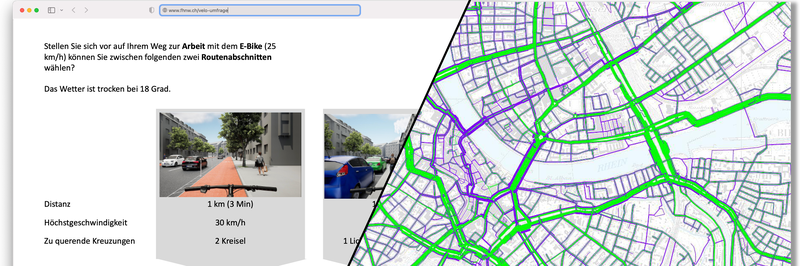
This project aims to represent the demand for cycling in transport demand models in a more detailed and measure-sensitive way by answering the the following key research questions. Which factors influence the ownership of e-bikes and S-pedelecs? What is the willingness to cycle along different types of bicycle infrastructure? Should the willingness to bicycle be differentiated according to trip purpose and bicycle type?
Conclusion
E-Bike sales increased from 7% to 45% between 2009 and 2022. Compared to conventional bicycles, e-bikes and S-pedelecs allow for higher speeds and make it easier to overcome inclines.
The new Swiss Cycle Route Act, which came into force on 1 January 2023, aims to create more, better and safer cycle routes. At the same time, current traffic models in Switzerland face limitations in evaluating the impact of e-bikes, S-pedelecs, and enhanced cycling infrastructure. This challenge arises from a dual deficiency: firstly, a scarcity of empirical analyses on traffic behavior related to these elements, and secondly, the absence of essential foundational data for bicycle traffic within existing transport models, such as route attributes and bicycle ownership information.
In order to be able to depict the increasing bicycle traffic in transport models in a more detailed and measure-sensitive way, we are investigating the following overarching questions:
- How do the ownership of e-bikes and S-pedelecs, the different types of cycling infrastructure, the trip purpose and environmental factors influence the willingness to cycle in Switzerland?
- How can the existing transport models in Switzerland be expanded to better map bicycle traffic in general and e-bikes and S-pedelecs in a measure-sensitive way?
Aim of the Project
The focus of the research work is on identifying, describing and quantifying the various aspects that influence the potential demand for cycling in Switzerland. The main objective is to differentiate the various impact mechanisms according to bicycle type (bicycle, e-bike and S-pedelec), the purpose of the journey, the design of the road space and environmental factors such as parking and weather conditions.
Implementation
Based on a literature analysis and expert interviews, we aim to set out how cycling is currently depicted in transport models and to identify existing gaps. Specifically, the focus is directed towards the consideration of factors like speed, safety, and comfort in the realms of trip generation, mode, and route choice. Subsequently, we undertake an analysis of the Swiss Mobility and Transport Microcensus concerning bicycle ownership and usage, distinguishing variations across different bicycle types on stages and routes.
Basic Information
Financing: | Bundesamt für Strassen (ASTRA) |
Project duration: | 10.10.2023 – 31.05.2026 |
Project manager: | |
Project co-worker: | Eva Vontobel, Aline Renard (Transitec), Michael Arendt (Arendt Consulting) |
Keywords: | Cycling; e-bike; s-pedelec; transport modelling; travel behaviour; cycling infrastructure |