The project aims to analyse the acceptance of measures and regulations for fast e-bikes to promote road safety in the DACH region.
Conclusion
Amid the two-wheeler market’s clear trend towards electrification in, sales of S-Pedelecs are also increasing significantly. S-pedelecs travel at up to 45 km/h faster than conventional e-bikes (motor assistance up to 25 km/h). This makes them particularly suitable for longer distances that are normally covered by motorised vehicles. A safe integration of S-pedelecs into the existing infrastructure, which is accepted by all road users, is a challenge that different countries face.
This project takes a user-centered approach to better understand road users’ acceptance of different regulations covering the integration of S-pedelecs into the mobility system from the perspective of S-pedelec riders as well as other road users.
Project Aims
The project aims to develop scientifically sound recommendations to enable the safe integration of S-pedelecs into the existing mobility system. To this end, the following goals will be pursued: (1) analyze the similarities and differences in existing regulations across different countries, (2) identify key factors influencing the acceptance of S-Pedelecs through different lenses, (3) identify s-pedelec riding behaviour and contrast it against E-Bike riding behaviour.
Implementation
In the first phase of the project, an analysis of the current situation is conducted by Salzburg Research and a collection of legal, organizational and technical regulations is compiled.
In the second part of the project, a quantitative and qualitative acceptance analysis will be carried out by the FHNW. At the Institute for Market Supply and Consumer Decision-Making at the School of Applied Psychology, a quantitative acceptance analysis will be carried out using online focus groups, consisting out of S-pedelec riders and other road users.
The transport and mobility research group at the School of Architecture, Construction and Geomatics will conduct a quantitative acceptance analysis in Germany, Austria and Switzerland using an online panel.
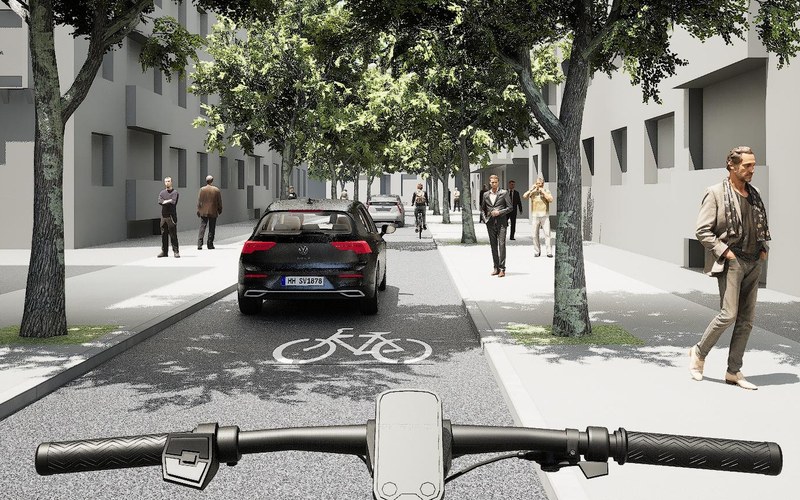
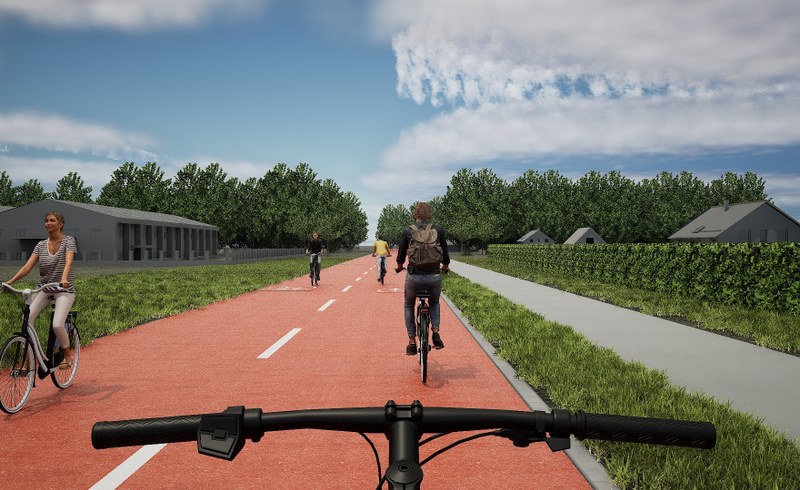
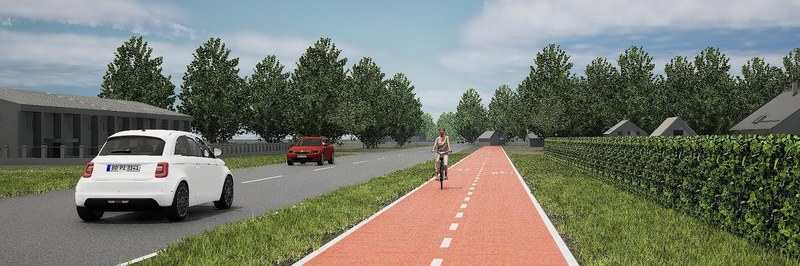
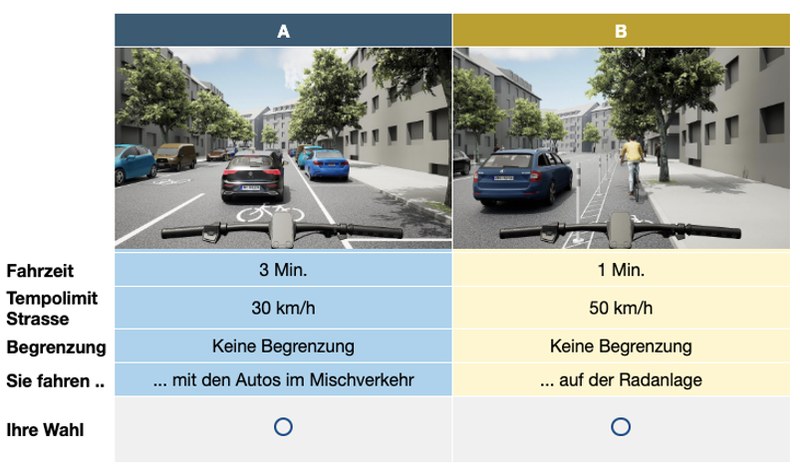
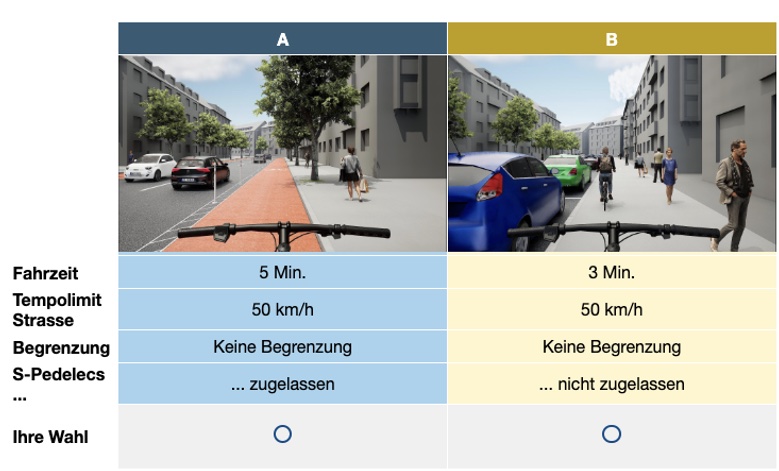
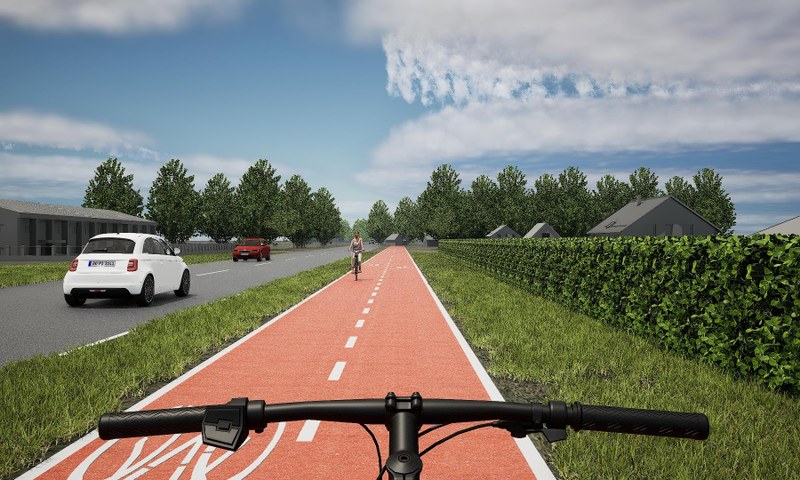
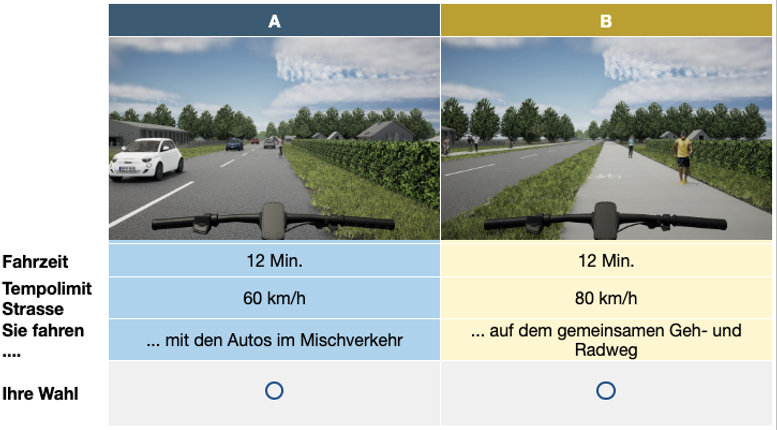
The survey consists of two parts: cyclists, e-bike riders and S-pedelec riders take part in an image-based stated preference route choice experiment as part of a web-based survey. The images are generated on the basis of an experimental design and visualised using ESRI City Engine and Unreal.
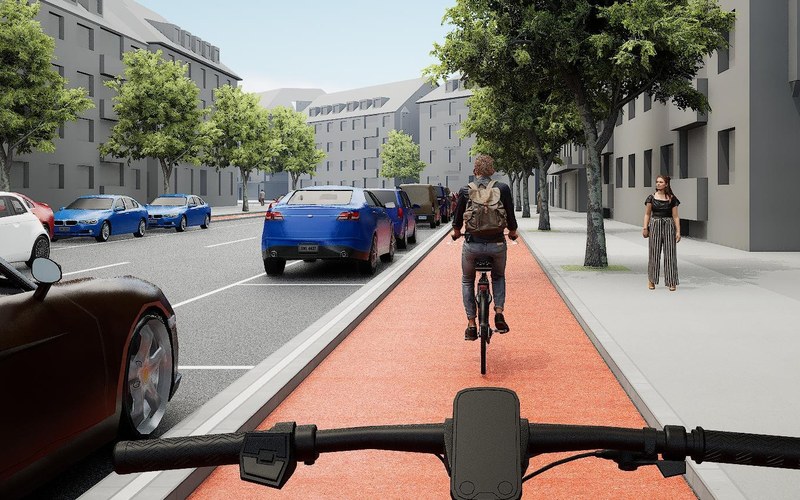
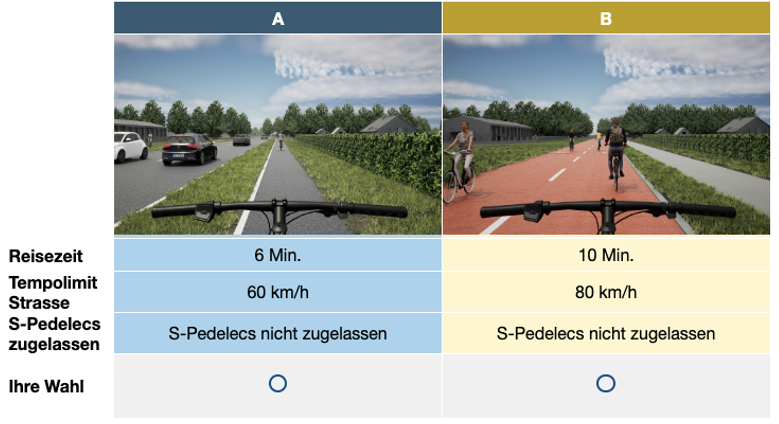
Next, a simulator study will be carried out in Germany to compare the cycling behaviour of e-bike riders and S-pedelec riders on different cycling facilities (speed, overtaking behaviour).
Finally, the results and recommendations will be discussed with experts active in the field of transport and active mobility planning.
Basic Information
Financing: | |
Project duration: | 1.1.2024 – 29.2.2024 |
Project manager: | |
Project co-worker: | HABG: Elia Ferrari, Wissam Wahbeh |
Keywords: | Survey, Stated Preference, Simulator, Visualisation, Street Design, Cycling Infrastructure |