FHNW researchers test a new multi-sensor surveying pole that combines GNSS positioning with 3D Time-of-Flight camera technology. This research explores whether adding a 3D depth camera to existing surveying equipment can make field measurements faster, safer, and more accurate.
Background
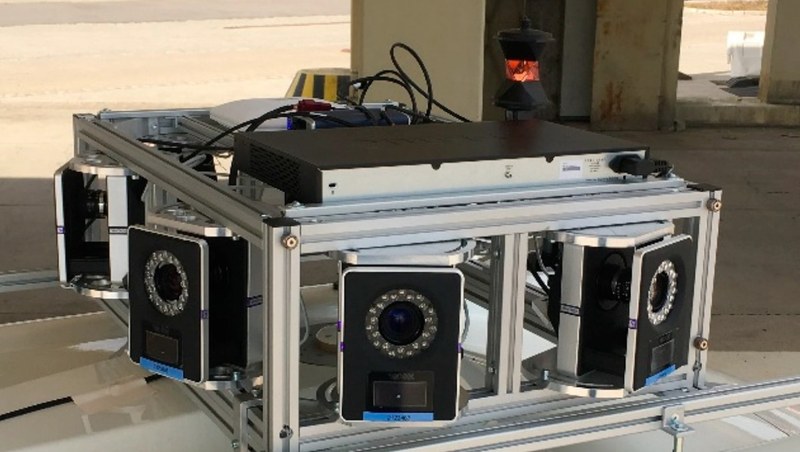
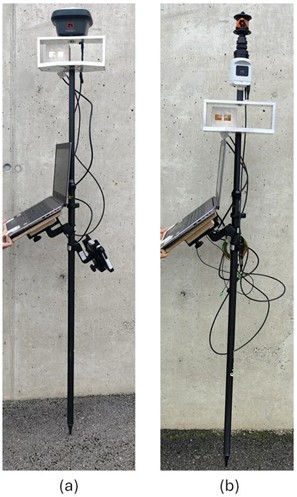
The team from FHNW's Institute of Geomatics worked with Leica Geosystems to test two setups: one combining a depth camera with a GNSS receiver (GS18 I), and another pairing it with an intelligent surveying pole (AP20) used with total stations. The AP20 combination proved genuine-ly useful, delivering measurements accurately within a few centimeters and working well in diffi-cult conditions like shaded areas or tight spaces where traditional methods struggle. The GNSS setup performed less well and needed more work. What stands out is that the successful AP20 integration could reduce the time surveyors spend in hazardous locations while maintaining pro-fessional-grade accuracy. See Figure 1.
Study Link: https://doi.org/10.3390/metrology5040078
Our Motion Capture System - What is it?
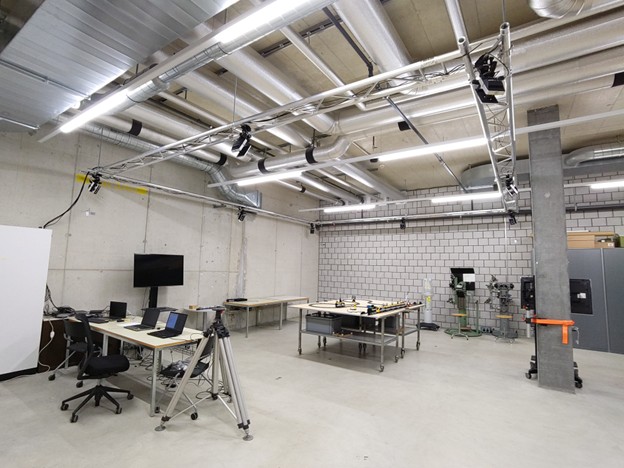
Our facility features a Vicon motion capture system, which is a high-precision optical tracking technology that uses 8 Vicon Vantage V5 infrared cameras to detect retroreflective markers in 3D space. These cameras are mounted on a specialized ceiling truss to track the movement of objects with sub-millimetre precision. By emitting infrared light and capturing reflections from small markers, the system calculates the exact position and orientation (pose) of any object in real-time. This facility serves as a "gold standard" reference, providing a highly accurate ground truth for testing new sensors, robotic systems, and measurement technologies. See Figure 2.
Engineering a Custom Coordinate System
To ensure the data is useful for geomatics and engineering applications, the laboratory is integrated into a permanent, high-precision coordinate system. This was achieved by establishing a network of fixed points on the floor and walls, which were surveyed using an industrial-grade Leica AT401 laser tracker. Through a specialized calibration process using a Vicon Active Wand, the motion capture system is "locked" into this physical environment. This allows researchers to measure the movement of robots or vehicles directly within a global laboratory frame, ensuring that digital data perfectly matches the physical world.
Research Highlight: Autonomous Vehicle Validation
The facility plays a critical role in Sensor Fusion. In the published study “Highly Accurate Pose Estimation as a Reference for Autonomous Vehicles in Near-Range Scenarios” (Kälin et al., 2022), the FHNW system was used to evaluate localization sensors for autonomous driving. By comparing the data from vehicle-mounted sensors against the ultra-precise Vicon reference, re-searchers can identify even the smallest errors in navigation algorithms. This research is essen-tial for developing the safe and reliable navigation systems required for future self-driving cars in complex, close-range environments (Figure 3).
This unique setup was developed for highly accurate 6-degree-of-freedom (6DoF) pose estimation with position uncertainty below 5 mm and orientation uncertainty below 0.3°.
Study Link: https://doi.org/10.3390/rs14010090
Creative Applications
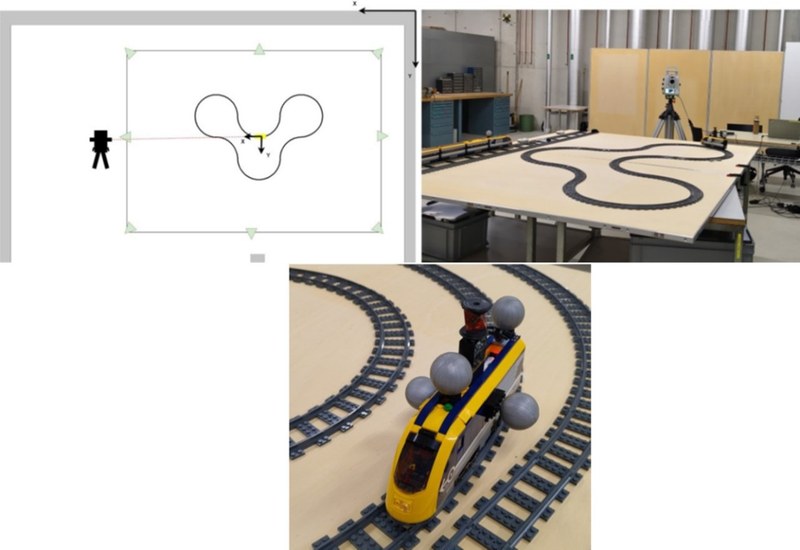
Beyond automotive research, our facility supports creative and educational experiments. The system's precision has been demonstrated using accessible setups like modified toy trains, mak-ing high-end metrology tangible for students and visitors. An interesting experiment in Figure 4 uses a Lego train with Vicon markers and a track configuration. By attaching both Vicon markers (14 mm passive pearls) and a mini-360-degree prism (Leica GRZ101) to the train, researchers compared the "ground truth" from Vicon to the measurements of the Leica MS60 Multi station. The experiment evaluates how well different computers and operating systems synchronize high-frequency data (Vicon at ~150 Hz vs. Leica MS60 at ~20 Hz).
Kontakt

Prof. Dr. David Grimm
- Telefon
- +41 61 228 53 63
- david.grimm@fhnw.ch