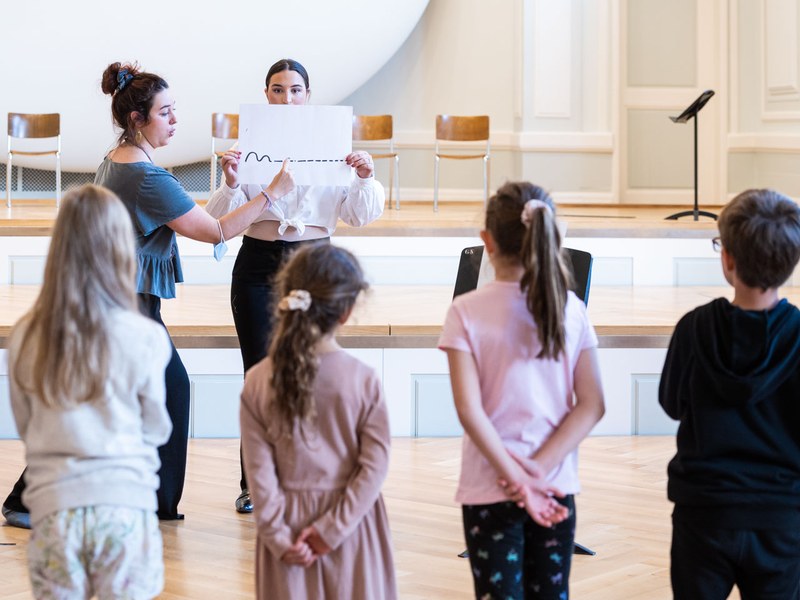
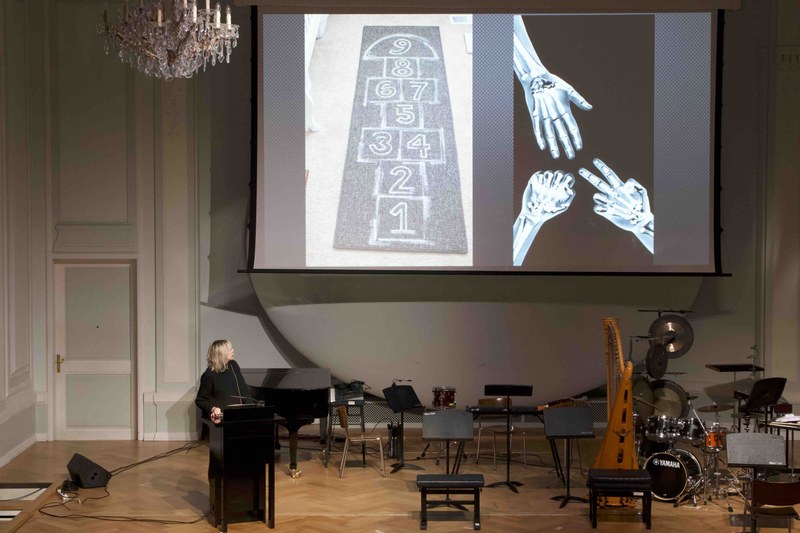
colloquium48 bietet Forschenden und Forschungsinteressierten eine Plattform zum Austausch.
colloquium48
Interessieren Sie sich für aktuelle Forschungserkenntnisse und den Austausch mit Gleichgesinnten?
Immer Dienstag abends gibt es Gelegenheit, Einblicke in die Musikforschung zu erhalten und sich mit Fachleuten aus Wissenschaft und Praxis auszutauschen. Neben dem beliebten offenen Format colloquium48 widmet sich das Interpretationsforum Fragen der performativen Umsetzung und künstlerischen Übersetzung; im Forum Musikpädagogik werden innovative Konzepte des Musikunterrichtens vermittelt und musikpädagogische Forschungsfragen thematisiert. Beteiligt sind Forschende, Musizierende, Denkende der HSM Basel sowie renommierte Gäste. Alle Veranstaltungen richten sich neben Studierenden und an die interessierte Öffentlichkeit.
Die Veranstaltungen bedürfen keiner Anmeldung, der Eintritt ist frei.
Eckdaten
- Veranstaltet durch
- Hochschule für Musik Basel, Klassik
- Veranstaltungssprache
- Deutsch/Englisch
- Kosten
- Keine
- Adresse
- Musik-Akademie Basel
Leonhardsstrasse 6
4051 Basel - Durchführungen
- 14.10.2025, 19:00–20:30, Campus Musik-Akademie Basel, Zi 6-301, Leonhardsstrasse 6, 4051 Basel
- 28.10.2025, 19:00–20:30, Campus Musik-Akademie Basel, Zi 6-301, Leonhardsstrasse 6, 4051 Basel
- 4.11.2025, 19:00–20:30, Campus Musik-Akademie Basel, Zi 6-301, Leonhardsstrasse 6, 4051 Basel
- 17.11.2025, 19:30–20:30, Campus Musik-Akademie Basel, Zi 6-301, Leonhardsstrasse 6, 4051 Basel
- 18.11.2025, 19:00–20:30, Campus Musik-Akademie Basel, Zi 6-301, Leonhardsstrasse 6, 4051 Basel
- 25.11.2025, 19:00–20:30, Campus Musik-Akademie Basel, Zi 6-301, Leonhardsstrasse 6, 4051 Basel
- 2.12.2025, 19:00–20:30, Campus Musik-Akademie Basel, Zi 6-301, Leonhardsstrasse 6, 4051 Basel
- 9.12.2025, 19:00–20:30, Campus Musik-Akademie Basel, Zi 6-301, Leonhardsstrasse 6, 4051 Basel
- 13.1.2026, 19:00–20:30, Campus Musik-Akademie Basel, Zi 6-301, Leonhardsstrasse 6, 4051 Basel
- 20.1.2026, 19:00–20:30, Campus Musik-Akademie Basel, Zi 6-301, Leonhardsstrasse 6, 4051 Basel
- 3.3.2026, 19:00–20:30, Campus Musik-Akademie Basel, Zi 6-301, Leonhardsstrasse 6, 4051 Basel
- 10.3.2026, 19:00–20:30, Campus Musik-Akademie Basel, Zi 6-301, Leonhardsstrasse 6, 4051 Basel
- 17.3.2026, 19:00–20:30, Campus Musik-Akademie Basel, Zi 6-301, Leonhardsstrasse 6, 4051 Basel
- 24.3.2026, 19:00–20:30, Campus Musik-Akademie Basel, Zi 6-301, Leonhardsstrasse 6, 4051 Basel
- 14.4.2026, 19:00–20:30, Campus Musik-Akademie Basel, Zi 6-301, Leonhardsstrasse 6, 4051 Basel
- 21.4.2026, 19:00–20:30, Campus Musik-Akademie Basel, Zi 6-301, Leonhardsstrasse 6, 4051 Basel
- 28.4.2026, 19:00–20:30, Campus Musik-Akademie Basel, Zi 6-301, Leonhardsstrasse 6, 4051 Basel
- 19.5.2026, 19:00–20:30, Campus Musik-Akademie Basel, Zi 6-301, Leonhardsstrasse 6, 4051 Basel
Programm 25/26
colloquium48

Steffen Krebber
Sinusoidal Run Rhythm
Sinusoidal run rhythm is created by the addition of in-phase cosine functions in integer ratios. Their maxima are temporally and dynamically shifted in relation to corresponding notated rhythms and exhibit a physicality that is not present in discretely controlled rhythms. sinusoidal run rhythm models microtemporal grids with dynamic weightings that are singular for each underlying combination of partials, which are all very groovy. sinusoidal run rhythm therefore defines rhythm as a wave and thus clearly sets itself apart from the conventional rhythm theory of a European musical tradition.
sinusoidal run rhythm is explicitly a supplement, specification and extension of existing rhythm models and rhythm theories and can integrate them. The theory invites us to dissolve the boundaries between performance and performance, score and interpretation, man and machine and to search for applications in the genesis of music, music analysis, psychoacoustics or philosophy.
A book and code were published by Wolke Verlag in 2023.
Links:
Github.com
Maxforlive.com
Steffen Krebber
Steffen Krebber is composer, sound artist and researcher. His work oscillates between computer music, instrumental and electroacoustic composition, sound art, research, language, epistemology, sociology and media art. h Amongst others he has held scholarships from the Schloss Solitude Academy, the Schreyahn Artists Retreat. His music has been performed at the Gaudeamus Muziekweek, the Witten New Chamber Music Festival, the ‘blurred edges’ Festival of Current Music (Hamburg), the ‘new talents’ Biennale (Cologne), Nachtstrom (Basle) and Piano+ at the Karlsruhe Center for Art and Media. He has also exhibited his work at the KOLUMBA Art Museum of the Archbishopric of Cologne, the Cologne Arts Association and the Schloss Solitude Academy. His language installation Weissagungen (‘divinations’) entered the permanent collection of the KOLUMBA Art Museum. As a composer he has worked with a great many ensembles and performers.

Inbar Sharet, Michel Roth
Musicking the Ferienkurse! Harnessing Music Institutions as Creative Resource
Musicking the Ferienkurse! set out to explore the Darmstadt Summer Courses (July 2025) as a game-like framework of New Music. At the center of this inquiry were its rules, its players, and its interplay with the surrounding urban environment. A diverse group of artistic researchers engaged simultaneously as participants, observers, and interventionists, documenting their experiences through multimedia practices supported by game-theoretical tools. Over two weeks, this process culminated in a lecture-performance that reframed the Ferienkurse from within.
The current presentation critically evaluates the outcomes of this experiment, highlighting both its artistic insights and methodological challenges, and opens the discussion on how the methodology of „participative observention“ can help to reconfigure musical institutions in a creative way.
Inbar Sharet
Inbar Sharet is an Israeli-born composer, arranger, and multi-instrumentalist currently residing in Basel, Switzerland. His music has been performed by ensembles such as Meitar Ensemble (IL), Ensemble Zone Experimentale (CH), and Sonic Space Basel Alumni Ensemble (CH). He has participated as both a composer and performer in festivals, including “Tzlil Meudcan” (Tel Aviv, IL), “Spiel!” (Basel, CH), and “Opening festival (Trier, DE). Inbar holds a Master of Music in Composition from the Hochschule für Musik Basel, and a Bachelor of Music in Composition from the Buchmann-Mehta School of Music at Tel Aviv University. Currently, he is pursuing his second master’s in music theory and pedagogy at the Hochschule für Musik Basel (Schola Cantorum Basiliensis, and Sonic Space Basel). He has received prizes such as the Sharett Scholarship from the America-Israel Cultural Foundation (2022–2025) and the Klon Competition for Young Composers (2021).
Michel Roth
Michel Roth is a composer and professor of composition, music theory and artistic research at the Basel Academy of Music (FHNW). He researches and publishes on musical applications of game theory and cybernetics (PhD from the University of Basel), collaborative art practices (Dieter Roth), organology of contemporary music and Alpine sound sociology (“Singende Seile”). As a composer and music researcher, he has received numerous prizes and grants, including the Musica Viva Munich Composition Prize for his orchestral piece Der Spaziergang (2009). His first opera, Im Bau, was staged by Georges Delnon at Theater Basel in 2011 and later released in a 3D simulated online environment (www.imbauprojekt.ch). His contemporary operetta Die Künstliche Mutter premiered at the Lucerne Festival in 2016. As the long-standing director of the Lucerne Studio for Contemporary Music, he worked with Pierre Boulez, Helmut Lachenmann and Sofia Gubaidulina, among others. Michel Roth is an associate researcher at the Institute of Alpine Cultures at the University of Lucerne and a member of the board of the Christoph Delz Foundation Basel.
MA MP Musiktheorie

MA Musikpädagogik | Musiktheorie

Stefan Pohlit
Das nahöstliche Kanun in zeitgenössischer Musik
Seit meiner Promotion am Musikforschungszentrum MİAM/Istanbul beherrscht die nahöstliche Zither, Kanun, einen Schwerpunktmeiner Forschung. Am Beispiel meiner Zusammenarbeit mit namhaften Kanunist*innen aus der Türkei und Griechenland beschreibe ich verschiedene Wege zu diesem Instrument als Komponist. Anhand meiner Symphonie Şafakların Cihangiri für Tahir Aydoğdu und die Staatsphilharmonie Rheinland-Pfalz, meines Streichquartetts mit Kanun eyéo und meines Trompetenkonzerts XY demonstriere ich Anwendungen des türkischen Standard-Kanuns bis in erweiterte Tonsysteme in reiner Stimmung – einschließlich jener Hindernisse, die in der Praxis unterschätzt werden.
Stefan Pohlit
Stefan Pohlit (*1976) studierte in Saarbrücken, Basel, Lyon, Karlsruhe, Adana. Nach Anfängen in Paris wendete er sich 1999 nachOsten. In Istanbul promovierte er über das Stimmungssystem des Kanunisten Julien Jalâl Eddine Weiss – eine Zusammenarbeit, die Eingang in die Literatur fand. Bis 2015 lehrte er als Juniorprofessor Komposition an der TU Istanbul. Beeinflusst von der postmodernen Ethnologie und vom Kontakt mit verschiedenen Geistesschulen, fließt seine Arbeit aus einem in sich transkulturellen Musikbegriff. Als Pionier erweiterter Tonsysteme beruft er sich auf die arithmetische Tradition Kleinasiens. Neben Aufführungen mit bedeutenden Ensembles und Orchestern initiierte er zahlreiche Projekte und Erstkontakte – in den letzten Jahren primär in wenig bekannten Volkstraditionen. Mit seinem Roman Münzevi Adası (Heyamola, Istanbul) trat er 2021 als Schriftsteller hervor. Seine Symphonie Şafakların Cihangiri mit Tahir Aydoğdu (Kanun) und der Staatsphilharmonie Rheinland-Pfalz unter Dirk Kaftan erschien 2024 bei Kalan Müzik.

Varun Rangaswamy
Musical Fabulation: Or, Hearing History in a Different Voice
In researching the Basel Mission Archive, I have been guided by Saidiya Hartman’s concept of “critical fabulation,” her methodology that attends to archival silences in order to imagine unarchivable moments in the archive of US slavery. My motivating question for the last year has been: can one critically fabulate musically?
Starting with examples from the Basel Mission's activities in South India, I will present the principles of an emerging methodology tentatively called "musical fabulation." Since Hartman's is a literary project focused on the material conditions of the Middle Passage, developing musical fabulation presents two challenges: (1) moving from words/literature to sound/music and (2) moving from a US–Africa historical context to a Europe–South Asia context. In this talk, I will discuss musical strategies for approaching both of these challenges, including the role of live and recorded voice in performance and the relationship between visual and aural attention to the archive. The former will touch on theorizations of “voice” in archival research while the latter will consider the possibilities of sonic engagement with the Basel Mission Archive despite the fact that it holds no audio records, only text and photographs. Finally, I will provide some original experimental examples of musical fabulation and anticipate future directions for this project.
Varun Rangaswamy
Varun Rangaswamy is an improviser-composer and scholar. His self-reflexive album REINHERITANCE has been praised for “creating a mesmerizing circular dialect” (I Care If You Listen). He has worked with such ensembles as International Contemporary Ensemble, Talea Ensemble, and Mivos Quartet. Collaborators have included Aakash Mittal, Fay Victor, Rebekah Heller, Sara Schoenbeck, and Jasmine Wilson. He has degrees from UCSD and Eastman and is trained in Karnāṭak vocal music and contemporary bassoon performance. He is currently studying at the Hochschule für Musik Basel in Music and Research.
MA SP Music and Research

Student projects in Music and Research

Winnie Huang
The Performing Body: The site of possibilities
How do you see sound, how do you hear movement, and how does one’s emotive performing transdisciplinary body engender new possibilities? Through interdisciplinary Artistic Research, my work on the Musical-Gestural perspective has provided an exploratory framework in how I educate tertiary level art students on the power of possibility. This presentation explores possibility creation through Artistic Research including an embodied musical-gestural participation from the audience, showcasing the empowerment of practice-based knowledge creation.
Artistic Research is a young field rich in possibilities, allowing deeper understanding on how one can make, think, and talk about art and ultimately how artists participate and share in society. My own diverse artistic career and Artistic Research in the contemporary Musical-Gestural perspective questions creativity and possibility by examining musical freedoms within and beyond boundaries. It examines musical works which feature prominent embodied physical elements, incorporating aspects of dance/choreography and theatre/dramatic expression, from sonic art to physical gestures, and the amalgamation of these crafts to create multi-sensorial experiences for performers and audiences alike.
As art students confront the difficult transition from master-apprentice style education to professional independent future pathways, my research provides a transdisciplinary provocation towards their identity creation. By using the multimodal learning experience of Musical-Gestural works, we move towards the establishment of a curious and proactive foundation for a sustainable artistic career. This presentation champions Artistic Research as a means for possibility creation especially for art students through celebrating the living, performing body, and the development of wonder through embodied practice.
Winnie Huang
Winnie Huang is a violinist, gestural performance artist, composer and artistic researcher. An active performer of new music, she continually works with young and established composers and regularly performs with international ensembles. Career highlights have included solo performances at the Berlin Philharmonie (DE), KKL Lucerne (CH), and the Elbphilharmonie (DE), among many international ensemble tours. Winnie’s strong interest in the performance of musical-gestural pieces is explored frequently through her own original compositions and collaborating with other composers, developing highly gestural contemporary works.
Winnie is a Schloss Solitude (DE) fellow in the field of “Aural & Physical” and “Artist étoile” for the Lucerne Festival (CH) in 2025.
Academically, Winnie has consistently taught, workshopped, and guest-lectured in Europe, Asia and Australia. She continues artistic research in the field of interdisciplinary musical-gestural performance and collaborative processes. After a few years as Junior Professor of Artistic Research at the Hochschule für Musik und Tanz Köln, Germany, Winnie now takes on a new position as Associate Professor for Research in Music Performance at the Conservatorio della Svizzera italiana, Ticino, Switzerland.

Mit Studierenden des Masters Musiktheorie
Enzo Sourhane: Stille in der Musik
Stille hat in der Musik verschiedene Funktionen. Wir werden uns mit ihren Verbindungen zu einem Musikstück befassen und damit, wie bestimmte Komponisten sie auf untypische Weise eingesetzt haben. Im weiteren Sinne werden wir uns damit beschäftigen, welche Faktoren es dem Gehirn ermöglichen, Klänge zu einer Einheit zusammenzufassen.
Im Alter von 8 Jahren begann Enzo Sourhane auf Anregung seines Vaters, eines Musikers, mit dem Studium der klassischen Gitarre. Parallel dazu wandte er sich dem Komponieren zu und trat mit 19 Jahren in das Conservatoire National Supérieur de Musique et de Danse de Paris (CNSMDP) ein. Mit 25 Jahren fühlte er sich zunehmend zum Jazz hingezogen und beschloss, sich als Autodidakt diesem Genre zu widmen. Parallel dazu komponiert er und bildet sich als aktiver Lehrer an französischen Konservatorien in Pädagogik an den Schweizer Musikhochschulen weiter.
Inbar Sharet: Songs of an extinct invented tradition – reconstructing the 1936 passover ceremony of Yehuda Sharett
Yehuda Sharett (1901–1979) was a leading figure in the cultural formation of the kibbutz movement in Mandatory Palestine and Israel. In his works, he developed a genre that bound an entire community together through mass singing, instrumental playing, and narration. The whole community participated in the artistic act, breaking down any hierarchy between performer and spectator.
In his research, Inbar Sharet - the great-grandson of Yehuda Sharett - is reconstructing the first version of Sharett’s Passover ceremony from 1936. This ongoing project comprises both the preparation of a critical edition of the score and a performance based on historical sources. The lecture offers a first insight into this artistic act of reconstruction, outlining its working methods and underlying motivations. It will also present excerpts from a newly documented performance of songs from this edition, recorded by an ensemble in Basel under the direction of Inbar Sharet.
Inbar Sharet is an Israeli-born composer, arranger, and multi-instrumentalist currently residing in Basel, Switzerland. His music has been performed by ensembles such as Meitar Ensemble (IL), Ensemble Zone Experimentale (CH), and Sonic Space Basel Alumni Ensemble (CH). He has participated as both a composer and performer in festivals, including “Tzlil Meudcan” (Tel Aviv, IL), “Spiel!” (Basel, CH), and “Opening festival (Trier, DE). Inbar holds a Master of Music in Composition from the Hochschule für Musik Basel, and a Bachelor of Music in Composition from the Buchmann-Mehta School of Music at Tel Aviv University. Currently, he is pursuing his second master’s in music theory and pedagogy at the Hochschule für Musik Basel (Schola Cantorum Basiliensis, and Sonic Space Basel). He has received prizes such as the Sharett Scholarship from the America-Israel Cultural Foundation (2022–2025) and the Klon Competition for Young Composers (2021).

Gender Balance Series 1
Gender Balance Series
Der Kanon der Musikgeschichte wird auch im Unterricht geformt. Wenn weibliche Stimmen Teil des Kanons werden sollen, müssen wir sie in den Musikunterricht aufnehmen. Das kann mit einigem Aufwand verbunden sein und viele Dozierende schrecken vor der Mehrarbeit zurück. In dieser Vortragsreihe stellen Dozierende der Hochschule für Musik musikalische und musiktheoretische Arbeiten von Frauen vor, die sie für ihren Unterricht entdeckt haben, um sie mit den Studierenden zu diskutieren.
Karin Wetzel & Christoph Haffter: Ruth Crawford Seeger & Lou Märten
Im ersten Vortrag der Reihe werden zwei Frauen aus dem Beginn des 20. Jahrhunderts im Zentrum stehen: Die Komponistin Ruth Crawford Seeger und die Kunsttheoretikerin Lou Märten. Beide Frauen eint nicht nur das Engagement für die avantgardistische Kunst, sondern auch die Solidarität mit der Arbeiterbewegung. Karin Wetzel wird zeigen, wie Seegers innovative Kompositionspraxis eine eigenständige Position in der Geschichte posttonaler Musik darstellt und Christoph Haffter wird Lou Märtens Musikphilosophie im Zusammenhang ihrer Theorie der klassenlosen Form vorstellen.

Clemens K. Thomas
Eine cute Oper – das gegenwartsästhetische Phänomen der Cuteness als kompositorische Strategie in der Oper Dollhouse
Die künstlerisch-wissenschaftliche Dissertation untersucht das gegenwartsästhetische Phänomen der Cuteness als kompositorische Strategie in der Oper Dollhouse (UA: Staatsoper Hamburg, November 2024) und führt damit Cuteness erstmals als ästhetische Kategorie in den musik-praktischen und -wissenschaftlichen Diskurs ein. Als gegenwartsästhetische Phänomen verstanden, ist Cuteness mehr als eine Äußerlichkeit. Der Anglizismus geht über das deutsche Wort Niedlichkeit hinaus und artikuliert eine Zugehörigkeit zu einer subversiven Jugend- und Popkultur, die – als Haltung – eine Ästhetik des Spiels, der Behaglichkeit, der kommunizierten Nähe und der Zugewandtheit ist. Vor allem aufgrund ihrer ästhetischen Ambivalenzen eignet sie sich für musiktheatrale Spannung und ein gegenwärtiges Erzählen, das sich durch ein Oszillieren zwischen Dichotomien auszeichnet. Die Arbeit argumentiert, dass Cuteness tradierte Ordnungen (high/low, Ernst/Spiel, harmlos/gewalttätig) überwinden kann und einen Raum für „beseelte Beziehungen“ (Kinship im Sinne Donna Haraways) schaffen kann. Auf dieser Grundlage wird Dollhouse als Prototyp von cuter Oper vorgestellt, die als spielerisches, medienhybrides Musiktheater definiert wird und Strategien der Cuteness nutzt, um mittels post-ironischer und zugewandter Erzählweise ambivalente Nähe zu erzeugen. Eine detaillierte Werkanalyse reflektiert gender-bezogene Implikationen von Cuteness, benennt Merkmale der (Hyper-)Pop- und Social Media-Cuteness, untersucht die Polyvalenzen der Cuteness (clumsy-cute, creepy-cute, harmlos cute) und vertieft sich in Machine Cuteness, sowie Cute Animal Media. Als künstlerische Forschung angelegt, nutzt die Arbeit die eigens entwickelte „Frederick-Methode“, um Inspirationsquellen offenzulegen, diese in den Cute Studies zu kontextualisieren und narrativ zu entfalten. Die konkrete kompositorische Umsetzung und die musikdramaturgische Anlage wird als gezielte Strategie decodiert, um die Ambivalenzen der Cuteness musiktheatral nutzbar zu machen und so mediale und alltägliche Gegenwart auf der traditionsreichen Opernbühne sinnlich erfahrbar zu machen.
Clemens K. Thomas
Als Komponist und Kurator erzählt Clemens K. Thomas Geschichten und verhandelt drängende Fragen unserer Zeit. Wiederkehrende Motive in seinen Werken ist die Beschäftigung mit Cuteness und die Verarbeitung unseres medialen Alltag. In der Spielzeit 25/26 tourt das als ECHO „Rising Stars“ ausgezeichnete Trio Concept mit seinem Auftragswerk „Save Pepe“ – einer kompositorischen Auseinandersetzung mit rechter Meme-Kultur – durch die europäischen Konzerthäuser. 2024 wurde an der Staatsoper Hamburg „Dollhouse – eine cute Oper“ uraufgeführt, als Teil seiner künstlerisch-wissenschaftlichen Promotion „Eine cute Oper“ (HfMT Hamburg).

Gender Balance Series 2
Gender Balance Series
Der Kanon der Musikgeschichte wird auch im Unterricht geformt. Wenn weibliche Stimmen Teil des Kanons werden sollen, müssen wir sie in den Musikunterricht aufnehmen. Das kann mit einigem Aufwand verbunden sein und viele Dozierende schrecken vor der Mehrarbeit zurück. In dieser Vortragsreihe stellen Dozierende der Hochschule für Musik musikalische und musiktheoretische Arbeiten von Frauen vor, die sie für ihren Unterricht entdeckt haben, um sie mit den Studierenden zu diskutieren.
Michel Roth: Fingerprints of Thinking - Marie Jaëll, Musician and Pioneer of Embodiment
Marie Jaëll (1846–1925) was an Alsatian pianist, composer, educator, and researcher. As a student of Franz Liszt, she devoted herself particularly to the physiognomy of piano playing; her influential Méthode Jaëll goes far beyond technical questions and is also highly innovative in its underlying research methods. In her richly illustrated writings, she combines corporeality with musical aesthetics, making her a pioneer of embodiment.
Andrea Neumann: Footprints of Ruth Anderson
Ruth Anderson (1928–2019) was an American composer, flautist and founder of the electronic music studio at Hunter College, New York.In her works, she explores minimalist electronics, microtonality, feedback, speech, drones and tape collages.Using two of her compositions as a starting point, I would like to discuss the connections and hypothetical influences on the works of her contemporaries and subsequent artists.

Lisa Fornhammar
How can transdisciplinary collaboration foster more sustainable forms of professionalism in contemporary vocal music and, more broadly, across higher music education.
This lecture presents findings from an article-based doctoral dissertation that explores the transformative potential of transdisciplinary and transprofessional collaboration in contemporary vocal music and higher music education. It responds to a persistent challenge in the field: the dominance of narrow specialization, siloed expertise, and individualised master–apprentice pedagogies, which often fail to prepare singers for the collaborative, interdisciplinary, and rapidly changing realities of professional life.
As professional singers today are increasingly required to be adaptable, collaborative, and professionally versatile, the study argues for an expanded understanding of professionalism—one that values shared knowledge production, democratic collaboration, and practitioner expertise alongside artistic excellence.
The research asks: How can transdisciplinary collaboration foster more sustainable forms of professionalism in contemporary vocal music and higher music education?
Methodologically, the dissertation adopts a hyper-transdisciplinary practitioner research approach, conceptualised as a holistic bricolage. Three interconnected studies combine meso-historical analysis, clinical voice science, and duoethnography within a practice-based cooperative inquiry. The concepts of beginner’s mind and third space function as key epistemological and pedagogical frameworks, enabling dialogic, exploratory, and boundary-crossing forms of learning and knowledge production.
The findings are presented across three peer-reviewed articles. The first demonstrates, through a meso-history of Western opera practices, that current models of specialization in higher music education are historically contingent rather than inevitable. The second offers empirical, science-informed insights into extended vocal techniques, supporting safer and more sustainable vocal practices. The third draws on duoethnographic pedagogical reflection to show how collaborative learning in third spaces between music professionals fosters innovation, mutual understanding, and resilient professional identities.
Overall, the dissertation advocates a collaborative turn in professional music education. It positions transdisciplinary professionalism as a key strategy for developing sustainable, adaptive, and future-oriented artistic practices—where innovation and creativity emerge through both mental and physical spaces of collaboration.
Lisa Fornhammar
Lisa Fornhammarist eine vielseitige Sopranistin, Pädagogin und Forscherin, bekannt für ihr breites künstlerisches Spektrum und ihre innovative Lehrtätigkeit. Ausgebildet in Stockholm und an der Universität Mozarteum Salzburg, interpretiert sie Repertoire von der Barockmusik bis zur zeitgenössischen Musik. Sie ist europaweit tätig, engagiert sich besonders für Neue Musik und hat zahlreiche Werke uraufgeführt. Sie unterrichtet Kammermusik und das Wahlfach “Transdisziplinarität in der neuen Musik” an der Universität Mozarteum Salzburg sowie Gesang als zentrales künstlerisches Fach im Rahmen des internationalen Masters für neue Musik, gibt internationale Meisterkurse und forscht zu experimentellen Vokaltechniken und innovativer Pädagogik. Von 2023–25 war sie Gastprofessorin an der Hochschule für Musik Dresden. Im April 2025 wurde sie zur Prorektorin für Forschung und Internationales ernannt.

Gender Balance Series 3
Gender Balance Series
Der Kanon der Musikgeschichte wird auch im Unterricht geformt. Wenn weibliche Stimmen Teil des Kanons werden sollen, müssen wir sie in den Musikunterricht aufnehmen. Das kann mit einigem Aufwand verbunden sein und viele Dozierende schrecken vor der Mehrarbeit zurück. In dieser Vortragsreihe stellen Dozierende der Hochschule für Musik musikalische und musiktheoretische Arbeiten von Frauen vor, die sie für ihren Unterricht entdeckt haben, um sie mit den Studierenden zu diskutieren.
Interpretationsforum

Text folgt
Beatrix Borchard
Alternative Konzertformen: Eine Konzertcollage über Pauline Viardot-García – Sängerin, Komponistin, Kulturvermittlerin
Für sie war Musik alles, was klingt. Pauline Viardot-García brachte Menschen und ganz unterschiedliche Musiktraditionen zusammen. Ihre Baden-Badener und Pariser Salons waren Orte des geistigen und musikalischen Austausches.
Die Viardot-Biographin Beatrix Borchard zeigt in diesem Interpretationsforum, wie aktuell Viardots Wirken auch heute noch ist: als Beispiel für künstlerische Vielseitigkeit, kulturelle Offenheit und weibliche Selbstbestimmung.
Beatrix Borchard, Konzept und Moderation
Xenia Lemberski, Gesang
Barbara Doll, Violine
Marco Scilironi, Klavier
Lieder und Kammermusik von Viardot und ihren Zeitgenossen Gabriel Fauré und Clara Schumann
Beatrix Borchard
Beatrix Borchard, Musikwissenschaftlerin und Musikpublizistin, Gründerin der Forschungsplattform Musik(vermittlung) und Gender(forschung) im Internet (MUGI). Studium: Musikwissenschaften, Germanistik, Philosophie und Geschichte in Bonn und Berlin, Promotion: »Clara Wieck und Robert Schumann, Bedingungen künstlerischer Arbeit in der 1. Hälfte des 19. Jahrhunderts« (1983, 2. Auflage Kassel 1992), Habilitation: »Stimme und Geige. Amalie und Joseph Joachim. Biographie und Interpretationsgeschichte« Wien 2002 (2. Auflage 2007).
Bis April 2016 Professorin für Musikwissenschaften an der HfMT Hamburg, zuvor am Musikwissenschaftlichen Institut Detmold-Paderborn sowie jahrelange Lehrtätigkeit an der Universität der Künste Berlin. Buchveröffentlichungen: »Pauline Viardot-Garcia. Fülle des Lebens«, Köln/Weimar/Wien 2016; »Musik(vermittlung) und Genderforschung im Internet. Perspektiven einer anderen Musikgeschichtsschreibung«, Hildesheim 2016 (gemeinsam hrsg. mit R. Back und E. Treydte), »Clara Schumann. Musik als Lebensform. Neue Quellen – andere Schreibweisen«, Hildesheim 2019 sowie »Pauline Viardot – Julius Rietz. Der Briefwechsel«, Hildesheim 2021 (gemeinsam hrsg. mit M.-A. Wigbers). Vor kurzem erschienen ist: Fanny und Felix Mendelssohn – zwei Wege, Hildesheim: Olms 2025. Ein Portrait über Joseph Joachim als Geiger für text & kritik ist in Arbeit.
2018 hat sie im Rahmen des Komponistenquartiers Hamburg „Räume für Fanny und Felix Mendelssohn“ sowie 2019 die Dauerausstellung zu Clara und Robert Schumann im Schumann-Haus Leipzig unter dem Aspekt „Experiment Künstlerehe“ kuratiert. Sie moderiert regelmässig Konzerte.

Elisa Rumici
Lecture Recital: Reframing Gilda Ruta through artistic practice.
This project explores the life, reception, and piano music of Gilda Ruta (1853–1932), an Italian composer whose legacy has been largely forgotten. Through examining historical articles, personal letters, and direct engagement with the performance of her piano works, the project aims to reconstruct Ruta’s artistic identity and critically assess the societal structures that shaped her career.
Ruta’s life offers a powerful example of how gender, class, and regional identity influenced both the opportunities available to women composers and the ways their achievements were framed. Raised in a privileged musical environment in Naples, Ruta benefited from strong family support yet encountered significant limitations within Italy’s musical world. After personal tragedy and professional setbacks, she reinvented herself in the United States as a pianist, composer, and educator. Her story reveals a complex relation between privilege and marginalization, ambition and expectation, resulting in a portrait that resists clear, univocal definitions and is continuously reframed through the perspectives of the various sources that speak about her.
The project combines historical research and artistic practice. Press articles, letters, and archival documents are analysed alongside a direct performance-based engagement with Ruta’s piano music, approaching her works from a performer’s perspective. Technical, stylistic, and interpretative aspects of her compositions are examined in live listening sessions, paired with readings from contemporary documents. This dual methodology allows for a critical comparison between the image Ruta projected through her music and the narratives society constructed around her.
The research draws on recent studies about Italian women composers such as Musiciste e compositrici. Storia e storie, by L. Aversano, O. Caianiello and M. Gammaitoni, and archival materials on Gilda Ruta preserved by G. Vigliar as well as his book Gilda Ruta. Le due vite di una musicista napoletana. It is also informed by contemporary discussions about the integration of practice and theory, among them Beyond the Score Music as Performance by N. Cook.
Rediscovering Ruta’s piano music not only restores the voice of a marginalised figure but also invites broader reflection on how forgotten repertoires can reshape the classical music field. Ultimately, the project confronts historical biases in the construction of musical canons and questions how performers, educators, and scholars can reframe the way underrepresented repertoires are valued and narrated today.
Elisa Rumici
Elisa Rumici is an Italian pianist and researcher. Active in the field of music dissemination, Elisa brings classical music to the public through innovative concert formats, regularly performing in Europe in across Europe in prestigious venues, including the Milan Expo, the Fazioli Showroom in Milan, the Italian Institute of Culture in Stuttgart, the Circolo dei Lettori in Turin, Teatro La Fenice in Venice, Teatro Vittoria in Turin, Teatro Nuovo Giovanni da Udine, and Gare du Nord in Basel. Selected performances have been recorded and broadcast by Antena 2 in Portugal, Lodi Crema TV, and Radio Antenna 5 in Italy.
As a soloist, she has performed Mozart’s Concerto K. 271 in Vicenza and Crema, Schumann’s Concerto Op. 54 at the FVG International Music Meeting, and Beethoven’s Triple Concerto with the Orchestra del Teatro Olimpico. Her collaborations include performances with the Ensemble Diagonal under the baton of Baldur Brönnimann and with the Schlagzeug-Ensemble of the Hochschule für Musik Freiburg under the direction of Håkon Stene. She is also a regular guest at the chamber music festival of the Orchestra del Teatro Olimpico.
Elisa has been awarded twenty-seven first prizes in national and international competitions and has received numerous scholarships. She is currently supported by the Cusanuswerk Stiftung. Her concert project Revealed Virtuosity was awarded the Walter und Corina Christen-Marchal-Stiftung Prize in 2024.
A dedicated advocate for contemporary music, Elisa premiered Luigi Donorà’s Concertino for Piano and Orchestra da Camera in collaboration with the composer and recorded Francesco Marino’s Oceano for the album Francesco Marino Piano Works (Diapason Records). Her discography further includes Gilda Ruta Piano Works (Da Vinci Publishing), A Musical Journey (Rhein Records), and a contribution to the soundtrack of the documentary Foibe, il dramma dei deportati e scomparsi, screened at the 71st Venice Film Festival.
Elisa received her first piano lessons from Maria Cristina Sgura and then studied with Maria Grazia Cabai, Roberto Plano, and Riccardo Zadra. She obtained her diploma in piano performance at the Music Conservatory J. Tomadini in Udine in 2013 at the age of 17, and in 2016, she received her diploma in piano performance at the Accademia Musicale Varesina and graduated magna cum laude at the Music Conservatory A. Pedrollo di Vicenza. After having studied at the Accademia Musicale in Pinerolo with Enrico Pace, she received a Master degree in Piano Performance and a Master degree in Piano Pedagogy under the guidance of Filippo Gamba at the Hochschule für Musik Basel.
An avid researcher, Elisa is currently pursuing a doctorate at the Hochschule für Musik in Freiburg under the supervision of Prof. N. Loges and Prof. A. Gomez. She has been invited to present her research at major international conferences and academic events, including the RAPP Lab at HfMT Köln, the 23rd GMTH Congress in Freiburg, the 1st and 2nd ANDA Conferences in Modena and Naples, the 20th and 21st GATM Congresses in Salerno, the 13th Biennial International Conference on Music since 1900 at KU Leuven, the Annual Conference of the Society for Music Research at HfMT Köln, the doctoral seminars at Hochschule für Musik Freiburg, the colloquium48 at Hochschule für Musik Basel, and the Study Days on Artistic Research at Hochschule Luzern.
Dedicated to fostering gender inclusivity in classical music, she co-organised the Feminale festival in Basel alongside Margalith Eugster and Sofia Will.

Camilla Köhnken
Eine vernachlässigte Informationsquelle für die Interpretation: Hervorhebungen von Dynamik in Autographen L. van Beethovens und W. A. Mozarts.
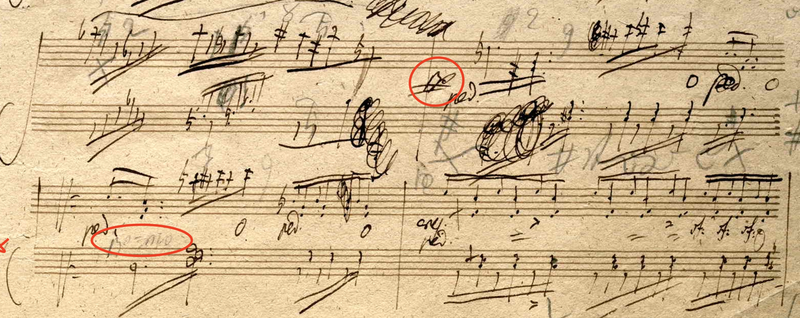
Beide Komponisten hoben in ihren Kompositionen bestimmte dynamische Angaben durch Unterstreichungen oder Ausschreiben hervor. Diese zusätzlichen Hinweise aus erster Hand können jedoch bis heute nur in Autographen nachverfolgt werden, denn obwohl Mozart und Beethoven die Markierungen in reicher Anzahl und Differenzierung notierten, sahen sie diese anscheinend nicht für den Druck vor und sind auch in neuen Urtextausgaben nicht wiedergegeben. Anhand von Autographen mehrerer Schlüsselwerke der beiden Komponisten für Klavier werden Claudio Martinez Mehner und Camilla Köhnken diese intentionalen Hervorhebungen als eine für die musikalische Interpretation wertvolle, zusätzliche Schicht von Informationen am Instrument vorstellen und Hypothesen zu ihrer Bedeutung und Tragweite diskutieren.
Camilla Köhnken
Camilla Köhnken studierte Klavier bei Pierre-Laurent Aimard (Köln), Jerome Rose (New York) und Claudio Martínez Mehner (Basel). Sie gab Solokonzerte in Sälen wie der Carnegie Hall in New York, dem Teatro La Fenice in Venedig oder dem Palacio de Festivales in Santander, außerdem spielt sie regelmäßig mit ihren zwei in Basel gegründeten Ensembles, dem Duo Ivory & Reed mit Saxophonist Pedro Cámara Toldos und dem Philon Trio mit Bratschist Adam Newman und Klarinettist David da Silva, mit denen sie auch mehrere CDs aufnahm.2018 schloss sie eine Dissertation an der Universität Bern über Interpretationspraktiken des Franz-Liszt-Kreises auf Grundlage früher Einspielungen ab und forschte 2019–22 als Postdoktorandin am Orpheus Instituut für Künstlerische Forschung in Gent (Belgien) im Rahmen von Tom Beghins Forschungsprojekt zu Beethovens Kompositionsprozess im Zusammenhang mit den Spieleigenschaften seiner verschiedenen Fortepianos.Seit 2024 lehrt sie Interpretationspraxis und Musikgeschichte mit Schwerpunkt Beethoven und Liszt an der Joseph Haydn Privathochschule in Eisenstadt.
Forschungsprojekt

Dynamische Emphasen

Misia Iannoni Sebastianini
Lecture Recital: George Enescu - Genius and dignity of soul between the popular and the innovative
A journey into the world of an ‘incandescent’ musician, a brilliant mind who could never forget what he heard, a composer, conductor, teacher, a man full of humour and, as his dearest pupil Yehudi Menuhin described him, ‘the most generous, altruistic and extraordinary human being’ he had ever met. In this lecture we will try to get more in touch with the music of George Enescu, still too little known, with his personal history and his origins: his relationship with Romanian folk music and his extremely profound and emotional way of being and composing.
Live music examples will be performed by students of the Hochschule für Musik Basel:
Çiğdem Tunçelli Sinangil (violin) and the Quartetto Werther
Misia Iannoni Sebastianini
Misia Iannoni Sebastianini is a Violin Professor at the "Morlacchi" Conservatory of Perugia. She graduated with top marks, honors, and special distinction from the "Santa Cecilia" Conservatory in Rome, and later earned a Master’s degree in Chamber Music from the "Arrigo Boito" Conservatory in Parma, also with honors and distinction.Winner of the "Annarosa Taddei" Competition in 2016, she furthered her studies with Marco Fiorini, Oleksandr Semchuk, Ksenia Milas, Pavel Berman, and later with Leonidas Kavakos, Massimo Quarta, Felix Ayo, Dora Schwarzberg, Mariana Sirbu, Natalia Prishepenko, and Virgilio Gori.At the Hochschule für Musik in Basel, she completed her Master’s in Performance and Soloist Studies in 2024 under the guidance of Rainer Schmidt, supported by the De Sono Association. Her graduation recital was awarded Best Exam of the Year, and she concluded her studies performing Tchaikovsky’s Concerto with the Sinfonieorchester Basel at the Stadtcasino in Basel.She is a founding member of the Quartetto Werther, with which she won First Prize at the "Brahms" International Competition in Gdańsk (2025), the Abbiati–Farulli Critics’ Award (2020), Third Prize at the "Trio di Trieste"International Competition, First Prize at the Alberto Burri Competition (2019), and Third Prize at the Città di PineroloCompetition (2023).

Musikpädagogisches Forum

Kontakt

Julia Kirchner
- Telefon
- +41 61 264 57 89
- julia.kirchner@fhnw.ch
Teilnehmen
colloquium48Rubén Bañuelos Preciado: Ghost whispered distortion - Disembodiment as a Performative Spectrum
- Datum
- 14.10.2025, 19:00–20:30 Uhr
- Ort
- Campus Musik-Akademie Basel
Zi 6-301
Leonhardsstrasse 6
4051 Basel
colloquium48Interpretationsforum - Georges Starobinski
- Datum
- 28.10.2025, 19:00–20:30 Uhr
- Ort
- Campus Musik-Akademie Basel
Zi 6-301
Leonhardsstrasse 6
4051 Basel
colloquium48Steffen Krebber: Sinusoidal Run Rhythm
- Datum
- 4.11.2025, 19:00–20:30 Uhr
- Ort
- Campus Musik-Akademie Basel
Zi 6-301
Leonhardsstrasse 6
4051 Basel
colloquium48Interpretationsforum Plus - Beatrix Borchard
- Datum
- 17.11.2025, 19:30–20:30 Uhr
- Ort
- Campus Musik-Akademie Basel
Zi 6-301
Leonhardsstrasse 6
4051 Basel
colloquium48Inbar Sharet, Michel Roth: Musicking the Ferienkurse! Harnessing Music Institutions as Creative Resource
- Datum
- 18.11.2025, 19:00–20:30 Uhr
- Ort
- Campus Musik-Akademie Basel
Zi 6-301
Leonhardsstrasse 6
4051 Basel