Get to know the research projects of MA SP Music and Research students
Studienbeginn 2026
Idun Gabrielle Fougner-Økland: Public Private Pianism
Information following soon
Bio
Victoria Eres: The Lived Experience of Conservatory Students
Information following soon
Bio
Studienbeginn 2025
Malcolm Braff: Generalized Theory Of Swing
I have been working on a generalisation of swing for over 20 years. Throughout this time, I have conducted in-depth research under different names such as Organic Groove, The Well Tempered Rhythm Machine, Non-Euclidean Rhythms and currently Generalized Theory Of Swing. I have integrated this approach into my playing, composing and teaching at the Jazzcampus in Basel as well as numerous masterclasses/lectures worldwide. Despite being referenced by many musicians, teachers, and researchers, this body of work has never been formally published or compiled. I now feel the need to dedicate focused time to deepen my research, organise my findings, and publish the results, making them accessible to others.
Duration 2025-2027
Mentors Dr. Michael Kunkel, Prof. Dr. Michel Roth
Bio
Links
Łukasz Moroz: Composing with Material Tendencies
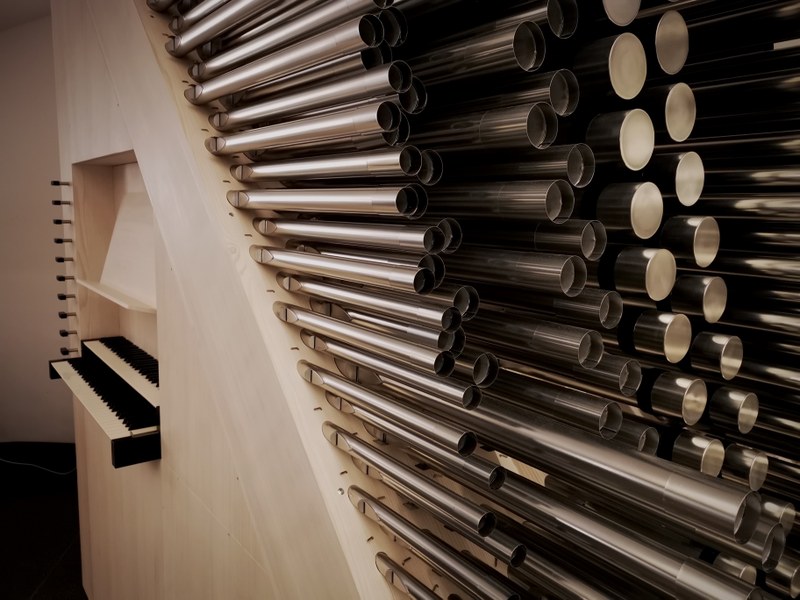
My research originates from two formative listening experiences as a former classical pianist: playing meantone temperament for the first time on a small portative organ, and later encountering La Monte Young’s The Well-Tuned Piano. In both situations, familiar harmonic relations appeared under new aspects: the keyboard itself lost its habitual clarity, and the piano’s resonance unfolded into an uncanny, seemingly autonomous order. In the first, the same tonal materials revealed new perceptual contours; in the second, the instrument itself seemed to exceed compositional control, articulating an order of its own. These moments of aspect-hearing and allure revealed to me that tuning and timbre are not neutral parameters but behaving materials, quasi-agents whose tendencies reshape our sense of pitch, duration, and relation. Rather than serving as means of expression, they disclose their own modes of organisation and resistance. From these experiences arises the central question of this project: What does it mean to compose when tuning, timbre, and material behaviour are not fixed, but co-constitutive and mutually constraining? Through my compositional practice, I aim to explore how instruments’ spectra co-determine consonant terrains, and how composition can 1 of 2unfold these spectral aEordances audible. By spectral aEordances I mean regions where a given tuning and an instrument’s partials jointly minimise roughness and/or maximise tonalness, opening particular pathways of consonance. In this view, composition becomes a practice of cultivating correspondences among sounding materials rather than imposing structure upon them.
Duration 2025-2027
Mentors Dr. Christoph Haffter, Prof. Dr. Michel Roth (2025/26)
Bio
Mads Emil Nielsen: Framework / Fragments
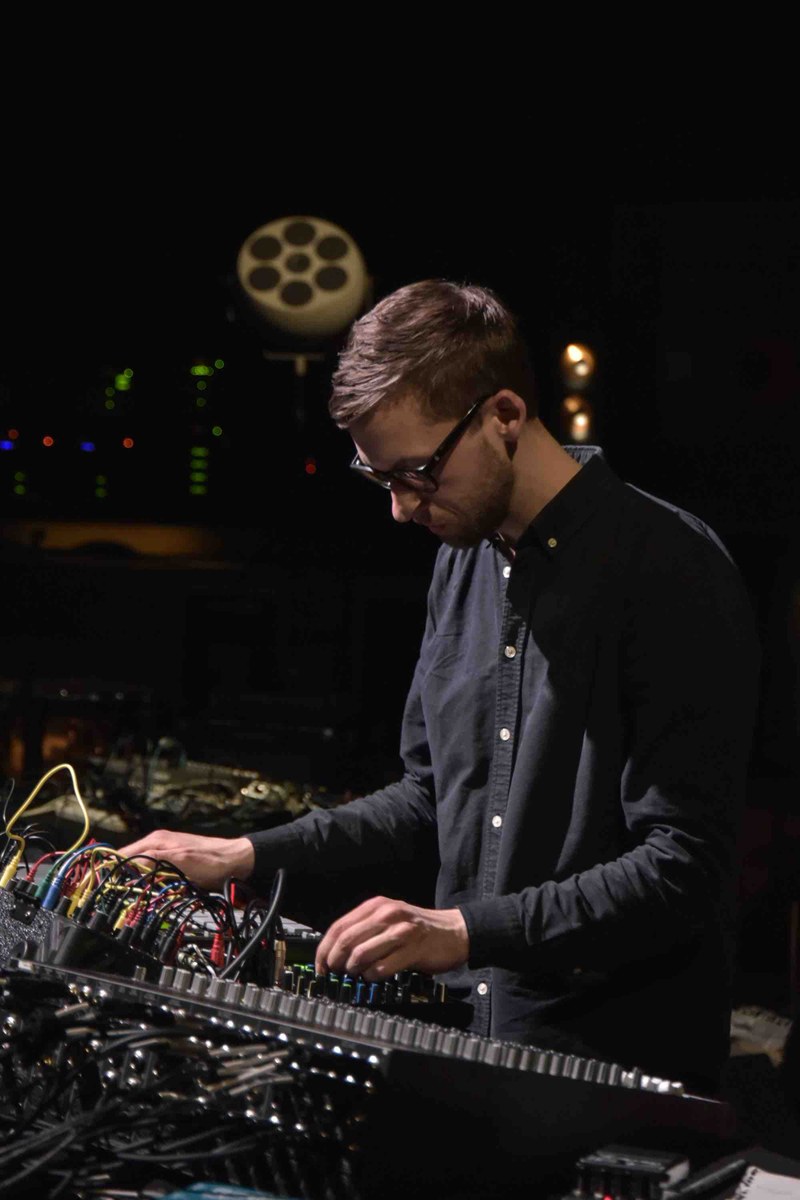
Framework / Fragments (working title) is a project based on graphic score explorations and a direct, visual approach to sound and composition. As a musician/composer I have been interested in architecture and graphic design and the question of how to intuitively sonify an image / “how does an image sound?” and in translating sounds and music into illustrations and scores. With this project, I would like to research texture and materiality, and visual qualities of sound, and the connections between visual materials and recordings.
The work is based on exchanging and producing multiple sound pieces and graphic score fragments. I see this as a research process and exploration, and feedback system with the potential of generating a large amount of sketches and material, also later in this process by collaborating with others – musicians, composers, graphic designers. In general, the work is based on a fascination of working with mainly basic electronic sound sources and analog electronic instruments, also in combination with entirely digital sounds and granulations, and emphasising and amplifying unpredictability, surprises, micro-events, noises and error sounds. I am interested in exploring how these recordings can already have “visual” qualities.
The process of producing and exchanging pieces and graphic score fragments will happen in several parts – starting from either one recording or drawing. Each piece / score is interpreted in multiple turns, back and forth, sound to image. In this process, I would like to research various material such as architectural sketches, historic and contemporary graphic scores, maps and experimental graphic design. I would also like to develop various methods and systems of describing and analysing the audio material, and other types of recordings in general (short texts, questionnaire, hörprotokoll). The intention is then to create a large archive of material which is edited, possibly deconstructed into final scores and compositions.
I am interested in how this work and output, which is strongly related to movements and aesthetics in sound and graphics from the 1960s-70s, can be placed and exist in a contemporary context. And in doing comparisons between these historic works and contemporary graphic notation projects & recordings. I would also like to research the following question: how can this material as music / sound in finalized recordings, and performances, diffusions or live compositions have materiality in sounds themselves, and these graphic, visual, or even (although perhaps more abstract) “architectural” qualities – e.g. being presented in stereo without using several loudspeakers, and without any of the visual material being present? This is something that I often miss when being part of the audience at presentations of graphic notation projects and “visual music”.
Duration 2025-27
Mentors Prof. Svetlana Maraš, Dr. Christoph Haffter
Bio
Links
Vittoria Pagani: Reinventing the Unwritten: The Archival Legacy of Hindustani Music in Academic and Artistic Practice
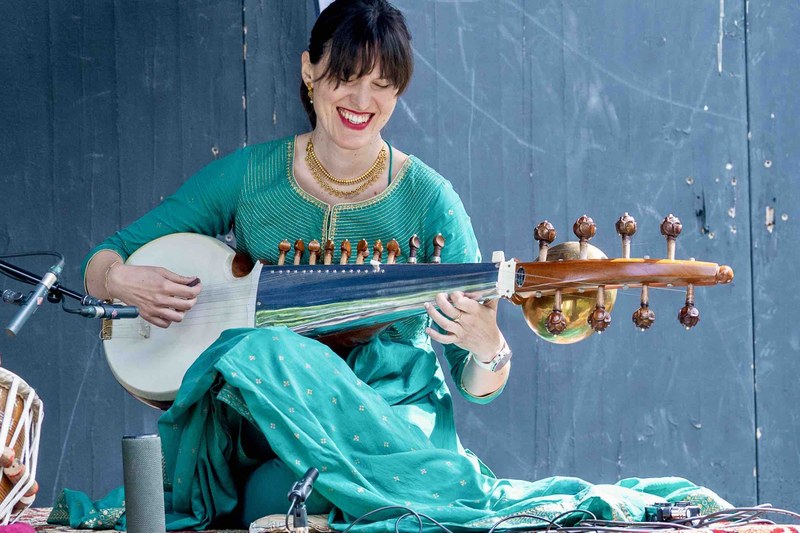
In Hindustani music, notation is not standardized but functions mainly as a mnemonic aid: an approximate record of a composition learned by ear and imitation. This paper examines the potential of the archival legacy of Hindustani music to complement and expand pedagogical and artistic approaches in European academic education. At the center of the project are numerous transcriptions and recordings of Ali Akbar Khan’s teaching, collected over decades by his student Ken Zuckerman.
Because Hindustani music is transmitted orally, these notations remain partial and open-ended. Rather than fixing musical meaning, they demand interpretation, requiring the performer to reconstruct melodic and rhythmic material through listening, memory, and embodied practice. In this sense, the archive becomes a generative site: it preserves the legacy of a master while simultaneously demanding reinvention, enacting an active process of cultural transmission.
My research explores two interconnected dimensions:
- Pedagogy in higher education – Integrating this archival legacy into ear training and guided improvisation courses at the Musikhochschule Basel, where students encounter Hindustani music as a parallel to European monodic traditions and learn to navigate oral transmission alongside Western notation. Key questions include: In what ways does learning Hindustani music foster skills applicable to other musical genres? What challenges and limitations arise when teaching an oral, non-European art form in a Western academic context?
- Artistic projects – Using the archive as a springboard for performances that place Hindustani material in dialogue with European modal traditions, highlighting melodic affinities and exploring transcultural approaches to musical expression. Central questions include: To what extent do skills acquired through Hindustani training versus Western academic training influence my compositional and creative practice? In collaborative projects with non-Hindustani musicians, is the oral dimension a limitation or an added value?
Duration 2025-2027
Mentors Dr. Budhaditya Chattopadhyay, Prof. Dr. Anne-May Krüger
Bio
Links
Arthur Wilkens: Ars organisandi: late medieval organ improvisation
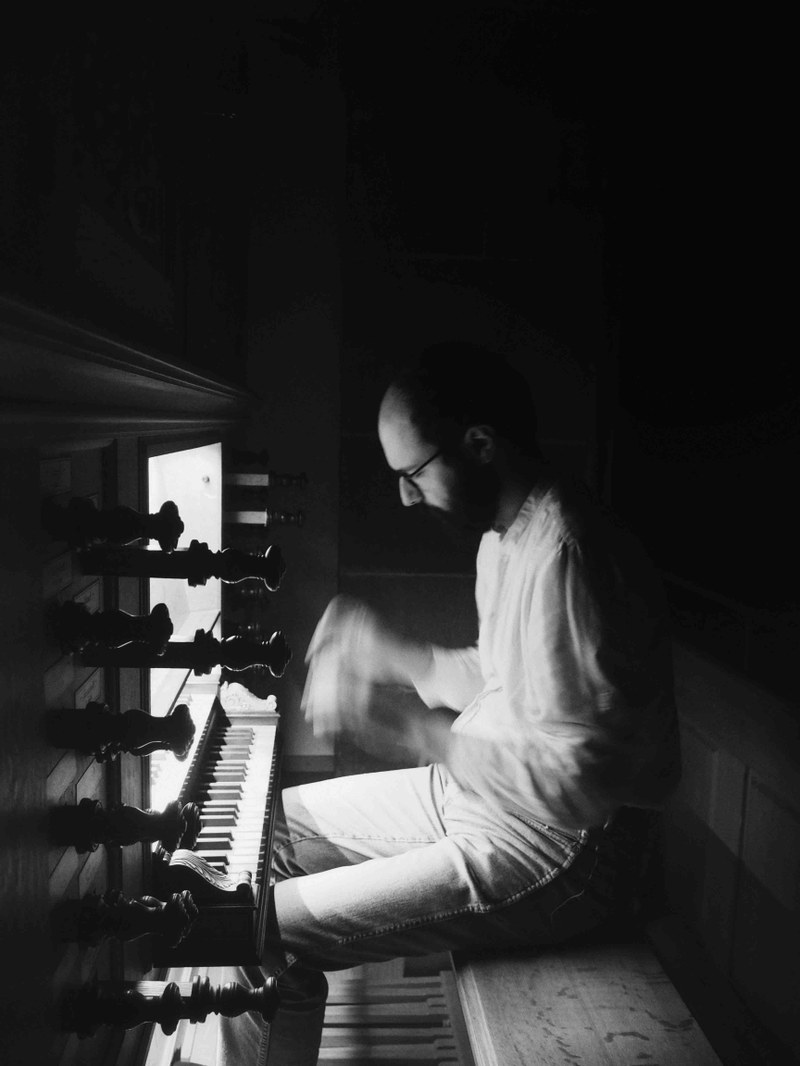
Ars organisandi: late medieval organ improvisation Keyboard music of the Middle-Ages has come down to us in the form of organ tablatures and pedagogic methods known as Fundamenta organisandi. My aim is to engage practically with this surviving material as traces of an orally transmitted tradition in which improvisation and the use of memory played a central role. Developing the skills described in the sources of the Ars organisandi requires a radical shift in how we conceive of music pedagogy today. While traditional musicology has placed much emphasis on the concepts of the musical “work” and authorship, a significant portion of medieval sources focuses instead on the process of making music – an approach that could be described as non-compositional. This research project is an experimental attempt to embody the mindset of late medieval instrumentalists in contemporary music-making. It is also a practical reflection on the generative nature of this music: an interesting encounter between two distinct yet complementary traditions – the ancient Ars organica and the mensural music of the 14th and 15th centuries.
Duration 2025-2027
Mentors Prof. Dr. Martin Kirnbauer, Prof. Dr. David Mesquita
Bio
Archiv
Abschluss 2026
Abschluss 2025
Researching about?
Dakota Wayne about his research project in MA SP Music and Research /2023
Teaching Staff
Kontakt
Prof. Dr. Anne-May Krüger
- Telefon
- +41 61 264 57 57 (Zentrale)
- annemay.krueger@fhnw.ch