
Through our research projects at the FHNW Institute of Data Science, we create a diverse range of data products and applications.
Some of them are freely available. This concerns data archives, data sets for machine learning and tools that support the access to data as well as their investigation and analysis: user interfaces, image processing and machine learning algorithms or data visualization software.
Open data products are created in the context of publicly funded research in solar physics, for example. Projects in the fields of speech recognition or word processing also generate scientific data products that are freely available to all and can be used for further investigations.
The only exception concerns products that are subject to data protection regulations or non-disclosure agreements with customers.
Freely available data products
Application: the Karabo pipeline for radio astronomy data
Karabo is a radio astronomy software distribution for validation and benchmarking of radio telescopes and algorithms. It can be used to simulate the behavior of the Square Kilometer Array or other supported telescopes. Our goal is to make installation and ramp-up easier for researchers and developers.
Dataset: Swiss German speech recognition
The Swiss Parliaments Corpus (SPC) is an automatically aligned Swiss German speech to Standard German text corpus. More specifically, it is a collection of sentence-level audio-text pairs. The current version of the corpus is based on publicly available data of the Bernese cantonal parliament and consists of 293 hours of data.
Data set: Drug side effects
A collection of 1139 medical reports from the US Food and Drug Administration (FDA) Adverse Events Reporting System (FAERS)
Data set: Wikipedia article
A collection of 240000 summaries of Wikipedia texts in German
Data set: SDO Benchmark
Image files of the Solar Dynamics Observatory SDO space telescope to develop prediction systems for solar flares using machine learning
Data center: X-ray telescope STIX
All data and tools related to the operation of the X-ray telescope STIX and the scientific processing of its observations
Python library: IRISreader
Functionality to read IRIS level 2 data by the IRIS satellite and to process it for big data applications. The IRISreader works best with a Jupyter notebook.
Data Archive: e-Callisto
Observations of the Sun in radio frequencies
Data: dynamic solar spectra
Frequency range: 20 - 5000 MHz
Instruments: radio spectrometer e-Callisto, Phoenix-3, Phoenix-4
Time range: 2002 - today
Data Archive: RHESSI
Observations of solar flares in the X-ray range
Data: raw data, observing summary
Energy range: X-ray (~3 keV) to gamma rays (up to ~20 MeV)
Instrument: X-ray space telescope RHESSI
Time range: 2002 - 2018
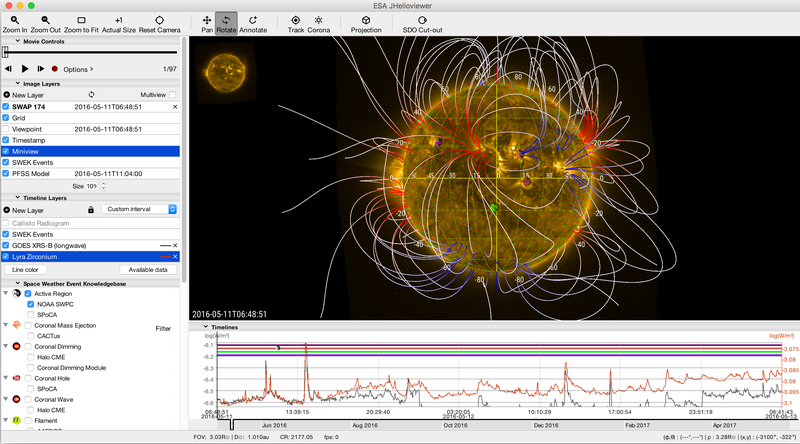
Visualization app: J Helioviewer
3D visualization tool for exploring solar data
Data: solar images of the main solar observatories from three different servers
Data format: JPEG (compression standard 2000)
Functions: timeline with image time series, events from the Heliophysics Events Knowledgebase and more
Visualization app: Heliotime
Interactive timeline for exploring solar activity in time
Data: GOES X-ray flow, SDO AIA 171, SOHO EIT 171
Time range: 1981 - today (almost in real time)
Special feature: The preview images are linked to the NASA visualization application helioviewer.org which allows to examine interesting solar events in detail
Web application: no software installation required
Forecast app: FLARECAST
An app for predicting the probability that a solar flare will occur in a given time
Data: magnetograms (HMI) of the Solar Dynamics Observatory SDO
Web application: no software installation required
Contact us

Prof. Dr. André Csillaghy
- Phone
- +41 56 202 76 85 (Direct)
- andre.csillaghy@fhnw.ch