
Craftsmanship in the digital era
New technologies are often perceived as an opposition to the traditional craftsmanship understood as a process in which skilled maker creates an object with attention to detail. Since industrial revolution the traditional crafts and trades have been in a significant decline, as the contemporary design industry favours cheap and standardized products over individualized ones.
At the same time, advancement in digital technologies for modelling and fabrication are very close to afford high quality and unique production, relevant for sophisticated craftsmen work. Unfortunately, due to the steep learning curve, digital technologies are usually taught as a goal itself and not as a response to the specific problem or cultural question.
With the understanding of craftsmanship as a language of material, context and making at the core of our investigation we circled around the question:
What are the new scenarios for contextualized craftsmanship in the era of digitalization?
The program combined theoretical and practical parts in an interweaving format. Site visits at craft museum in Ballenberg and local wood manufacturers Winkler AG and ERNE Holzbau AG were complemented with series of theoretical lectures, discussions and individual investigations. In parallel to the conceptual development, students proceeded with hands-on digital modelling and scripting (Rhinoceros+ GH) of their material- and fabrication aware projects.
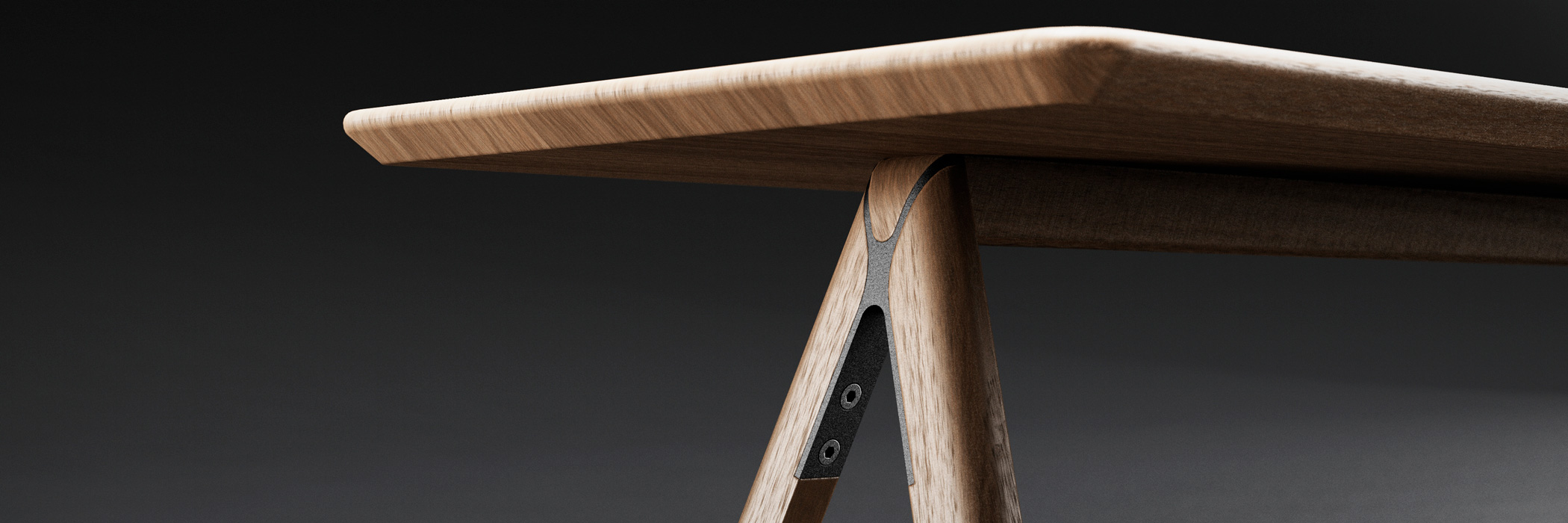
The outcomes resulted with theoretical essays and projects of varied scales and designations that utilize various wood properties and mixed fabrication methods (robotic or other CNC machine+ manual). Those include acoustic panel, artistic pavilion, dove house, disassembled sauna structures/wood connector, furniture set, assembly box, public bench collectively presented during the exhibition in September 2020 at HGK FHNW campus.
The project is an initiative and part of the research project CODE Facades.
Teaching team: Heinz Wagner (supervisor), Maria Smigielska, Edyta Augustynowicz, Daniel Nikles
The course was open for Bachelor, Master and Alumni students of Masterstudio Design, Industrial Design and Hyperwerk HGK FHNW: Michael Altmann, Pascal Decaillet, Lara Grandchamp, Elias Kopp, Daniel Mankel, Christoph Meyer, Sebastian Steffen, Santeri Taurula.
Funding: Lehrfonds FHNW
Fabrication facility: HGK FHNW, ERNE AG Holzbau