The project investigates how cycling skill in cyclists can be advanced with a digital training.
Conclusion
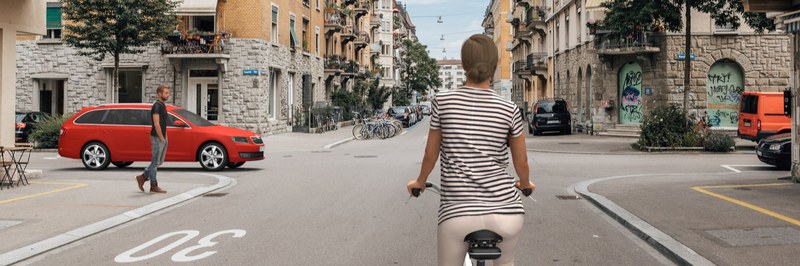
More and more Swiss people are cycling, which is beneficial for health, the environment, and reducing traffic congestion. However, this trend is also leading to an increase in accidents. An analysis of cycling skills in the first phase of the research project revealed shortcomings in the Swiss population's ability to recognize and respond appropriately to hazards in specific and complex situations.
By providing training to address these competencies, there is significant potential for preventing cycling accidents. The project aims to scientifically develop a user-oriented, digital cycling training program for adults.
The project is conducted by a team of the FHNW APS and the FHNW HABG.
Aim of the Project
The aim of the project is to analyse the impact and acceptance of digital training for adult cyclists.
Implementation
During the initial phase of the project, a digital cycling training program will be implemented utilizing available software. This will involve the creation of course materials, incorporating a range of media such as images, videos, and illustrations. Additionally, significant attention will be given to integrating gamification elements and providing users with feedback on their given answers. Finally, tests are carried out with potential users to ensure their effectiveness and user-friendliness. The effectiveness of the training will be tested using a virtual reality cycling simulator.
The findings will form the basis for the development and application of a digital training platform in a follow-up project.
Publications
- Konferenzbeitrag ICSC 2023: Evaluation and acceptance of an online cycling training for adults
- Factsheet Digitales Velotraining
Basic Information
Financing: | |
Project duration: | 1.7.2022 – 30.02.2023 |
Project manager: | |
Project co-worker: | |
Keywords: | Cycling; cycling safety; cycling skills |
Project Partner
- Yvonne Ehrensberger, Pro Velo Canton Zurich
- Wernher Brucks, Dienstabteilung Verkehrssicherheit, Stadt Zürich
- Chantal Bourloud, Am Steuer Nie