Skip to main contentSkip to search barSkip to navigationSkip to footer
Logo of the University of Applied Sciences and Arts Northwestern Switzerland
Degree Programmes
Continuing Education
Research and Services
International
About FHNW
DeEn
Locations and ContactFHNW LibraryMedia Relations
Logo of the University of Applied Sciences and Arts Northwestern Switzerland
  • Degree Programmes
  • Continuing Education
  • Research and Services
  • International
  • About FHNW
DeEn
Locations and ContactFHNW LibraryMedia Relations
Sc...
FHNW School of Compu...
Institute for Dat...
Data Products and Applic...

Data Products and Applications

Through our research projects at the FHNW Institute of Data Science, we create a diverse range of data products and applications.

Some of them are freely available. This concerns data archives, data sets for machine learning and tools that support the access to data as well as their investigation and analysis: user interfaces, image processing and machine learning algorithms or data visualization software.

Open data products are created in the context of publicly funded research in solar physics, for example. Projects in the fields of speech recognition or word processing also generate scientific data products that are freely available to all and can be used for further investigations.

The only exception concerns products that are subject to data protection regulations or non-disclosure agreements with customers.
Freely available data products

Application: the Karabo pipeline for radio astronomy data

Karabo is a radio astronomy software distribution for validation and benchmarking of radio telescopes and algorithms. It can be used to simulate the behavior of the Square Kilometer Array or other supported telescopes. Our goal is to make installation and ramp-up easier for researchers and developers.

Karabo includes and relies on OSKAR, RASCIL, WSClean, PyBDSF, MIGHTEE, GLEAM, Aratmospy, Bluebild, Eidos, Dask, Tools21cm, katbeam plus configuration of 20 well-known telescopes. Karabo can simulate instrument behavior and atmospheric effects, run imaging algorithms, and evaluate results.

> To the Karabo Github

Dataset: Swiss German speech recognition 

The Swiss Parliaments Corpus (SPC) is an automatically aligned Swiss German speech to Standard German text corpus. More specifically, it is a collection of sentence-level audio-text pairs. The current version of the corpus is based on publicly available data of the Bernese cantonal parliament and consists of 293 hours of data.

> To the data set 

Data set: Drug side effects

A collection of 1139 medical reports from the US Food and Drug Administration (FDA) Adverse Events Reporting System (FAERS)

> To the text collection  

Data set: Wikipedia article

A collection of 240000 summaries of Wikipedia texts in German

> To the text collection 

> To the corresponding publication 

Data set: SDO Benchmark

Image files of the Solar Dynamics Observatory SDO space telescope to develop prediction systems for solar flares using machine learning

> To the project and the data set on github 

> To the project and the data set on Kaggle 

Data center: X-ray telescope STIX

All data and tools related to the operation of the X-ray telescope STIX and the scientific processing of its observations

> To the STIX data center  

> To the STIX project page 

Python library: IRISreader

Functionality to read IRIS level 2 data by the IRIS satellite and to process it for big data applications. The IRISreader works best with a Jupyter notebook.

> To the library

> To the project page @I4DS 

Data Archive: e-Callisto

Observations of the Sun in radio frequencies

Data: dynamic solar spectra

Frequency range: 20 - 5000 MHz

Instruments: radio spectrometer e-Callisto, Phoenix-3, Phoenix-4

Time range: 2002 - today

> To the data and quick looks @I4DS  

> To the data on ESA's space weather portal  

> To the project page @I4DS   

> To the international project page  

Data Archive: RHESSI

Observations of solar flares in the X-ray range

Data: raw data, observing summary

Energy range: X-ray (~3 keV) to gamma rays (up to ~20 MeV)

Instrument: X-ray space telescope RHESSI

Time range: 2002 - 2018

> To the RHESSI data archive 

> To the RHESSI browser   

> To the project page @I4DS   

> To the international project page   

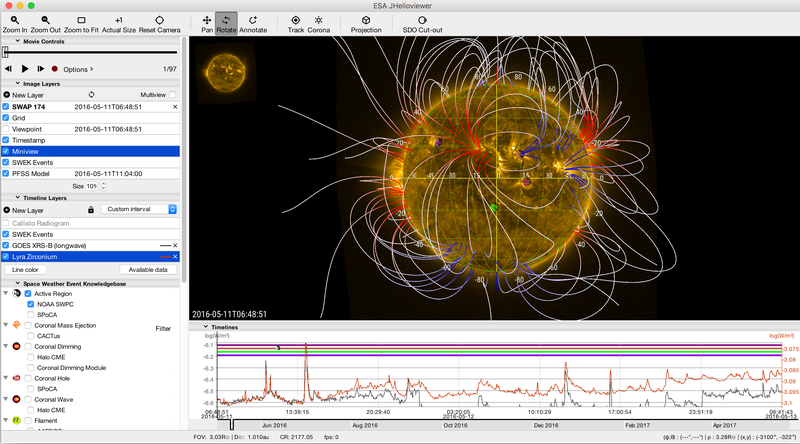
Visualization app: J Helioviewer

3D visualization tool for exploring solar data

Data: solar images of the main solar observatories from three different servers

Data format: JPEG (compression standard 2000)

Functions: timeline with image time series, events from the Heliophysics Events Knowledgebase and more

> To the visualization app  

Visualization app: Heliotime

Interactive timeline for exploring solar activity in time

Data: GOES X-ray flow, SDO AIA 171, SOHO EIT 171

Time range: 1981 - today (almost in real time)

Special feature: The preview images are linked to the NASA visualization application helioviewer.org  which allows to examine interesting solar events in detail

Web application: no software installation required

> To the visualization app  

Forecast app: FLARECAST

An app for predicting the probability that a solar flare will occur in a given time

Data: magnetograms (HMI) of the Solar Dynamics Observatory SDO

Web application: no software installation required

> To the forecast app

> To the forecast app @ESA's Space Weather Portal   

> To the project page @I4DS  

> To the international project site  

Contact

  • Prof. Dr. André Csillaghy

About FHNW

FHNW School of Computer Science
Institute for Data Science

What we offer

  • Degree Programmes
  • Continuing Education
  • Research and Services

About FHNW

  • Schools
  • Organisation
  • Management
  • Facts and Figures

Information

  • Data Protection
  • Accessibility
  • Imprint

Support & Intranet

  • IT Support
  • Login Inside-FHNW

Member of: