The effect of a sonic toothbrush on the cleaning of interdental spaces was investigated and the shear stress during cleaning in the tooth gap was optimized.
Project details
Background
Sonic toothbrushes enable good mechanical and shear-induced hydrodynamic cleaning of interdental spaces by means of shear stress.
In the innovation project, supported by Innosuisse, the hydrodynamic cleaning effect of the sonic toothbrush from Curaden was investigated in a tooth gap. The vibration of the bristles, the induced flow and the resulting shear stresses, which lead to the removal of the biofilm on the tooth, were investigated. Two test rigs were set up at the FHNW for this research topic and various simulations were carried out.
Objectives
The aim of this project is to design and further develop a sonic toothbrush head in order to maximise the cleaning effect in interdental spaces. To this end, the shear stress during cleaning in the interdental space is to be optimised.
Results
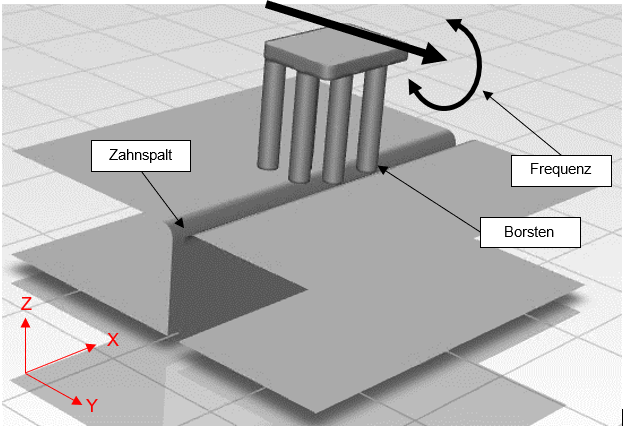
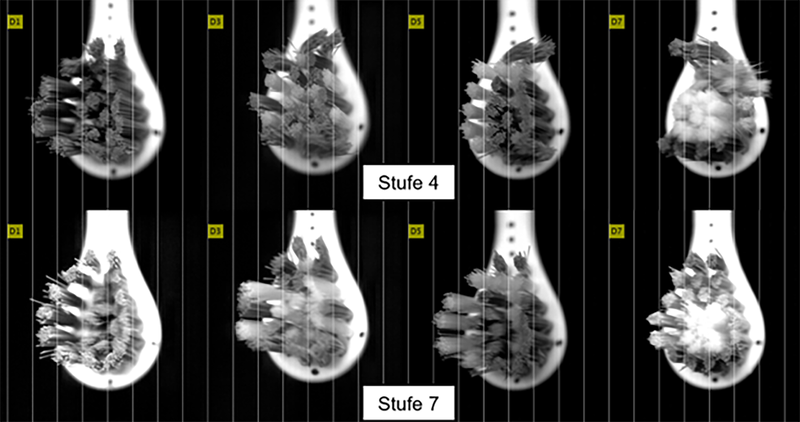
In a comprehensive parameter study using mechanical FEM and fluid-structure interaction simulations, the vibration of the brush head and its hydrodynamic effect on interdental tooth cleaning were analysed. The simulative investigations were also extended with high-speed recordings of various brush heads in order to visualise the vibration of the bristles. The influence of the excitation of the vibration on the tooth gap flow and ultimately the effect of tooth cleaning could be determined, which resulted in several realised prototypes of different brush heads.
Using a developed test bench with flow measurement technology (hot-wire probes), the various brush heads were analysed with regard to their induced gap flow. Furthermore, the different brush heads were examined and validated with our research partners at the Centre for Dental Medicine at the University of Zurich (UZH) with regard to biofilm removal in the interdental gap.
Finally, as part of the project, brush heads were developed that exhibit improved hydrodynamic cleaning effects in the tooth gap, which were experimentally proven by the FHNW and the UZH.
Project information
Client | |
Execution | FHNW Institute of Thermal and Fluid Engineering, Zentrum für Zahnmedizin – Universität Zürich |
Funding | |
Duration | 2 years |
Project team | Norbert Hofmann, Mario Ackermann, Joshua Bopp, Merima Hotic, Cédric Kocher, Lea Ulrich, Pune Paqué, Denisa Schmid, Helga Lüthi-Schaller |