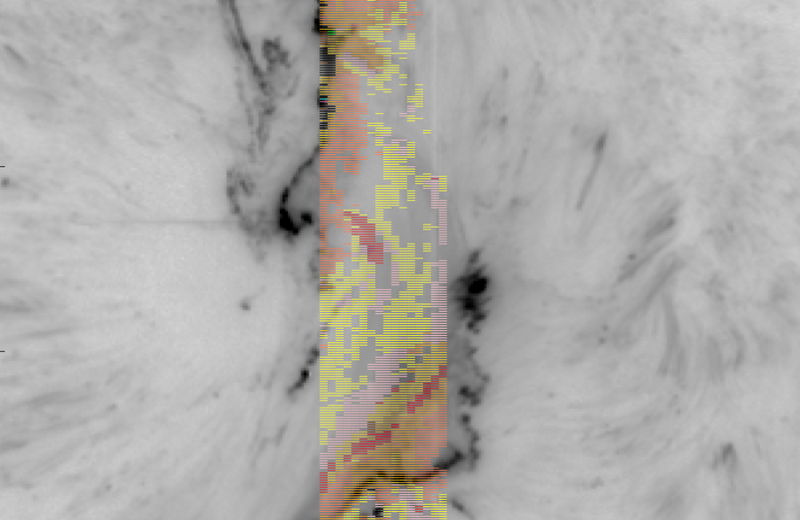
Machine learning methodology to detect, analyse and possibly predict solar flares from data provided by NASA's space telescope IRIS.
Summary
Interface Region Imaging Spectrograph (IRIS) is a NASA Small Explorer Mission designed to observe the transition region between the solar chromosphere and corona. It records around 12 GB of image data every day, amounting to a current total of >35 TB of available data.
Current telescopes deliver huge amounts of data which cannot be handled by traditional methods anymore. This project uses machine learning to detect and analyse solar flares in data from the NASA space telescope IRIS. The new methods are expected to significantly contribute to the understanding of the physics behind solar flares. They will also improve capabilities to predict them, a core element in space weather prediction.
Project details
- Type
- Research project
- Research field
- Image Processing & Computer Vision, Astroinformatics and Space Sciences
- School
- FHNW School of Engineering and Environment, FHNW School of Computer Science / Institute of Data Science
- Funding
- National research program NFP 75 "Big Data"
- Duration
- since 2017
- Project lead
- Prof. Dr. Martin Melchior, Prof. Dr. Samuel Krucker
Contact us

Prof. Dr. Martin Melchior
- Phone
- +41 56 202 77 07 (Direct)
- martin.melchior@fhnw.ch
Further Projects

kennwerte.ch: Web application for estimating construction costs
- Institute
- Institute of Data Science
- Research field
- Information Processing

DrugSafety: Semi-automated reporting of side effects of drugs
- Institute
- Institute of Data Science
- Research field
- Information Processing
SySTEM2020: Connecting Science Learning Outside The Classroom
- Institute
- Institute of Data Science

Pioneering Swiss Building Renovation with Computer Vision and Digital Twins
- Institute
- Institute of Data Science
- Research field
- Image Processing & Computer Vision