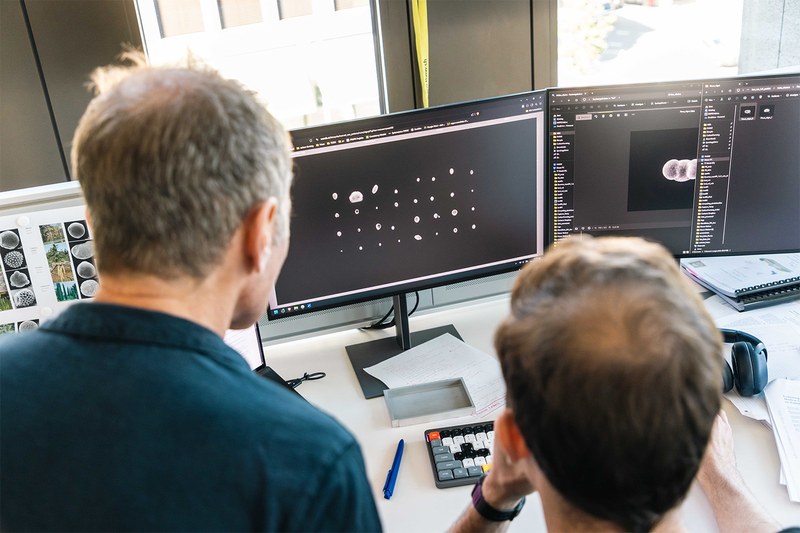
Together with our project partners, we develop zero-shot learning and other machine learning tools for recognising pollen particles anywhere in the world. As a result, it will be easier to create reliable pollen weather forecasts.
Testimonial
Background
Estimates suggest that 10–40% of the world’s population suffer from pollen allergies, and this number is expected to rise as the climate continues to warm. In Switzerland, MeteoSwiss supports allergy sufferers with its real-time pollen forecast.
Our research partner Swisens has made this possible by providing MeteoSwiss with technologies for the detection and identification of pollen particles. These technologies are highly effective at identifying common pollen species in Central Europe. However, extending them to new geographical regions with different plant species remains challenging using current methods.
Objectives
Swisens aims to deploy its pollen detection system in additional regions around the world. However, as different pollen species occur in these regions, a large volume of data must first be collected. The Marvel project is designed to simplify and accelerate this process.
Methods
To develop a pollen detection system that can be deployed worldwide, the Institute of Data Science, FHNW School of Computer Science, is collaborating with Swisens.
Establishing the current system in Switzerland required extensive manual work to prepare a labelled training data set. This approach is not suitable for global scaling. Our project will therefore develop a machine learning model capable of identifying a new pollen particle, even if it has never encountered it before.
Swisens will be able to integrate this model into an effective pollen forecasting tool and transform it into a market-ready product for people with pollen allergies around the world.
Technologies
Our Institute’s contribution to the project focuses on machine learning and artificial intelligence. We apply deep learning methods and are extending our approach towards few-shot learning combined with active learning, while continuously collecting and validating increasing volumes of pollen data.
The Marvel project is a strong example of how a university of applied sciences operates: we use state-of-the-art technologies and identify practical applications for them. As a result, our industry partner gains a solution that can be commercialised immediately. People with pollen allergies around the world will soon benefit from even more accurate forecasts and warnings.
Project details
- Type
- Research project
- Research field
- AI, Machine Learning & Natural Language Processing (NLP), Exploratory Data Science, Image Processing & Computer Vision
- Topics
- Data Science und Engineering, Informatik und Data Science
- School
- Hochschule für Informatik FHNW, FHNW School of Computer Science
- Partners
- Swisens AG
Universität Bern, Institut für Pflanzenwissenschaften
METAS - Eidgenössisches Institut für Metrologie, Chemie
Swisens AG - Funding
- Innosuisse
- Duration
- Januar 2024 – Dezember 2025
- Project lead
- Martin Melchior (Projektleitung, Institut für Data Science FHNW)
- Team
- Tinner Willy (Universität Bern)
Konstantina Vasilatou (METAS)
Erny Niederberger (Swisens)
Contact us
For further information about the FHNW School of Computer Science or to discuss potential collaboration opportunities, please contact us.

Prof. Dr. Martin Melchior
- Phone
- +41 56 202 77 07 (Direct)
- martin.melchior@fhnw.ch
Further Projects

kennwerte.ch: Web application for estimating construction costs
- Institute
- Institute of Data Science
- Research field
- Information Processing

DrugSafety: Semi-automated reporting of side effects of drugs
- Institute
- Institute of Data Science
- Research field
- Information Processing

SySTEM2020: Connecting Science Learning Outside The Classroom
- Institute
- Institute of Data Science
IRIS Big Data
- Institute
- Institute of Data Science
- Research field
- Image Processing & Computer Vision, Astroinformatics and Space Sciences