When you build the world’s largest telescope, you end up collecting an astronomical amount of data. We help the international mega-science project SKAO manage its Big Data.
Testimonial
Background
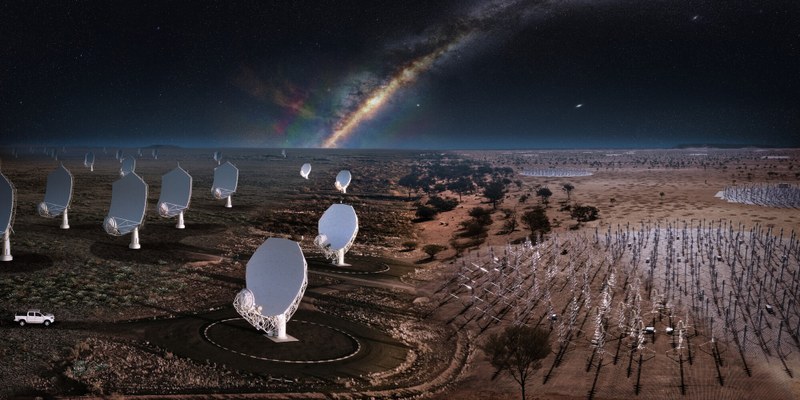
Countries around the world have joined forces to investigate fundamental scientific questions across a wide range of fields, including the precise nature of relativity, the formation and evolution of galaxies, the origin of life and solar activity. To achieve this, the Square Kilometre Array Observatory (SKAO) is building a giant radio telescope at two sites in South Africa and Australia. Thousands of antennas will combine their signals to form the largest astronomical observatory ever constructed.
Goals
At present, ten countries are involved in the construction of the SKA telescope. The aim is to commission it by the end of the 2020s. The Swiss SKACH team comprises several universities and research centres from across Switzerland.
- SKA Regional Centre Network (SRCNet):Vast volumes of data must be transported from the desert to researchers. This requires close cooperation between the participating countries. The data are distributed to centres around the world, forming a global network of regional SKA centres – the SRCNet. We contribute to its development to ensure that researchers in Switzerland can be reliably supplied with data.
Digital twin of the data pipeline (Karabo Pipeline): The telescope will only generate data once construction has been completed. In the meantime, the Karabo software produces synthetic data sets to simulate the flow of real astronomical data. This enables us to prepare and test the pipeline to ensure it functions correctly and can be commissioned immediately once the telescope is fully operational.
- Artificial Intelligence:We develop AI methods to optimise the scientific output of the telescope.
The Head of theInstitute of Data Science, FHNW School of Computer Science, André Csillaghy, is a member of the SKAO Science and Engineering Advisory Committee (SEAC).
Technologies
The Science Data Processor consists of supercomputers installed at the two telescope sites. We apply our expertise in high-performance computing to develop algorithms, integrate pipelines and optimise performance.
SRCNet is a distributed network for storing, processing and visualising telescope data, designed to deliver data to researchers. Our primary task is to establish a Swiss node within this network, including data transfer and storage services, as well as the integration and provision of a data science platform for the analysis and visualisation of observations.
The telescope data are ideally suited to the development and testing of new AI methods. Our AI experts investigate how to accelerate data analysis and deepen our understanding of the data. They do so by combining observational data with AI-generated data that model the underlying physical processes, particularly in the context of solar observations. This enables us to compare the results with those obtained from our STIX telescope.
The Head of the Institute of Data Science, FHNW School of Computer Science, André Csillaghy, is a member of the SKAO Science and Engineering Advisory Committee (SEAC).
The SEAC advises the Director-General and the Board of Directors of the SKA Observatory on scientific and technical matters related to the construction of the Square Kilometre Array radio telescope.
This project is a strong example of how our Institute supports scientific research in astroinformatics and heliophysics. SKACH also provides an excellent opportunity for our students to be part of a large international team and to work with technologies they would not typically encounter in a standard professional environment.
Ultimately, the role of a university of applied sciences is to transfer knowledge and technologies from research into industry. Participation in such pioneering research programmes enables us to develop entirely new technologies and subsequently support commercial projects in collaboration with industry partners.
Project details
- Type
- Research project
- Research field
- Astroinformatics and Space Sciences, Data Engineering
- Topics
- Data Science und Engineering, Informatik und Data Science
- School
- FHNW School of Computer Science, Hochschule für Informatik FHNW / Institute of Data Science
- Partners
- Universität Zürich (UZH)
Eidgenössische Technische Hochschule Zürich (ETHZ)
École Polytechnique Fédérale de Lausanne (EPFL)
Zürcher Hochschule für Angewandte Wissenschaften (ZHAW)
Universität Basel (UniBas), Université de Genève (UniGE)
Haute École spécialisée de Suisse Occidentale (HES-SO)
Centro Svizzero di Calcolo Scientifico (CSCS) - Funding
- State Secretariat for Education, Research and Innovation SERI
- Duration
- Started in January, 2022; open-ended
- Team
- André Csillaghy (Institut für Data Science FHNW)
Rohini Joshi (Institut für Data Science FHNW)
Lukas Gehrig (Institut für Data Science FHNW)
Manuel Stutz (Institut für Data Science FHNW)
Andreas Wassmer (Institut für Data Science FHNW)
Pascal Herzog (Institut für Data Science FHNW)
Michel Plüss (Institut für Data Science FHNW)
Predrag Matavulj (Institut für Data Science FHNW)
Brandon Panos (Institut für Data Science FHNW)
Contact us
For further information about the FHNW School of Computer Science or to discuss potential collaboration opportunities, please contact us.
Further Projects

kennwerte.ch: Web application for estimating construction costs
- Institute
- Institute of Data Science
- Research field
- Information Processing

DrugSafety: Semi-automated reporting of side effects of drugs
- Institute
- Institute of Data Science
- Research field
- Information Processing
SySTEM2020: Connecting Science Learning Outside The Classroom
- Institute
- Institute of Data Science
IRIS Big Data
- Institute
- Institute of Data Science
- Research field
- Image Processing & Computer Vision, Astroinformatics and Space Sciences