Advanced concentrate treatment for integrated membrane based water reuse systems
In the context of water scarcity mitigation, high quality water reuse based on dense membrane treatment is expected to be progressively applied to provide the additional water resources required. Many countries started to invest in double membrane reclamation plants. However environmental concerns and the high costs associated with membrane concentrate management limit the application of high quality water reuse, especially in inland locations.
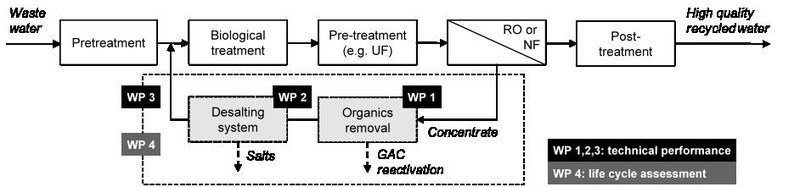
The project aims at the investigation of integrated reverse osmosis and nanofiltration membrane concentrate treatment concepts, with minimized costs and environmental impact. Applying the sustainable Zero Liquid Discharge principle, it combines treatment methods for the removal of bulk and trace organics with a subsequent desalting system. The concentrate desalination shall be based on a low energy consuming and low fouling concentration step, e.g. ED or FO, to significantly increase the salt concentration of the brine and then precipitate the salts or use wind aided intensified evaporation as final stage for salt production. The system configuration will differ whether designed for RO or NF concentrates due to different ion compositions.
Instead of producing additional disposable waste, the salts should be recyclable. The focus of the research will be on the optimum removal of micropollutants and foulants affecting the desalting system to allow a complete recycle of the concentrate to the upstream process, such as wastewater treatment or effluent filtration.
Project details
- Type
- Research project
- Research areas
- Environmental and water technologies
- University
- FHNW School of Life Sciences / Institute for Ecopreneurship
- Funding
- European Commission (FP7 Marie Curie International Outgoing Fellowship, Grant Agreement 272584)
- Running time
- 2011 – 2014
Contact
Prof. Dr.-Ing. Thomas Wintgens
- Phone
- +41 61 228 55 31
- thomas.wintgens@fhnw.ch