For two months, Prof. Dr. Jibril Gabriel Solomon served as a visiting lecturer at the School of Social Work at the University of Applied Sciences and Arts Northwestern Switzerland FHNW. In this interview, he reflects on meaningful encounters, new perspectives on Switzerland, and how his stay inspired concrete ideas for future international collaboration.
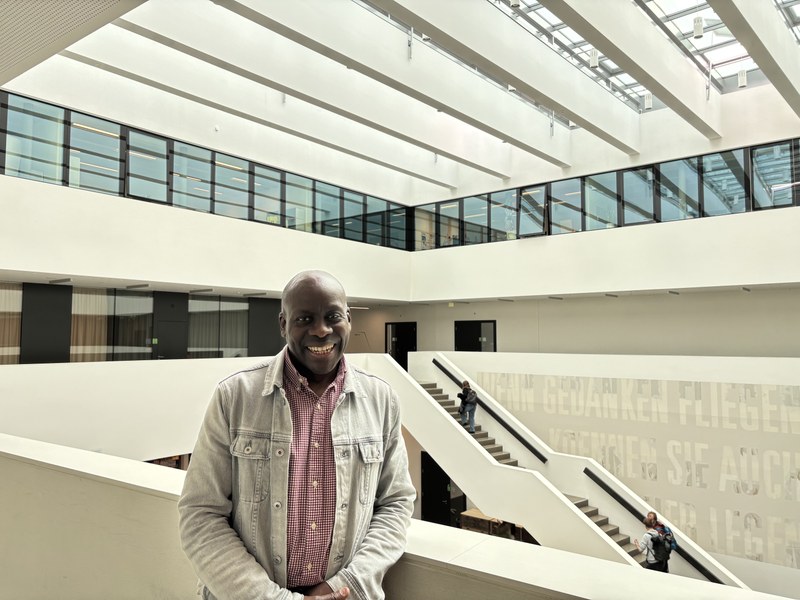
Gabriel, your two months at the FHNW are slowly coming to an end. How do you feel?
I feel great. This experience has given me a much deeper understanding of Switzerland—not just as a country, but as a place shaped by its people, culture, and professional practices. I’ve been able to travel to cities like Zurich, Bern, Lucerne and Geneva, and connect with academics, professionals and everyday people. It’s been a valuable learning experience, especially in understanding social work here—not only as a field of study, but as a profession.
Two months ago, you said you hoped to grow personally and professionally and build meaningful connections. What is your take on that today?
That definitely happened. Personally, my perception of Switzerland has changed a lot. Before coming here, I had a more touristic view—beautiful landscapes, wealth, and stability. Living here showed me a more complex reality: cultural diversity, social challenges like poverty and homelessness, and the everyday lives of people that we don’t usually see from the outside.
Professionally, I’ve built meaningful relationships—with colleagues, students, and others—which I believe will last beyond this stay.
You described this stay as the beginning of a longer collaboration. Has that vision become more concrete?
Yes, very much so. I’ve been involved in several teaching modules and had many discussions about future collaboration—research projects, student exchanges, and joint programs. For example, students from FHNW are interested in coming to my university in Massachusetts, and students from the U.S. are exploring opportunities to study here. We’re also discussing the possibility of hosting a student trip.
You mentioned possible joint projects — can you give us a glimpse of what those might entail?
There are several initiatives in progress. I’m working with colleagues here on expanding the Solidarity Research Network to North America. We’re also discussing sustainability projects, including a potential summer program that would involve students from both institutions.
Another area is suicide prevention and intervention. The U.S. has long-standing experience in this field, and I hope to contribute models, workshops, and teaching concepts that could be adapted here.
You call yourself a Scholar Adventurer. How has this experience changed the way you think or teach?
It has had a strong impact. One key insight is that social work is always shaped by its context—culturally and socially. Unlike disciplines with fixed formulas, social work must adapt to local realities.
Seeing how practices differ even between Swiss cities reinforced this idea for me. I’ll bring that perspective back to the U.S., where we also work with very diverse populations. This experience confirmed that social work must always be contextualized—regardless of the country.
How did working with students here compare to your experience in the U.S.?
There are clear differences. In the U.S., teaching often involves debate—students actively challenge ideas, and that’s part of the learning process. Here, the format is more structured: a lecture followed by discussion.
What impressed me was the depth of those discussions. Students engaged thoughtfully, and many continued the conversation afterwards via email. That level of engagement beyond the classroom was a wonderful surprise.
You said new experiences are essential to being human. What did you learn about yourself during these two months?
I became more aware of my pace of life. In the U.S., everything is very fast. Here, things move more slowly, which pushed me to be more intentional with my time—how I plan, reflect, and prioritize.
I also learned how easily meaningful human connections can happen. I built friendships not only at the university, but also in everyday life in Basel. Even small encounters—like conversations in a supermarket—reminded me how universal human connection is.
Was there a place in Switzerland that stood out to you?
Bern. I felt an immediate connection—maybe because of the combination of nature, the river, and the historic architecture. It has a calmness that really resonated with me. I could imagine living there.
In one sentence: how would you sum up your time at FHNW?
It has been an enriching learning experience – academically, professionally, and personally—and one that opened up exciting perspectives for future collaboration.
What would you like to see when you come back?
I hope to see stronger international collaboration – especially an expanded Solidarity Network connecting Europe and North America. I’d also like to see active student and faculty exchanges, and more joint research projects.
Ultimately, it’s about connecting people, sharing knowledge, and strengthening the field of social work together.
Kontakt
Judith Sibold
- Phone
- +41 62 957 25 72
- judith.sibold@fhnw.ch