
Further articles

Swiss HIPOGRAPH
In this Innosuisse funded Project (45921.1 IP-ENG) we developed a highly porous graphene based composite membrane for waterproof breathable applications via Chemical Vapor deposition. This breathable membrane was chemically functionalized and developed for textiles and related high end membrane applications. During the project methods for the selective chemical modification of…

The Gymnasium Laufental-Thierstein vists the nanoLab
Impression of the Gymnasium Laufental-Thierstein visiting the nanoLab.On May 16th 2024, a class from the Regionales Gymnasium Laufental-Thierstein visited us in the nanoLab. After a short introduction about the nanoLab, the students were allowed to actively experience the world of nanometers and produce red gold nanoparticles in the laboratory, observe…

Renzo Raso at the Itechstyle Summit 2024
Renzo Raso attended the Itechstyle Summit 2024 in Porto (Portugal) where he was invited to speak in the field of performance materials.The conference is organized by CITEVE and is held annually having more than 500 attendees and over 50 speaksers.CITEVE – Tecnologia Têxtil | We started the afternoon with…

Welcome to Kavya Pramod
Kavya Pramod We are happy to welcome Kavya Pramod in our research group at FHNW HLS. Kavya started on May 15th in our lab and will focusDuring the next months on the synthesis and modification of highly repellent materials for surface coatings. The efforts to find alternative solutions toCurrently…

Spotlight on Giulia Venuti
Since October 2023 Ms Venuti investigates oxidation processes of biobased monomers in the frame of her master thesis. She joined us from the University of Bologna. For the FHNW Newsletter she was interviewed on her experience at HLS.Click here to read the full article on our…

New publications in the Instrumental Analytics group
Hair and steroids in DBS
As part of the SNSF-funded project "Understanding the resilience pathways of adolescent students with experience of physical family violence: The interplay of individual, family and school class risk and protective factors", we developed a liquid chromatography tandem mass spectrometry (LC-MS/MS) method to detect eight different steroids in hair samples.

Microplastic detecion in water samples
The increasing microplastic pollution in air, water and soil requires the development of robust and sensitive analytical methods to better understand and address the problem. Plastics are cheap, stable and corrosion resistant, making this class of materials attractive for many applications. Plastics consist of long chains of polymer molecules made…
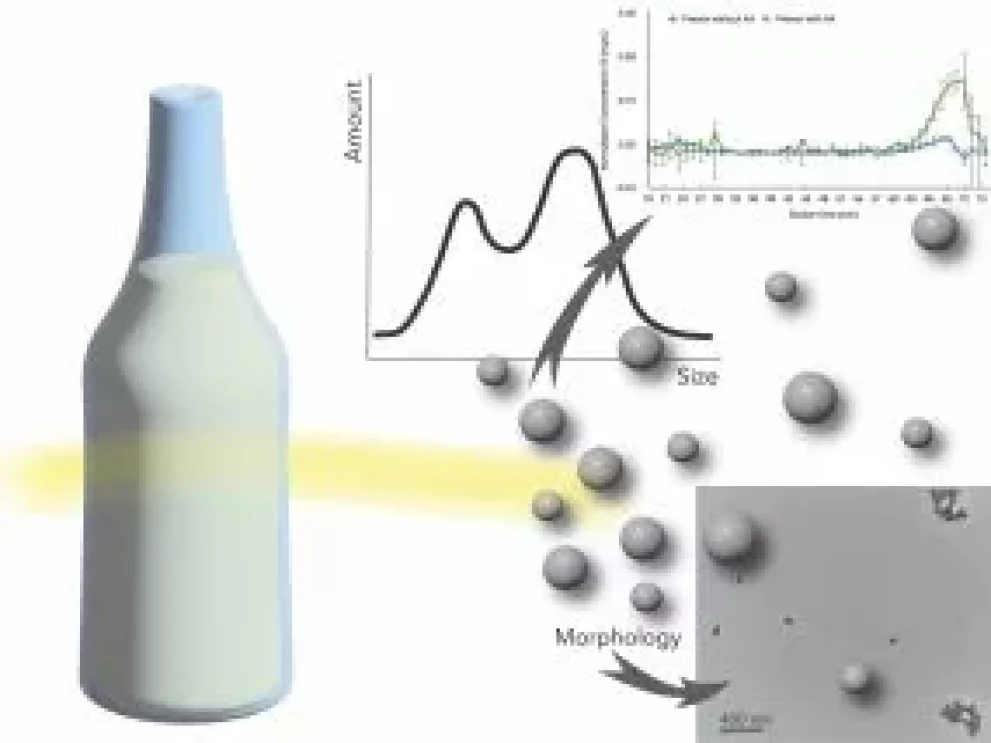
New publication in the nanoLab research group
Our findings of the SiNP Food project, a Argovia Project funded by the Swiss Nanoscience Institute are now published in the open access Journal ACS Omega with the title “High-Throughput Silica Nanoparticle Detection for Quality Control of Complex Early Life Nutrition Food Matrices” (https://doi.org/10.1021/acsomega.3c09459)Publication ACS Omega…
