
Lilo Viehweg
Situated Knowledges of Complex Matter
Fall Semester 2021
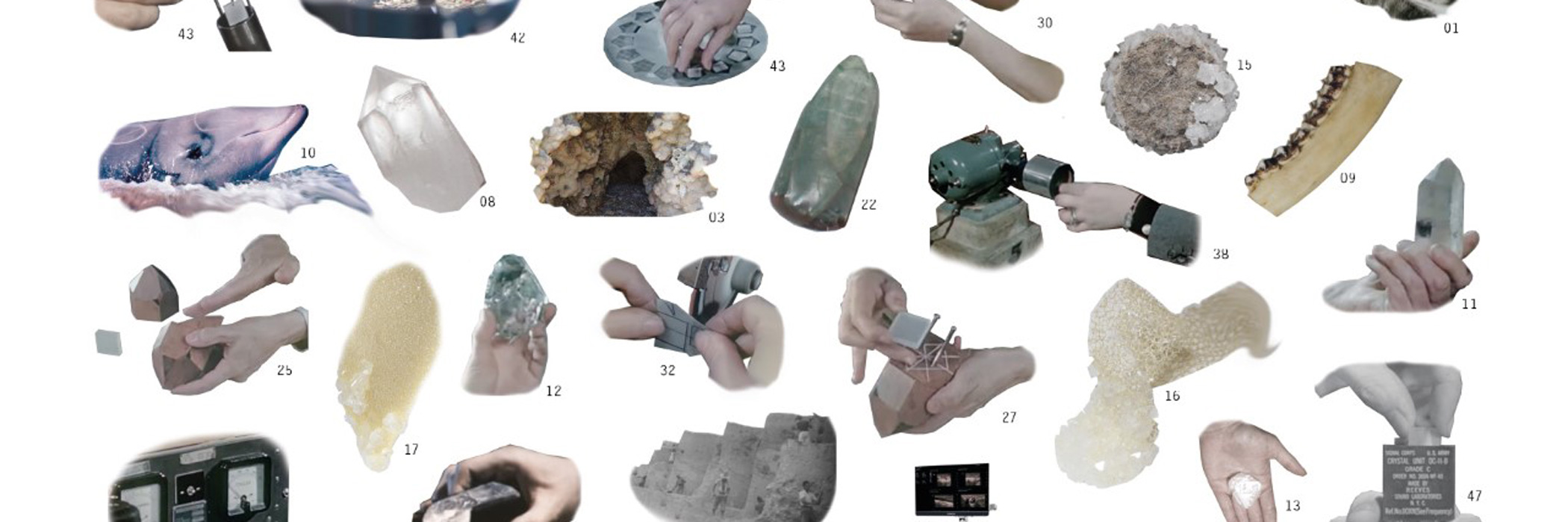
Piezoelectric materials are products of a complex kind of global industrial design carried out by material scientists and engineers taming the material inherent properties of crystals for the exchange of information between human and non-human bodies. As components implemented in measurement and information technologies, those materials have influenced forms of human perception and communication over the past century. Today they are referred to as “smart materials“ - designed materials that are often applied in design, artistic and maker practices, but whose various forms of becoming have received little to no attention in design research so far. While in design, artistic and maker fields essential and invaluable research on tacit knowledges, somatic relations, inter- and intra-actions was conducted to challenge the hierarchies of knowledge production, questions about the situatedness of the piezoelectric materials in relation to the realities of global industries, labour and environmental effects remain open. When starting to investigate the becomings of piezoelectric materials situated knowledges of complex matters emerge in a double sense: On the one hand, the term “arranged complex matter“ describes a field of mundane physics which paradigms of a mathematized nature at the end of the 19th century influence the material scientific design processes of piezoelectric materials until today (Katzir 2006). On the other, the process of decoding their myriad forms of becoming is riddled with complex matters of social, ecological and political context in design: human-non-human entanglements whose situated knowledges have to be studied collectively to make sense of them. To draw connections between the situated knowledges of complex matters, the research aims to investigate the becomings of piezoelectric materials through design anthropological methodologies. In the course of the project, approaches that understand collective practices as cultural critique (Smith, Kjaersgaard, 2015) will be observed, developed and reflected upon. The aim is to find out how addressing social conditions within the production processes of piezoelectric materials might open up possibilities of letting different forms knowledges between material science, critical social theory and experimental material-based practices, yet separated, converge to create space for collective debates on the liveliness of matter and other forms of human-non- human relationships.
Rachel Charlotte Smith, Mette Gislev Kjaersgaard, Design Anthropology in Participatory Design, Interaction Design and Architecture(s) Journal - IxD&A, N.26, 2015