

Product development
We support our customers through the entire product development cycle with the process steps of design, simulation and production.
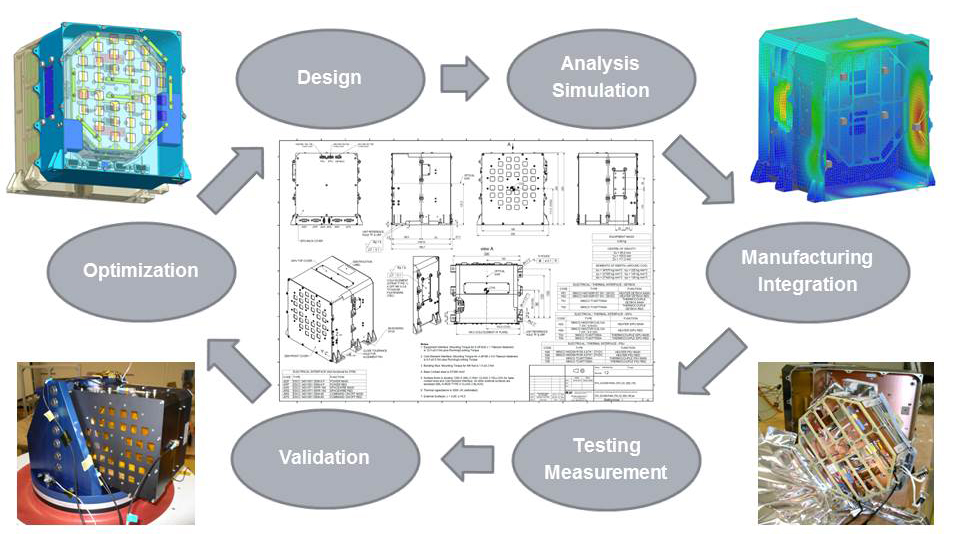
Product development cycle using the example of the X-ray telescope STIX, which was co-developed by the IPPE
The Institute of Product and Production Engineering always views the product development cycle, with the process steps of design, simulation and production, as a whole.
The Institute has experience with the entire cycle and, if required, can execute this in full. It also works in partnership with customers and partners who require support during one or more process steps.
Product development begins with the concept idea, from which a draft and a design are created iteratively. This design is initially produced as a prototype, engineering model or structural thermal model (STM) and tested for compliance with specifications, depending on model strategy and generally after simulation. These steps in the product development cycle – design, prototype production and quality assurance measurements – can be performed fully or in part by the Institute of Product and Production Engineering.

3D model and cross-sectional drawing of the CaSSIS CRU (Color and Stereo Surface Imaging System Camera & Rotation Unit), an instrument of the ESA ExoMars mission, created at the IPPE
Optimisation is carried out continuously throughout the entire product development cycle, in the interplay between the various sub-tasks. For example, design adjustments are made based on simulation results to influence the component behaviour positively, or the most favourable design options are determined using a topology optimisation simulation.
However, optimisation is also an independent process if an existing, validated serial product is improved in terms of its performance and thus concludes the product development cycle.

Topology optimisation of a satellite bracket for RUAG Space
With the constant improvement in computer performance, in the past ten years it has become possible to use FE simulations to consider problems where more than two fields are active; these are any combination of structural mechanics, fluid mechanics, thermal, electromagnetism, mass transfer and chemical activity. Such pairings are summarised under the keyword multiphysics. Examples of this are the expansion of metals under heating and oxidation, which causes known problems in turbine blades, as well as in fuel cells, or the thermo-electro-mechanical deformation of certain polymers or the electrodes of lithium batteries.
Finite element simulation has its origin in the solution of structural mechanics and thermal problems, where one solution variable was sought in each: displacement or temperature. This was followed by a pairing of these two fields, i.e. the solution of thermo-mechanical problems, where first only the one-sided pairing (thermal to mechanical) was considered via thermal expansion, but later the effect of mechanics on the thermal problem was also considered, e.g. in systems susceptible to friction.

Thermo-chemo-mechanical simulation of an oxidising superalloy plate (blue: initial geometry)
Product development is the heart of a healthy company, because technological advancement is continuously moving forward. Keeping step is therefore necessary for a company to survive, and a role as a technological leader guarantees economic success. The new and further development of products is nothing other than the translation of this advancement into a company's product portfolio.