The promotion of the passive use of solar heat for heating buildings is the goal of this international research project in cooperation with HIAL-TERI-FHNW.
Background
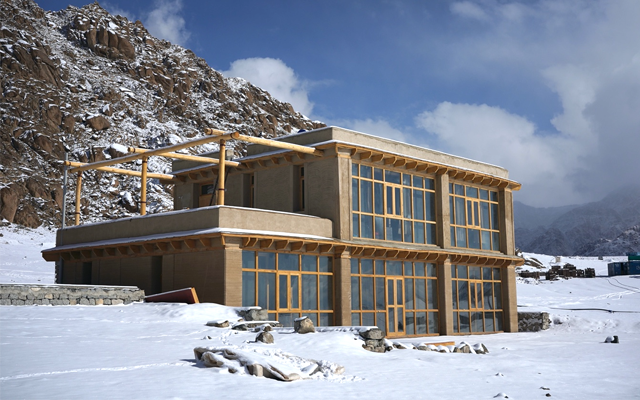
Ladakh has an extremely harsh and long winter climate and buildings currently are poorly insulated, using fuels such as coal and biomass for heating. Through this research, we intend to promote the usage of Passive Solar Heated (PSH) buildings initially among the local government and attached institutions, as these are the major energy consumers in the winters, and also the decision makers. These stakeholders have also become more sensitized for sustainability together with increasing energy shortages and climate change, which challenge India’s development in general and threaten all forms of life in this fragile ecology in particular. Therefore, it is important that new buildings require less energy for heating and substitute fossil fuels with renewable energy.
With this focus, several NGOs have promoted PSH buildings in the regions since the early 1980s as an appropriate technology. Despite 40 years of promotion, PSH houses have not been mainstreamed and new construction using modern building materials still uses climatically inappropriate building methods without taking advantage of PSH design concepts.
Objectives
Through this research project, we aim to identify and address the major hurdles in the path to mainstreaming the PSH concept and come up with design thumb rules, capacity building modules, and policy recommendations for its uptake.
Tasks
- understand the major developments made in the past
- investigate reasons for low acceptance of PSH
- assess the performance of selected existing PSH buildings
- computer-simulate expected thermal behaviour of existing and designed PSH houses
- recommend PSH building concept-friendly bye-laws
- promote skills development in the PSH market
- outline a techno-socio-economical pathway
- transfer Swiss project management approaches through exchange visit by HIAL staff
A member of Institut für Geistes- und Sozialwissenschaften FHNW (IGS) initiated this project from the Swiss side together with the two Indian partners. The technical partner on the Swiss side is the Institute of Energy in Building (IEBau), School of Architecture, Civil Engineering and Geomatics, which is responsible for the thermal simulations and measurement campaign for the quantitative study. Further, IGS will be involved in the stakeholder and market analyses when developing the training and capacity building modules and in the dissemination plan for implementation of PSH houses. Due to the intercultural and interdisciplinary project the project is managed by K. Schrader, a member of IGS.
Project details
- Type
- Research project
- Research field
- Energy and environment
- Topics
- Architecture, construction and spatial development, Building materials and building technology, Environment and sustainability, Environmental technology and recycling, Technologies and engineering
- School
- FHNW School of Engineering and Environment / Institute of Sustainability and Energy in Construction , Institute of Technology and Society
- Partners
- Himalayan Institute of Alternatives, Ladakh, Indien (HIAL)
The Energy & Resources Institute, New Delhi, Indien (TERI) - Funding
- This project has been financed by the Federal Department of Foreign Affairs (FDFA), Swiss Agency for Development and Cooperation (SDC), Global Programme Climate Change and Environment (GPCCE).
- Project lead
- Karen Schrader