
Your path to a sustainable future!
Factsheet
- Degree
- Bachelor of Science FHNW in Data Science & Artificial Intelligence
Study Track Data Science & AI for Sustainability - Study mode
- Full-time, Part-time/work-study, Practice-integrated bachelor's degree program (PiBS)
- ECTS credits
- 180
- Next start
- 1.3.2027
- Teaching language
German / English- Place
- FHNW Campus Brugg-Windisch
The study track is part of the Data Science & Artificial Intelligence degree programme. Apply for the Bachelor’s degree in Data Science & Artificial Intelligence, and you will automatically gain access to this study track.
Why Data Science & Artificial Intelligence for Sustainability?
Imagine you can not only develop artificial intelligence and analyze data, but also actively do something for the planet. This is exactly what “Data Science & Artificial Intelligence for Sustainability” offers. You will become a fully-fledged data scientist while also learning how to tackle sustainability issues and develop solutions for urgent environmental and social problems.
Whether energy efficiency, resource conservation or climate protection: you will work on concrete projects that show how modern analysis techniques support the transition to a more sustainable world. By combining data-driven insights and an understanding of ecological and social interrelationships, you will acquire sought-after skills that will not only benefit you professionally, but with which you can contribute to a better future.
The new “Data Science & Artificial Intelligence for Sustainability” degree program at the FHNW offers you a unique combination of state-of-the-art data science methods and a sound understanding of sustainability. You will be perfectly equipped for a future in which sustainable technologies and data-based innovations are crucial.
Sustainability Data Analyst
Machine Learning Engineer for environmental solutions
Sustainability Consultant
Energy Data Specialist
Data Scientist for NGOs
Structure and programme contents
What can you expect?
This study track is fully embedded in the curriculum of the Data Science & Artificial Intelligence degree programme. You acquire all core data science competencies required for data-driven analytics, machine learning and the development of digital solutions. In addition, you specialise in applying data science to sustainability and expand your competence profile with the following skills:
- Data analysis and modelling for climate protection, energy efficiency and sustainable cities
- Sustainability reporting and regulatory standards (e.g. ESG frameworks, SDGs, CO₂ tracking)
- Systems thinking to evaluate and optimise sustainable solutions
- Interdisciplinary collaboration with experts from environmental sciences, business and technology
Here you can find the curriculum of the Data Science & Artificial Intelligence degree programme and – on the second page – the specific modules of the study track
You can acquire the competencies of Data Science & AI for Sustainability either by attending modules or by working in an Open Learning setting. Open Learning means that you decide where, how and when you learn to develop your competency. For example, you may participate in a MOOC, watch YouTube videos, address a task within your professional work, or by completing an applied challenge as part of your studies.
Whatever learning path you choose, you will be supported by our coaches.
How will you learn?

Practical learning with challenges
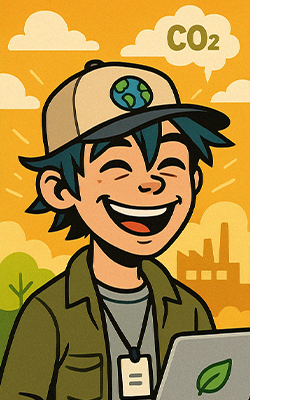
Sam is interested in climate modelling. He acquires many skills in the course's practice-oriented challenges and works in interdisciplinary teams to predict CO₂ emissions. In independent research projects and interactive workshops, he learns to analyze complex systems and develop data-based solutions.

Flexible learning for entrepreneurial solutions
Annie combines her studies with her own sustainable mobility start-up enterprise. She integrates real data into her projects, models traffic systems for cities and uses open learning to acquire competencies individually and practically. Her learning journey is characterized by networking, her own initiatives and direct transfer into practice.
Questions? Students provide the answers.
Do you have questions about course content, student life or study formats? Our Data Science & Artificial Intelligence students Damian and Lukas are available to you via WhatsApp.
Requirements and Organisational matters
Language
Further Computer Science Degree Programmes
Discover our fascinating further degree programmes in Computer Science in german
Weiterbildungen
Apply now to secure your spot!
Bachelor of Science in Data Science & Artificial Intelligence for SustainabilitySpring Semester 2027
- Date
- 1.3.2027
- Duration
- 6-8 Semesters
- Place
- FHNW Campus Brugg-Windisch
Bachelor of Science in Data Science & Artificial Intelligence for SustainabilityAutumn Semester 2027
- Date
- 20.9.2027
- Duration
- 6-8 Semesters
- Place
- FHNW Campus Brugg-Windisch
Contact us
For further information about studying at the FHNW School of Computer Science, please contact us.

Dr. Marie-Thérèse Rudolf von Rohr

Study Administration and Advisory
- Phone
- +41 56 202 99 33 (Direct)
- start.informatik@fhnw.ch
Info-Events
Loading...