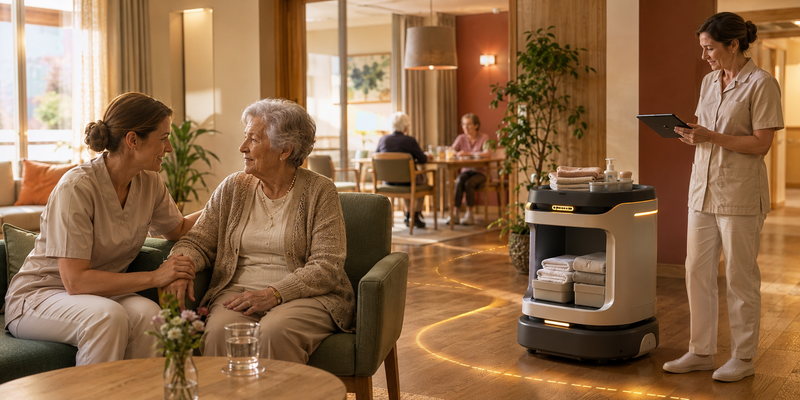
This project explores how robotic assistants can be meaningfully integrated into care homes. Together with caregivers, it develops safe and practical solutions that relieve staff and support quality of care.
Testimonial
Care homes across Switzerland are facing increasing pressure: a growing shortage of qualified staff, rising care demands, and physically and emotionally demanding work environments. While robotics is often presented as a solution, meaningful support in care settings requires far more than simply introducing a robot into the workplace.
Caregivers perform a wide range of demanding tasks every day, from lifting and transferring residents to supporting mobility and managing extensive documentation alongside direct care. As Switzerland’s population continues to age, incremental optimizations are no longer sufficient. Sustainable improvements require carefully designed forms of assistance that genuinely fit everyday practice.
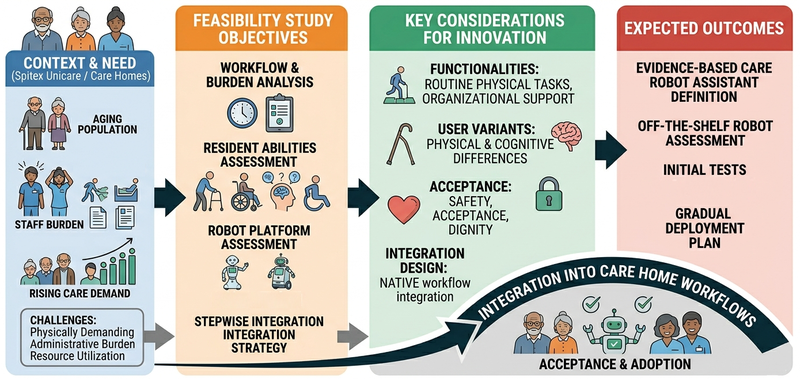
Although robotic systems capable of operating in complex environments already exist, care homes pose unique challenges. Residents differ widely in their physical and cognitive abilities, including conditions such as dementia or motor impairments, making generic solutions unsuitable. Care work combines regulated procedures with highly situational, sensitive interactions. Any robotic assistant must therefore be integrated into real care workflows, supporting staff without disrupting routines, trust, or human relationships.
This project follows a needs-driven, human-centered approach. In close collaboration with Spitex Unicare AG, which operates 11 care locations across Switzerland, the Institute of Interactive Technologies (FHNW) conducts interviews, shadowing, and observational studies with caregivers. The goal is to identify concrete situations where robotic assistance can create real value, and equally where it should not be used.
Building on these insights, the project explores suitable robot functionalities, interaction concepts, and physical form factors, and develops initial prototypes. A particular focus is placed on acceptance, safety, and stepwise integration, ensuring that residents, relatives, and care staff can trust and understand proposed solutions.
The project results in an evidence‑based concept for a robotic assistant in care homes, an evaluation of existing off-the-shelf robotic platforms, and a deployment roadmap. Together, these outcomes lay the foundation for a subsequent development phase in which a functional prototype can be built and evaluated in real care environments.
Project details
- Type
- Research project
- Research field
- Spatial Computing and 3D-Technologies
- School
- FHNW School of Computer Science / Institute of Interactive Technologies
- Partners
- Spitex Unicare AG
- Funding
- Hightech Zentrum Aargau
- Duration
- 01.01.2026 - 30.06.2026
- Project lead
- Kevin Kim
Contact us

Prof. Dr. Kevin Gonyop Kim
- Phone
- +41 56 202 82 38 (Direct)
- kevin.kim@fhnw.ch
Further projects
Ah that's how it works! – AI Competencies for the Next Generation
- Institute
- Institute of Interactive Technologies
- Research field
- AI, Machine Learning & Natural Language Processing (NLP)

Live Paper
- Institute
- Institute of Interactive Technologies

Bonseyes Marketplace for Artificial Intelligence
- Institute
- Institute of Interactive Technologies
Serai Care
- Institute
- Institute of Interactive Technologies
- Research field
- Extended Reality (XR)