We are advancing cultural heritage digitization by combining state-of-the-art 3D capture techniques with automated processing, streaming, and real-time rendering — delivering museum-grade visual quality for immersive exploration directly in the browser.
Testimonial
Digital Originals advances the digitization of cultural heritage by combining state of the art 3D capture technologies with automated processing, adaptive streaming, and real time rendering. The project enables high fidelity, museum grade visual quality for interactive exploration of cultural artifacts—directly in the web browser.
By integrating complementary imaging techniques, Digital Originals achieves a new level of realism and detail in digital 3D models. Precise geometric representations, such as meshes and point clouds, are combined with extended texture and material information to create lifelike digital surrogates of physical objects. The project streamlines the entire workflow—from data acquisition and processing to distribution and visualization—ensuring consistent quality and scalability. In parallel, the project captures rich technical and material metadata, documenting the acquisition process and measurement quality to support accurate interpretation, research, and long term preservation.
For data acquisition, the project integrates cutting edge techniques such as Reflectance Transformation Imaging (RTI), photogrammetry, and Gaussian Splatting. Automated capture processes ensure reproducibility, transparency, and explainability of the resulting datasets. All captured data is automatically post processed, compressed, and converted into efficient, streamable 3D formats, enabling real time visualization with the highest rendering quality on the web.
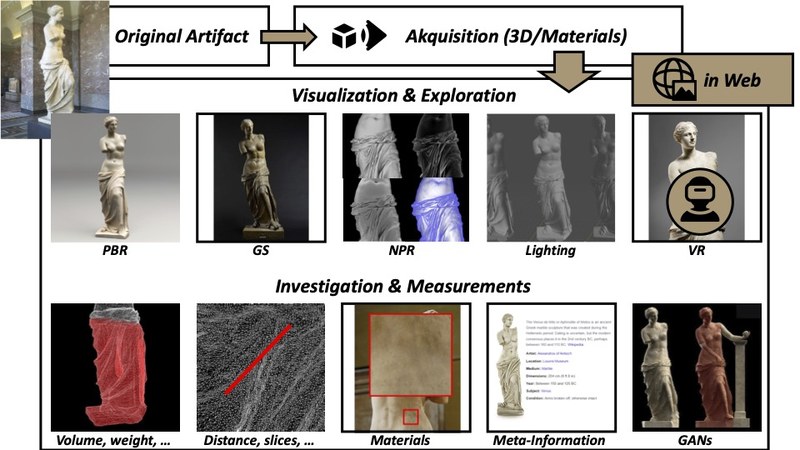
To address challenges related to storage, performance, and interaction with complex 3D models, Digital Originals develops modern file formats and adaptive streaming technologies, guided by open standards such as the International Image Interoperability Framework (IIIF). For visualization and exploration, the project employs advanced rendering techniques, including physically based rendering, non photorealistic rendering, and Gaussian splatting.
Digital Originals opens new possibilities for museums, researchers, and educators to preserve, study, and share cultural heritage. The resulting digital artifacts enable detailed visual analysis, comparison of materials and techniques, identification of condition and damage, and new forms of interactive exploration, measurement, and documentation in virtual environments.
Project details
- Type
- Research project
- Research areas
- Visual Computing
- University
- FHNW School of Computer Science / Institute of Interactive Technologies
- Funding
- Schweizerischer Nationalfonds (SNF)
- Running time
- 01.12.2025 - 30.11.2028
- Management
- Hilko Cords,
Christoph Stamm,
Peter Fornaro, - Collaboration
- Lizeth Fuentes,
Andrei Aioanei,
Vera Chiquet,
Aaron Ebnöther,
Simon Freiermuth,
Aeneas Kaiser,
Cyrus Kazemiraad,
Marian Clemens Manz,
Julian Steinacher,
Raphael Sulzer,
Contact us
Prof. Dr. Hilko Cords
- Phone
- +41 56 202 87 48 (Direct)
- hilko.cords@fhnw.ch

Prof. Dr. Christoph Stamm
- Phone
- +41 56 202 78 32 (Direct)
- christoph.stamm@fhnw.ch
Further Projects
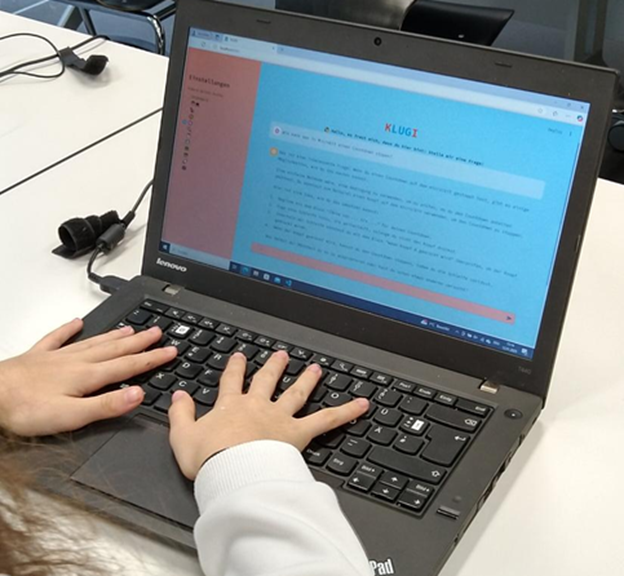
Ah that's how it works! – AI Competencies for the Next Generation
- Institute
- Institute of Interactive Technologies
- Research field
- AI, Machine Learning & Natural Language Processing (NLP)
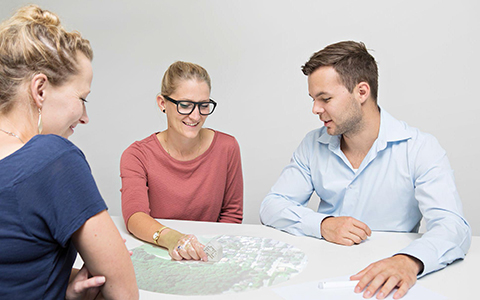
Live Paper
- Institute
- Institute of Interactive Technologies
Bonseyes Marketplace for Artificial Intelligence
- Institute
- Institute of Interactive Technologies