Thanks to machine learning algorithms, defects along the production chain of hybrid photon counting (HPC) detectors can be detected and eliminated early.

Testimonial
Objective
Early detection of chip defects in HPC modules using machine learning-based methods
Background
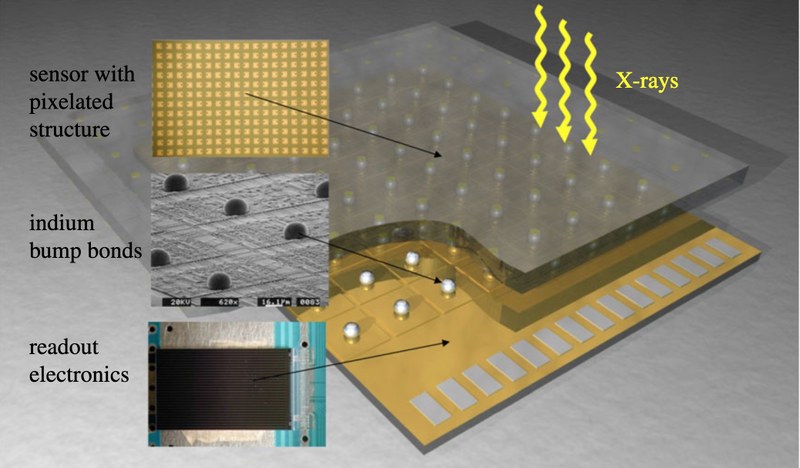
DECTRIS is an innovative, world-leading company that manufactures X-ray detectors based on Hybrid Photon Count (HPC) technology. The company is currently undergoing a transformation from single-unit production to small-batch manufacturing.
Against this background, quality control is a key step in the manufacturing process of HPC modules, especially in an international and increasingly competitive environment.
Early identification and elimination of defects along the production chain is of central importance for economic reasons. During product qualification and validation, increasing amounts of data are collected, offering significant potential for predicting device adjustment parameters.
The use of traditional analytical approaches has so far not achieved the desired results in identifying and eliminating defects.
Findings
The Institute for Data Science FHNW examined existing data for correlations and modeled dependencies within the data using machine learning (ML) algorithms. Deep learning, in particular, is well-suited for predicting the quality of manufactured end products based on pixel or chip properties.
In selected cases, a successful machine learning-based method has been developed that enables early prediction of the relationship between measurement data and quality characteristics of chips across production steps. Predictions of specific calibration parameters were deemed directly relevant to practical application, as they are suitable for improving the combination of sub-components in production and have the potential to increase production yield. Based on the promising results of the feasibility study, an Innosuisse project has now been submitted.
Project details
- Type
- Research project
- Research field
- AI, Machine Learning & Natural Language Processing (NLP), Image Processing & Computer Vision
- Topics
- Data science and engineering, Computer science and data science
- School
- FHNW School of Computer Science / Institute of Data Science
- Partners
- DECTRIS
- Funding
- Innosuisse
Hightech Zentrum Aargau - Duration
- 12 Monate
- Team
- Marco Willi, Michael Graber, Daniel Perruchoud
Contact us
For further information about the FHNW School of Computer Science or to discuss potential collaboration opportunities, please contact us.

Prof. Dr. Michael Graber
- Phone
- +41 56 202 84 08 (Direct)
- michael.graber@fhnw.ch

Further Projects

kennwerte.ch: Web application for estimating construction costs
- Institute
- Institute of Data Science
- Research field
- Information Processing

DrugSafety: Semi-automated reporting of side effects of drugs
- Institute
- Institute of Data Science
- Research field
- Information Processing

SySTEM2020: Connecting Science Learning Outside The Classroom
- Institute
- Institute of Data Science
IRIS Big Data
- Institute
- Institute of Data Science
- Research field
- Image Processing & Computer Vision, Astroinformatics and Space Sciences