Machine Learning turns complex space telescope sensor data into near real-time insights and images for research and industry.
Testimonial
Turning complex data into actionable insights
Whether in space research, industrial production or other data-intensive environments, the challenge is often the same: large amounts of complex sensor data need to be analysed quickly and transformed into useful information.
Solar research provides a particularly demanding example. Solar flares are among the most energetic events in our solar system. Understanding where they occur and how they develop helps researchers investigate the physical processes taking place on the Sun.
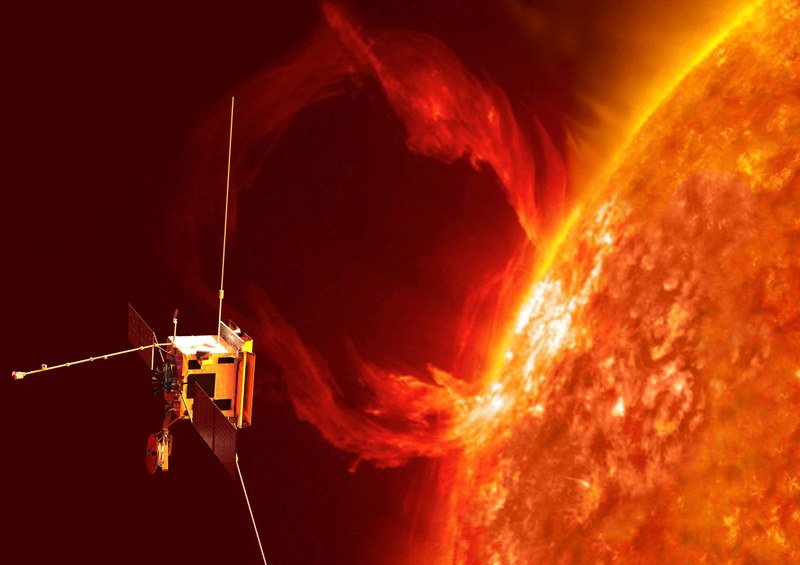
The Spectrometer/Telescope for Imaging X-rays (STIX) aboard ESA’s Solar Orbiter provides valuable measurements of solar flares. However, STIX does not capture conventional images. Instead, images and the positions of solar flares have to be reconstructed from complex measurement data.
Using Machine Learning to accelerate data analysis
This project investigates how Machine Learning and Deep Learning can make this process significantly faster.
The project team enhanced an existing Machine Learning model that estimates the position of a solar flare directly from STIX measurement data. The model was trained and evaluated using observational data and optimised to cover a larger area of the Sun.
The localisation method was then combined with a Deep Learning approach for image reconstruction. Together, the two methods create an automated workflow from complex detector data to flare localisation and a reconstructed image.
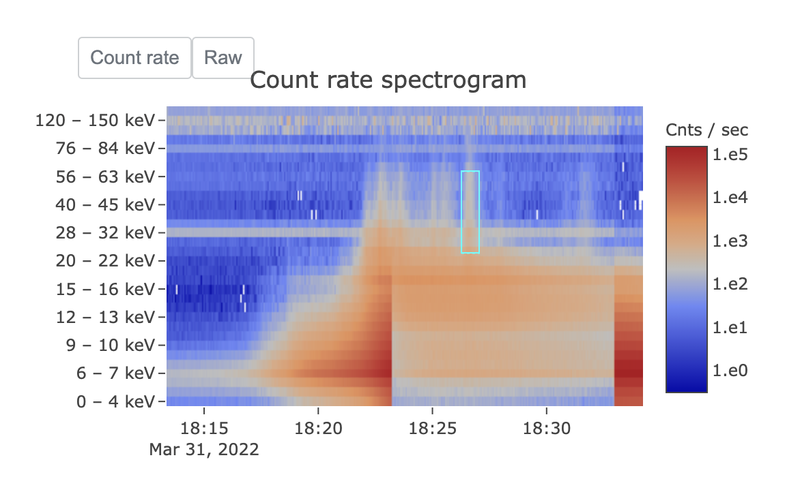
Time-energy selection: Optional fine-tuning: Users select the time and energy range of a flare on the count-rate spectogram. Those counts are the input to the localization model.
©Maik Degen, Erhan Bilgili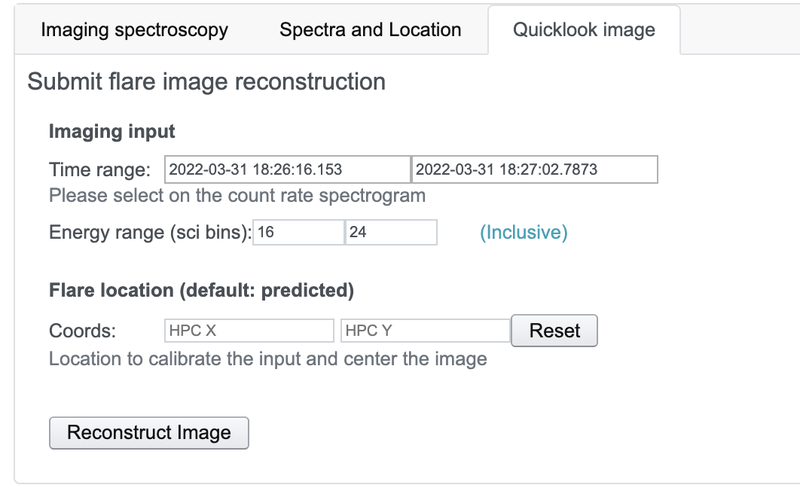
Optional fine-tuning: Adjust time/energy bounds before submit, or optionally provide a known location for calibration.
©Maik Degen, Erhan Bilgili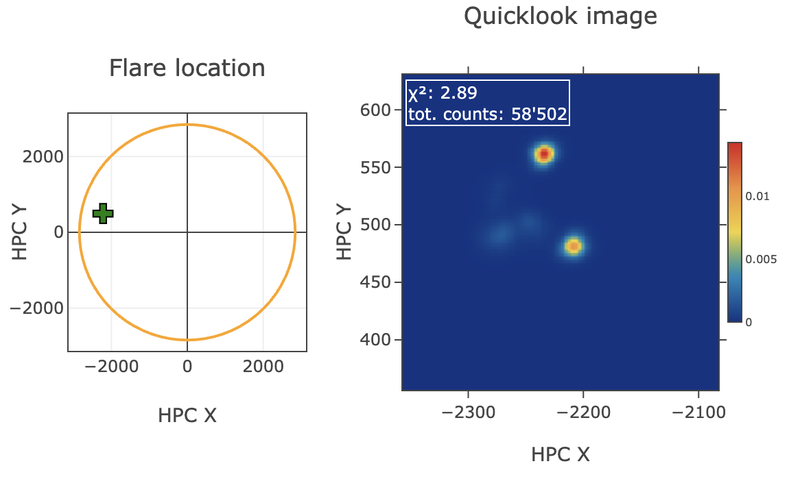
Location + quick-look image: The localization model predicts the flare position (left); FCD reconstructs an image (right) centered on that prediction.
©Maik Degen, Erhan Bilgili
From research prototype to practical application
The developed solution has been integrated into the STIX Data Center, bringing the Machine Learning models directly into the researchers’ workflow.
Researchers can select a time and energy range and receive both an estimated position of the solar flare and a reconstructed quick-look image in near real time.
On independent observational data, the Machine Learning model achieves a mean positional error of around 22 arcseconds. At the same time, it determines the flare position around 60 times faster than traditional methods and covers a larger area of the Sun than the previous solution.
From space research to your data challenge
The methods demonstrated in this project are not limited to astrophysics. Many organisations face similar challenges: large volumes of sensor, measurement or image data need to be processed efficiently, patterns identified automatically and results made available quickly for decision-making or further analysis.
Our expertise in Machine Learning, Deep Learning, image reconstruction, sensor data analysis and AI-driven data processing can be transferred to applications in industry and other fields.
Together with companies and research partners, we develop AI solutions for complex data challenges – from feasibility studies and prototypes to applied research and integration into real-world processes.
Project details
- Type
- Student project
- Research field
- Astroinformatics and Space Sciences, Visual Computing
- Topics
- Computer science and data science
- School
- FHNW School of Computer Science
- Duration
- Springsemester 2026
- Project lead
- Team
Maik Degen
Erhan Bilgili
Advisor
Paolo Massa
Säm Krucker
Key terms
STIX | X-ray telescope on ESA’s Solar Orbiter |
FCD | Deep-learning model that reconstructs flare images |
Multilayer Perceptron (MLP) | The localization model predicting flare (x,y) from detector counts |
Field of view (FOV) | The region of the Sun where the localization model can predict flare positions |
Arcsecond (″) | Angular unit to measure positions on the solar disk (~700 km on the Sun as seen from Earth). |
STIX Data Center | Web portal for browsing and analyzing STIX observations |
Count-rate spectogram | Plot of detector counts versus time and energy |
Euclidean error/distance | Distance between predicted and true flare position, used as the localization accuracy metric |
Contact us

Prof. Dr. Samuel Krucker
- Phone
- +41 56 202 77 04 (Direct)
- samuel.krucker@fhnw.ch
Further projects

Bubblee – Pond of Reflections
- Research field
- Human-Computer Interaction (HCI), Image Processing & Computer Vision
Custom Testing Interface for Circuit Breakers
- Research field
- Human-Computer Interaction (HCI), Requirements and Software Engineering