This AI assistant is designed to support older adults before and after surgery and help detect, prevent and treat cognitive impairments at an early stage.
Testimonial
POCD project is about an AI powered augmented and mixed reality assistant to predict, prevent, and rehabilitate postoperative cognitive dysfunction in older adults. POCD is often a serious complication after surgery, and above all, after cardiac surgeries. By combining risk assessment, patient preparation, and gamified cognitive training, the project aims to improve quality of life and reduce long term healthcare burden.
The project has been a successor from a previously funded SNF project (VISDOM) and predecessor of a CH-Brazil Collaboration funded by SERI through the “Leading House” program, as well as an SNF Scientific Exchanges funding.
Postoperative Cognitive Dysfunction (POCD) is a frequent and serious complication following surgery in older adults, affecting an estimated 15–53% of patients. It manifests as persistent memory and cognitive disturbances, significantly reducing quality of life and increasing the risk of long term cognitive decline, including dementia. Despite its prevalence and impact, POCD is often detected late, limiting opportunities for prevention and effective intervention.
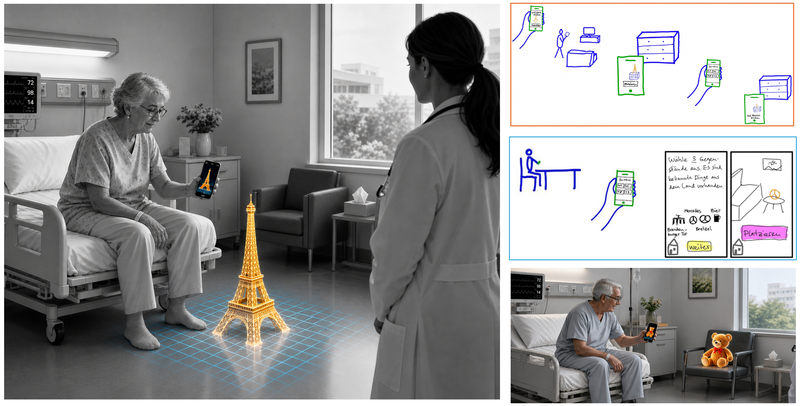
The POCD project, carried out in partnership with Altoida AG, Klinik Hirslanden AG and Brazilian National Institute of Cardiology (INC), addresses this challenge by developing a novel, human-centered, technology driven approach that combines artificial intelligence, mixed reality, and serious games. At the core of the project is an AI powered virtual medical assistant that runs on smartphones and tablets, designed to support patients before and after surgery and passively collects data that can help characterize POCD risk as well as its monitoring, and informs clinicians for prediction, prevention, and rehabilitation of the disease.
For risk prediction, the project builds on Altoida’s award winning Alzheimer’s Disease Predic-tion Service (ADPS), which detects early cognitive impairments, which is one of the strongest risk factors for POCD. By assessing patients before surgery, we can estimate a personalized POCD risk score, enabling early intervention. For prevention, our approach can support patients through a custom designed chatbot that prepares and informs them ahead of surgery, reducing stress and cognitive vulnerability. For rehabilitation, the project introduces personalized, gamified, and socially enhanced mixed reality cognitive training, supporting recovery after surgery through interventions that increase adherence to clinicians’ recommendations and prescriptions.
While cognitive training has been shown to be effective, existing solutions often suffer from poor usability and low long term adherence, especially among older users. POCD project addresses this limitation by applying human centered design, adaptive interaction paradigms, and engaging game mechanics to create an accessible and motivating experience tailored to older adults.
With strong interest from hospitals and clinics, the POCD project has the potential to support millions of people at risk, reduce long term healthcare costs, and improve postoperative outcomes. Against the backdrop of a rapidly ageing global population expected to reach 2 billion people over 60 by 2050, the project represents a scalable, clinically relevant contribution to future oriented healthcare.
Project details
- Type
- Research project
- Research field
- Extended Reality (XR)
- School
- FHNW School of Computer Science / Institute of Interactive Technologies
- Partners
- Altoida AG
Klinik Hirslanden
Instituto Nacional de Cardiologia (INC), Rio de Janeiro - Funding
- Innosuisse
- Duration
- 15.01.2020 - 15.01.2024
- Project lead
- Arzu Cöltekin,
- Team
- Kathrin Koebel,
Mikaela Buzdin,
Rahel Ganarin,
Joelle Keller,
Martin Lacay
Contact us

Prof. Dr. Arzu Çöltekin
- Phone
- +41 56 202 84 73 (Direct)
- arzu.coltekin@fhnw.ch
Further projects
Ah that's how it works! – AI Competencies for the Next Generation
- Institute
- Institute of Interactive Technologies
- Research field
- AI, Machine Learning & Natural Language Processing (NLP)

Live Paper
- Institute
- Institute of Interactive Technologies
Bonseyes Marketplace for Artificial Intelligence
- Institute
- Institute of Interactive Technologies
Serai Care
- Institute
- Institute of Interactive Technologies
- Research field
- Extended Reality (XR)