Beyond Single-Use Diagnostics: Reusable Biosensors with Protected Aptamer Surfaces
Most medical biosensors are designed for a single measurement and must be discarded after use. Reusable aptamer biosensors could reduce costs, minimize waste, and enable entirely new diagnostic applications. Aptamers, synthetic DNA or RNA molecules that specifically recognize biological targets, offer exciting potential for such next-generation sensors. However, their instability in biological fluids remains a major challenge.
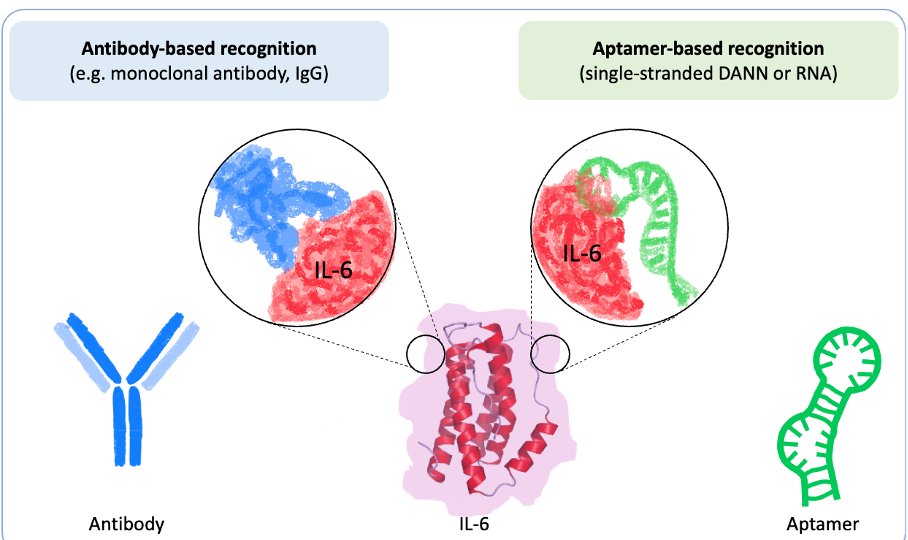
At FHNW nanoLab, we investigate protective surface-engineering strategies that help aptamers withstand harsh biological environments while maintaining their sensing performance. Using the inflammatory biomarker Interleukin-6 (IL-6) as a model target, we evaluate how reusable aptamer-based assays compare with established antibody-based ELISA methods.
Reusable biosensing platforms could offer significant advantages over conventional single-use diagnostic systems. By extending sensor lifetime and maintaining analytical performance in complex biological samples, they may contribute to more sustainable healthcare technologies. Such approaches could support future point-of-care diagnostics, wearable sensing devices, and integrated microfluidic platforms for continuous biomarker monitoring.
Our goal is to advance reusable aptamer biosensors for applications ranging from saliva diagnostics and microfluidic devices to continuous health monitoring.
Interested in aptamer-based biosensors, surface engineering, or diagnostic applications? Get in touch with our team to learn more about our research.
Contact

Head of nanoLab
FHNW – School of Life Sciences
nanoLab
Hofackerstrasse 30
4132 Muttenz
Switzerland

Head of nanoLab
FHNW – School of Life Sciences
nanoLab
Hofackerstrasse 30
4132 Muttenz
Switzerland
Comments
No comment posted about Beyond Single-Use Diagnostics: Reusable Biosensors with Protected Aptamer Surfaces