SwissHolo
Holographic identification of titanium implants. Security 1st and 2nd levels features provide (hidden) unique identifying structures for trademark protection of titanium implants.
An innovative design attribute was developed as Unique Device Identification (UDI) for medical devices. Holographic security features and highly complex Diffractive Optical Elements (DOE, revealing images like QR codes, logos, article or lot numbers when illuminated by a laser) are integrated directly into the titanium implant material to ensure traceability or brand protection to prevent product counterfeiting. This nanostructured surface-labelling is fully tissue-compatible because the embossing process is based on a physical structuring of the implant surface without additives or coating. The underlying holographic nanostructures are resistant to all conventional sterilization methods.
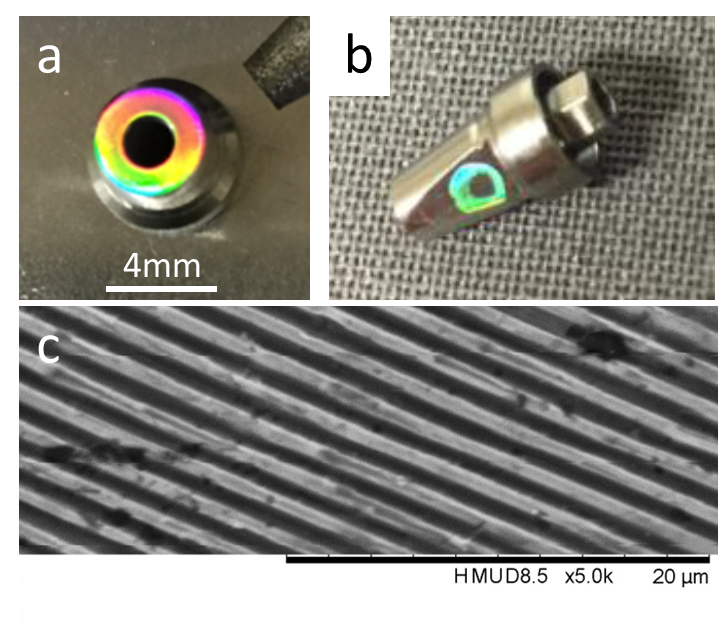
a, b) Clearly visible embossed holograms on Ti abutments. c) Scanning Electron Microscopy image shows the periodicity of the diffractive structure on the tooled titanium surface. From: M. de Wild et al., Holographic identification of titanium implants, European Cells and Materials, Online Periodical, Coll 1; p10 (2019).
Link to the Conference Abstracts.
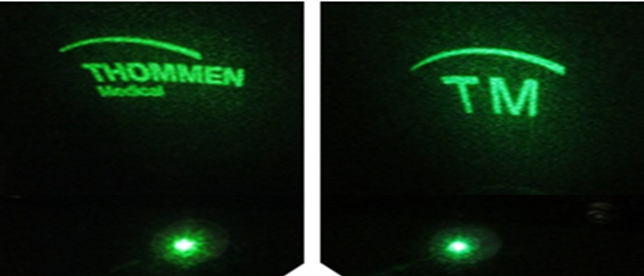
A DOE-diffracted laser produces a visible, precalculated image on a screen.
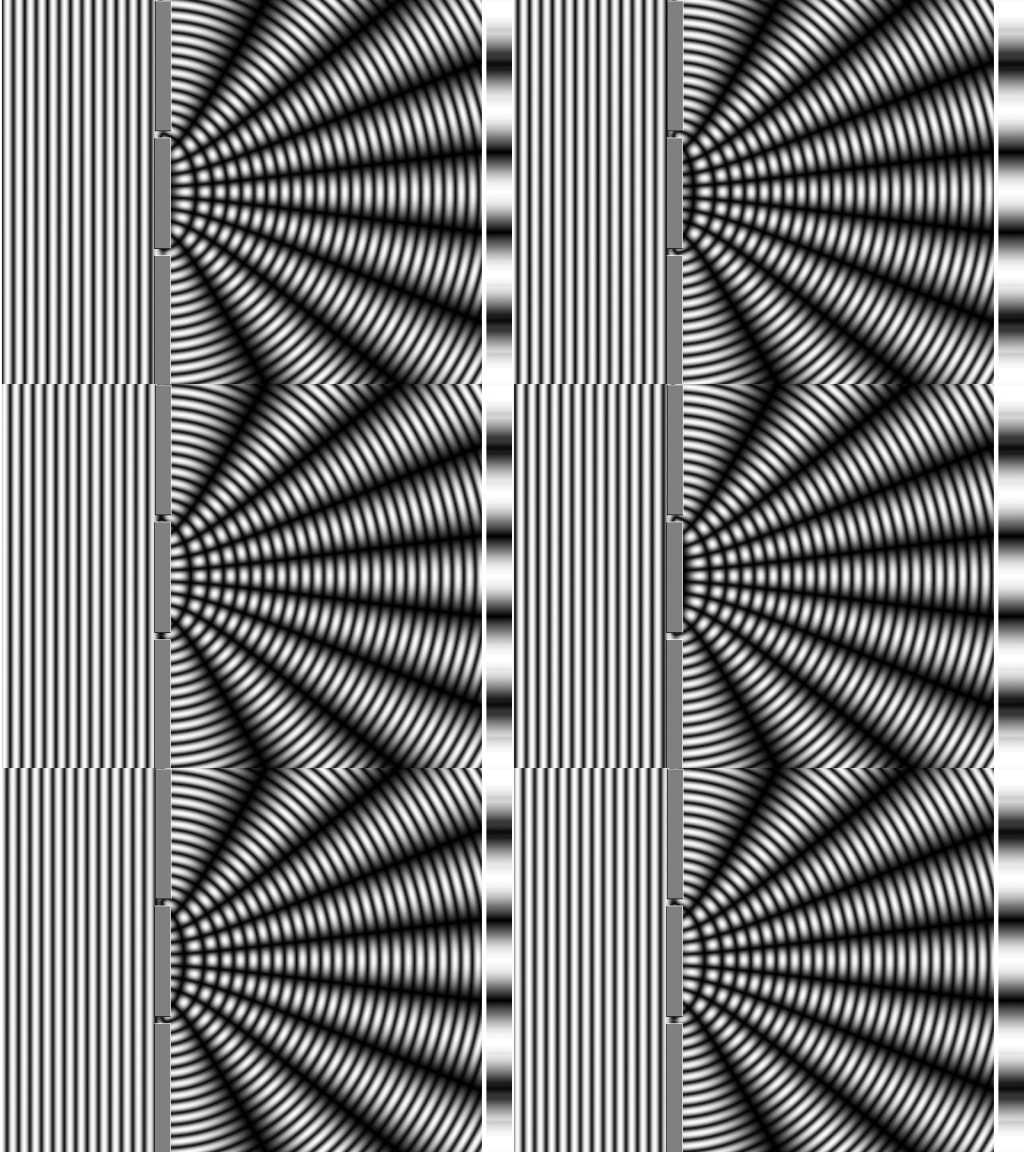
Diffraction and interference at the double slit. From https://www.alanzucconi.com/2017/07/15/understanding-diffraction-grating
Link to https://www.alanzucconi.com/2017/07/15/understanding-diffraction-grating
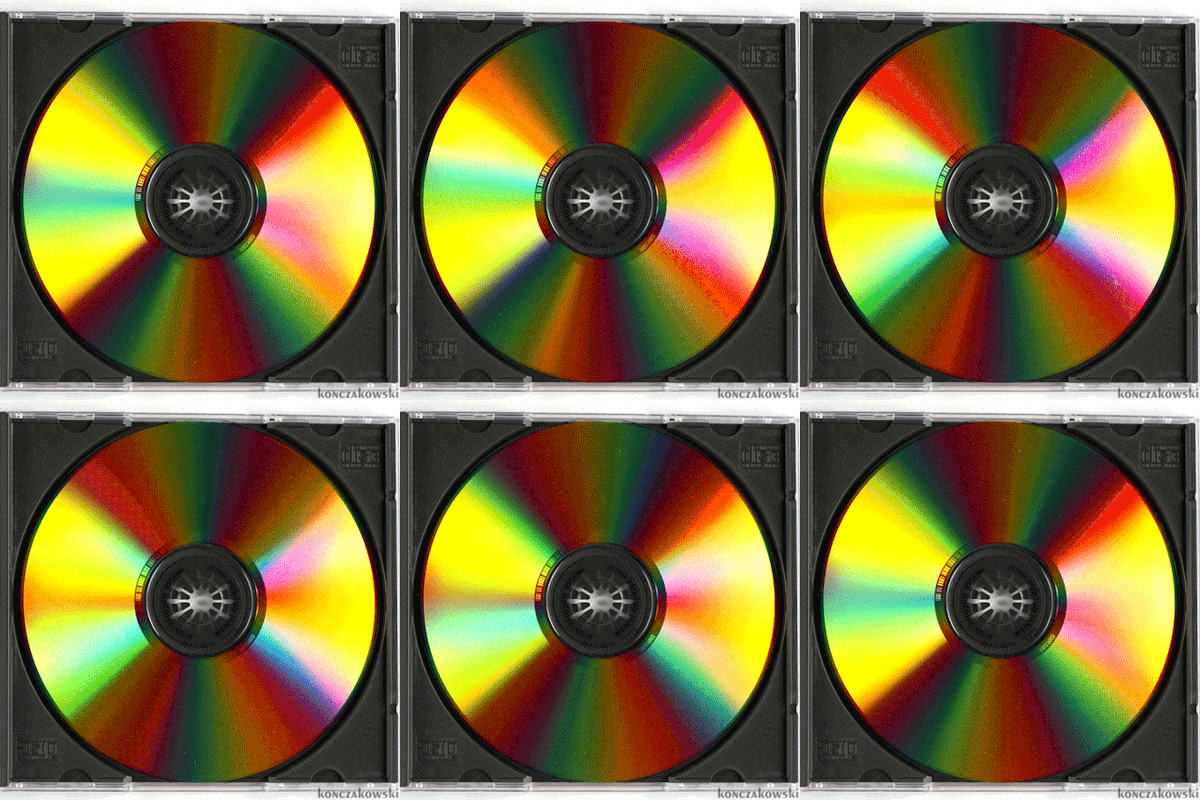
Iridescent effect of a CD. Iridescence, goniochromistic properties: gradual change of colors when looking at a surface from different angles. From: https://konczakowski.tumblr.com/post/134500316667

Link to https://konczakowski.tumblr.com/post/134500316667
- M. de Wild, R. Krähenbühl, D. Kallweit, R. Marek, M. Estermann, M. Schnieper, Holographic identification of titanium implants, European Cells and Materials, Online Periodical, Collection 1; Meet the Expert Conference Abstracts, p10 (2019).
- M. Estermann, J. Waser, Ch. Schneider, A. Luu-Dinh, M. Schnieper, D. Kallweit, R. Krähenbühl, M. de Wild, R. Marek, Medical prostheses, medical osteosynthetic devices or hearing aids with security and/or identification elements, patent application, EP18164627.4 and EP18164630.8, 28.03.2018.