International learning with ChallengeEU: FHNW student at the BIP in Lisbon
Last summer, Zoë von Frankenberg, a student at the FHNW School of Applied Psychology, participated in the Blended Intensive Programme (BIP) «Promotion of Diversity, Inclusion and Wellbeing Policies in Companies through Sports Practice» organised by Universidade Europeia Lisboa. Our ChallengeEU partner university came up with a programme combining diversity, inclusion and sports through an international, interdisciplinary experience. From collaborating with students from other countries to discovering a new university and taking part in activities like surfing, yoga, and factory visits, she gained new perspectives and memorable moments. Our two FHNW student ambassadors Marija Kosovljanovic and Marion Angsthelm wanted to find out what she experienced during her week in Lisbon.
Marija and Marion: Why did you choose to do this week?
Zoë: Several aspects sparked my interest: First of all, I was interested in the title itself. The programme was called Promotion of Diversity, Inclusion and Wellbeing Policies in Companies through Sports Practice. I was particularly fascinated by the combination of sport and the topics of diversity, inclusion and wellbeing. I wanted to find out how these areas could be brought together and how I could contribute my psychological perspective. It was also exciting to get a different perspective on Portugal, as I am there often. It was great to see what it's like at a university in Lisbon.
Was it how you imagined it? What surprised you the most?
It probably wasn't quite what I expected. The students were all a bit younger than those in the Master's programme in applied psychology at home in Switzerland. That was a bit unexpected for me, but it didn't bother me. What surprised me most was the interdisciplinary nature of the project itself. Although it was in the title, I was surprised by the variety of topics – from diversity and inclusion to sport and business aspects – and how difficult it was to reconcile everything.
What did you learn in terms of knowledge, skills or personal development?
I learned so many things. I was particularly impressed by the realisation that I could combine different perspectives from my psychology studies and my previous training in economics. I had difficulties with the area of sport and occupational health management. But at some point, everything made sense and fell into place. I learned a lot about sports management and how to combine it with other disciplines. This challenge spurred me on, and in the end, we were proud of our project.
What did you appreciate the most (people, place, teachers, activities…)?
I really appreciated how well everything was organised. The University did a great job and put together a fantastic programme for us. We had time for comprehensive onboarding, received input from various disciplines and gained exciting insights from external experts such as someone from the Paralympic Committee in Portugal. We even went surfing and had time for personal conversations with employees of our practice partner Palaria Portuguesa, as well as a tour of their factory and logistics centre.
Can you share one or two memorable moments?
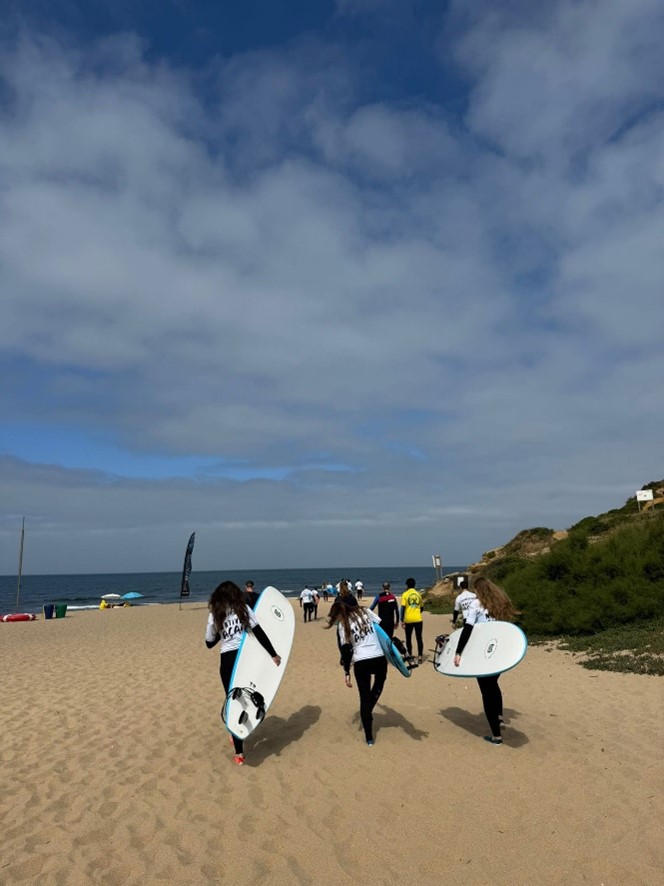
A special moment for me was surfing with an organisation that enables people with disabilities to surf. As an experienced surfer, I was able to support three men with disabilities in catching their first waves. Enabling an experience they could not access on their own filled me with a deep sense of purpose. It touched me profoundly. It showed me the philosophy of empowerment in a new way and inspired me to do something like this again in the future. Another great moment was the Eureka moment shortly before the end of the project, when everything came together and made sense.
Did you meet someone new who inspired you?
Yes, definitely. That was Armanda Antunes, professor and master's director at the European University in Lisbon. I find her very inspiring because I found her to be a very approachable and thoughtful woman, an intelligent woman, a very likeable woman in a leadership role.
Did you notice any cultural differences (school, city, people)?
Well, I find it incredibly difficult to say what the difference is in the culture and what is simply the difference between people per se. But I think I could say that I've experienced Portuguese culture or this organisation as having a greater focus on social aspects.
What skills or knowledge from this week will be useful for your future studies/career?
I think that experiencing and really learning about interdisciplinary thinking on different levels is important for my future; it has certainly shaped me. I think it's also true that the psychological focus can sometimes be a bit limiting. For example, a company simply has to be economically viable. Of course, as occupational and organisational psychologists, we want to design it in such a way that people are as comfortable as possible, and I think that in occupational health management and sports management, we see many great innovative projects that could make people in organisations feel better, but how can we design them in such a way that they are interlinked and make sense, and that they are also economically viable in the end?
I believe that realising, experiencing and truly thinking through these different disciplines will help me to realise projects in the future. I would like to thank everyone who made this experience possible for me and who invests in such projects!
I also learned to accept uncertainty in projects like this, that things may feel a bit unfinished for a while. It means not jumping at the first solution that appears, but holding the ambiguity, circling around the problem, and staying patient until the real common thread emerges
Would you recommend other students to do it? What advice would you give them?
I would definitely recommend it. I think it's a unique experience, a great experience, a valuable experience, and yes, I would recommend to do it because you can really experience a complete change of perspective and take away a lot.
But I think you have to bring something to the table. So what advice would I give? The organisations that set this up put a lot into it, so it takes a lot of work to get something like this off the ground. And I think what you really need to bring with you is to be well prepared: read through the material, do a bit of groundwork beforehand, don't just turn up and have done nothing.
I think you should be open to new experiences and also bring motivation and a willingness to work for your own growth, because you're doing it for yourself and lots of great people are working so that you can grow.