Skip to main contentSkip to search barSkip to navigationSkip to footer
Logo of the University of Applied Sciences and Arts Northwestern Switzerland
Degree Programmes
Continuing Education
Research and Services
International
About FHNW
DeEn
Locations and ContactFHNW LibraryMedia Relations
Logo of the University of Applied Sciences and Arts Northwestern Switzerland
  • Degree Programmes
  • Continuing Education
  • Research and Services
  • International
  • About FHNW
DeEn
Locations and ContactFHNW LibraryMedia Relations

Info-Event
BA + MA
12. Nov. 25

Sc...
Basel Academy o...
Institute Experimental De...
MAKE/SENS...
Roberta...

Roberta Burchardt

Polyphonic visions: colonial modernity in the Luso-Brazilian Sobrado house

Spring Semester 2023

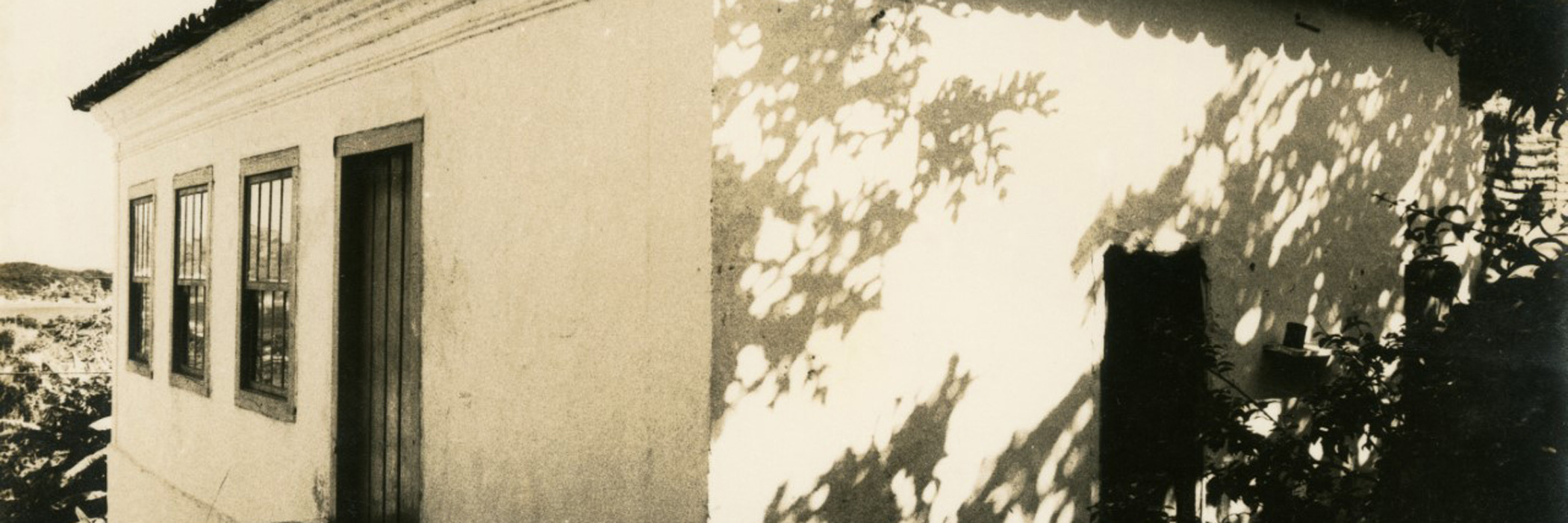
The Luso-Brazilian Sobrado house – built ca 1840, situated in the Nossa Senhora da Conceicao parish, Santa Catarina island – is evidence of Luso-Azorean colonial occupation in southern Brazil. Contextualizing both house and site - listed national heritage - as living archive, as living knowledge systems, the proposal reckons materiality and atmosphere as performative entities to engage with. The intention is to generate polyphonic writings, sourcing sounds, stories and matter; storying the space, resisting reduction and linearity, walking towards polyphonic, pluriversal narratives. Working to presentify an access into materialities and subjectivities through engaging with an intimate heritage site, the spirit of this place and erasures that enforce a praxis tell us of histories not told, heritages not acknowledged, and a systematic perpetuation of disparities. Learning through matter and sound, affective relationships with ancestries and cosmologies, come forth. Acknowledging these logics, the proposal aims to voice how different temporal regimes impose different interdependencies, reflecting social and environmental transformations and injustices, but also resistances. Moving within and beyond the extractive zone (Gómez-Barris), how can we both confront and learn from colonial concurrence? How can we better understand what the passage from pre-colonial, colonial to global temporalities - unlading resources of extraction - have to teach us? Colonial modernity becomes a condition from which to listen to and write on its polyphonic imaginaries, crafting a form of historiography between material and immaterial vestiges. Attempting to open what holds coloniality in place, its deep implications, the proposal sits between integrity and futurity, in the abundance of relations and world-making.

Supervisors

Prof. Dr. Helen V. Pritchard, Prof. Dr. Sabine Pollack, Prof. Dr. Shintaro Miyazaki

Roberta Burchardt

Roberta Burchardt I´m a Brazilian researcher, artist, writer, lecturer, mentor, editor and cultural worker, based in Sweden and Brazil. My language meshes architecture, visual arts and crafts, with a poetic, literary, philosophic, autoethnographic and decolonial grounds. My practice is embedded in the Luso-Brazilian Sobrado house, southern Brazil, confronting and engaging its colonial heritage via notions of atmosphere, materiality, ownership, private and public, vernacular and contemporary, emancipation and meaningfulness. Generating intimate convivialities and an affective practice, I am concurrently active in different positions and environments, during 2021/22 some being: PhD candidate HGK FHNW, CH; tutor Decolonizing Architecture, Royal Institute of Art, SWE; lecturer Research Lab, Konstfack, SWE; curator/coordinator Autumn Open Studios, Spring Open Studiosand co-editor Urgent Pedagogies, IASPIS, The Swedish Arts Grants Committee; speaker Archival Interactions: Performing Intersectional Counter-Archives, Research Center for Material Culture and Maastricht University, NLD; speaker Home in a monument, Estonian Academy of Arts; co-editor and contributor Architectural Dissonances, L´Internationale Online; and speaker Heritage and Decoloniality, UNIGE – Geneva School of Social Sciences with University of Exeter.

Image captions: 1-4. Sobrado house, Luso-Azorean heritage. Lagoa da Conceicao, Florianopolis, island of Santa Catarina, Brazil. 1981. Photo Leopoldo Plentz

About FHNW

MAKE/SENSE
hgk_ixdm_makesense_phd-project

What we offer

  • Degree Programmes
  • Continuing Education
  • Research and Services

About FHNW

  • Schools
  • Organisation
  • Management
  • Facts and Figures

Information

  • Data Protection
  • Accessibility
  • Imprint

Support & Intranet

  • IT Support
  • Login Inside-FHNW

Member of: