
Skip to main contentSkip to search barSkip to navigationSkip to footer
Logo of the University of Applied Sciences and Arts Northwestern Switzerland
  • EN
  • Home

Ten Schools One Goal

The FHNW comprises 10 schools with different specializations. Select a school to see its specific courses, study programmes and information.

Applied Psychology

Architecture, Construction and Geomatics

Art and Design

Music

Computer Science

Life Sciences

School of Education

Social Work

Engineering and Environment

Business

  • Study offerings

    • All degree programmes
    • Bachelor programmes
    • Master programmes
    • Bachelor info events
    • Master info events
  • Study information

    • Why FHNW School of Business
    • Should I study Business?
    • Regulations
    • Student organisations
    • Success stories
  • Study internationally

    • Semester abroad
    • Double Degrees (Bachelor)
    • Dual Degrees (Master)
    • International student projetcs
    • Summer schools and intensive programmes
    • COIL (Collaborative International Learning)
    • Virtual exchange
  • Continuing education offerings

    • All continuing education programmes
    • MBA - Master of Business Administration
    • MAS - Master of Advanced Studies
    • DAS - Diploma of Advanced Studies
    • CAS - Certificate of Advanced Studies
    • Courses and seminars
    • Info events
  • Research

    • Research fields
    • All projects
  • Collaborate with us

    • Student projects
  • International

    • International office
    • China Centre
    • Partner universities
    • Study internationally
    • Study in Switzerland (Incoming Students)
  • Updates and insights

    • News and stories
    • Reports and publications
  • Events

    • All events
    • Information events
  • Media Relations

  • About the School of Business

    • Management
    • How we teach
    • Institutional partnerships
    • Career services
    • People directory
  • Institutes

    • Institute for Finance
    • Institute for Nonprofit- and Public Management
    • Institute for Human Resource Management
    • Institute of Management
    • Institute for Information Systems
    • Institute for Competitiveness and Communication
Logo of the University of Applied Sciences and Arts Northwestern Switzerland
  • About the School
    • Degree Programmes
    • Continuing Education
    • Research and Services
    • News and Events
  • Social Media
    • Facebook
    • Instagram
    • YouTube
    • LinkedIn
    • TikTok
  • About FHNW
    • Organisation
    • Schools
    • Locations
    • FHNW Library
    • Media Relations
  • Support
    • IT Support
    • Inside FHNW
    • Webmail
  • Data Protection
  • Imprint
  • Accessibility
  • Study offerings

    • All degree programmes
    • Bachelor programmes
    • Master programmes
    • Bachelor info events
    • Master info events
  • Study information

    • Why FHNW School of Business
    • Should I study Business?
    • Regulations
    • Student organisations
    • Success stories
  • Study internationally

    • Semester abroad
    • Double Degrees (Bachelor)
    • Dual Degrees (Master)
    • International student projetcs
    • Summer schools and intensive programmes
    • COIL (Collaborative International Learning)
    • Virtual exchange
  • Continuing education offerings

    • All continuing education programmes
    • MBA - Master of Business Administration
    • MAS - Master of Advanced Studies
    • DAS - Diploma of Advanced Studies
    • CAS - Certificate of Advanced Studies
    • Courses and seminars
    • Info events
  • Research

    • Research fields
    • All projects
  • Collaborate with us

    • Student projects
  • International

    • International office
    • China Centre
    • Partner universities
    • Study internationally
    • Study in Switzerland (Incoming Students)
  • Updates and insights

    • News and stories
    • Reports and publications
  • Events

    • All events
    • Information events
  • Media Relations

  • About the School of Business

    • Management
    • How we teach
    • Institutional partnerships
    • Career services
    • People directory
  • Institutes

    • Institute for Finance
    • Institute for Nonprofit- and Public Management
    • Institute for Human Resource Management
    • Institute of Management
    • Institute for Information Systems
    • Institute for Competitiveness and Communication

Type a search term and search continuing education,degree programmes, events, documents and other content.

Tap into New Markets with Agile Internationalisation, FHNW School of Business

19.6.2020 – School of Business


  • Business
  • News and events
  • News and stories
  • All news and stories
All news and stories
Header-V1.jpg

Traditional internationalisation models often do not fit the specific needs of SMEs and start-ups. In addition, external shocks (e.g. the coronavirus crisis) and the dynamics of global markets demand ever faster adjustments when operating in foreign markets. Today, it is no longer the big companies that beat the small ones, but the fast ones that beat the slow ones!

This text was originally published on 11th June 2020 as part of the Switzerland Global Enterprise Newsletter.

SMEs and start-ups first have to build up their global network; usually with limited financial and human resources, meaning it is unnecessary to establish an international sales structure (direct export). In addition, they often have no experience in the subject and its challenges and are confronted with seemingly incalculable risks. This further increases uncertainty, making successful internationalization more difficult. In order to overcome precisely these obstacles, creative and innovative approaches are needed that take into account the individual situation.

The 7 principles of agile development - an introduction

The principles of agile development, which originated in software development, can be applied to internationalization strategies of SMEs and start-ups. We have identified 7 principles, some of which are now explained in the context of the agile internationalization process:
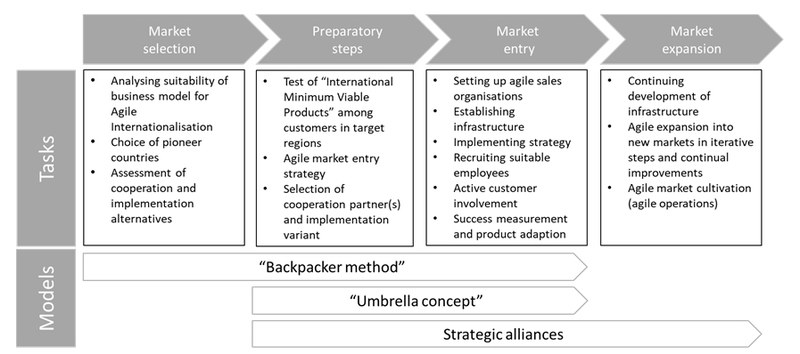
Check your own business model - for example with pop-up stores

First, the agile internationalization business model must be tested for suitability. Any products and models, which can be quickly developed with customers abroad on the basis of a “minimum viable product” and adapted to local conditions, are possible here. For this reason, classic market entry strategies via local distributors (indirect export) are generally not compatible with agile forms of internationalization, as there is no direct contact and exchange with end customers on site. In order to quickly achieve tangible results, pop-up stores in the target countries can be used, for example.

Choosing the market: Where can I find the ideal ecosystem for my product / service?

Even when selecting pioneer markets, agile concepts require a departure from traditional approaches, which usually involve initial internationalization steps in neighboring countries (Germany, Austria, France). An agile approach would be more likely to focus on where “clusters” of other companies and service providers already exist that might assist the development of one's own company in such an ecosystem, and where the “emerging markets” for one's own products are.

New Chances through Agile Internationalisation

The backpacker method

One way to access more distant key markets is the “backpacker method”. Here, SMEs or start-ups are subcontracted by established large companies to “backpack” abroad, where they can familiarize themselves with the market conditions and local partners and develop their own market presence on site.

In order to achieve market development goals quickly, it is necessary to focus on the central elements of value creation in foreign markets. This is usually the sales function, sometimes also production. This requires flexible agreements with local cooperation partners in order to acquire the complementary skills needed to enter the market.

The umbrella concept

The umbrella concept is an agile market entry model in which a local service provider acts as a “virtual subsidiary”. A sales-focused employee is recruited there who concentrates exclusively on business development for the Swiss SME, who is also responsible for technical and sales management, and who therefore has first-hand knowledge of what is happening on site. Once successfully established in the local market, it is possible to convert the company into an independent local branch at a later date.

The advantages of the umbrella concept

This option reduces risk and costs, because it only takes place once the chances of success in the foreign market concerned are clearly calculable. The “withdrawal costs” in the event that the market entry should prove unsuccessful are also significantly lower with the umbrella solution than with conventional market entry strategies. Further advantages include rapid market access based on established local relationship structures. The quality and the network of relationships of the local provider are decisive for success here.

Soft entry with a joint venture

Another variant of the umbrella concept is to establish a joint venture between the local service provider and the Swiss company. The basic idea of this approach, which is particularly suited to start-ups, is that the local company contributes its sales power and the Swiss company the product and marketing materials. The intellectual property (IP) remains with the Swiss company.

Local strategic partnerships as umbrella partners

Established local strategic partners are an alternative to an umbrella partner. Strategic partnerships with companies that already have a corresponding sales structure in the industry are a good option here. This can also be combined with a role as strategic investor. The risks here include a possible loss of independence / IP and insufficient direct access to customers in foreign markets.

Agile internationalization requires employees at all levels with a corresponding mindset (including flexible handling of unstructured situations) and accompanying change management in the company.

Further Information

Website MBA - Master of Business Administration

School of
Business FHNW University of Applied Sciences and Arts Northwestern Switzerland

  • About the School
    • Degree Programmes
    • Continuing Education
    • Research and Services
    • News and Events
  • Social Media
    • Facebook
    • Instagram
    • YouTube
    • LinkedIn
    • TikTok
  • About FHNW
    • Organisation
    • Schools
    • Locations
    • FHNW Library
    • Media Relations
  • Support
    • IT Support
    • Inside FHNW
    • Webmail
Logo FHNW - 20 Years
Logo Swiss Universities
Logo European University Association
Logo AACSB International
© University of Applied Sciences and Arts Northwestern Switzerland (FHNW)
  • Data Protection
  • Imprint
  • Accessibility
  • EN