Skip to main contentSkip to search barSkip to navigationSkip to footer
Logo of the University of Applied Sciences and Arts Northwestern Switzerland
  • EN
  • Home

Ten Schools One Goal

The FHNW comprises 10 schools with different specializations. Select a school to see its specific courses, study programmes and information.

Applied Psychology

Architecture, Construction and Geomatics

Art and Design

Business

Computer Science

Engineering and Environment

Life Sciences

Music

School of Education

Social Work

  • Study offerings

    • All degree programmes
    • Bachelor programmes
    • Master programmes
    • Bachelor info events
    • Master info events
  • Study information

    • Why FHNW School of Business
    • Should I study Business?
    • Regulations
    • Student organisations
    • Success stories
  • Study internationally

    • Semester abroad
    • Double Degrees (Bachelor)
    • Dual Degrees (Master)
    • International student projetcs
    • Summer schools and intensive programmes
    • COIL (Collaborative International Learning)
    • Virtual exchange
  • Continuing education offerings

    • All continuing education programmes
    • MBA - Master of Business Administration
    • MAS - Master of Advanced Studies
    • DAS - Diploma of Advanced Studies
    • CAS - Certificate of Advanced Studies
    • Courses and seminars
    • Info events
  • Research

    • Research fields
    • All projects
  • Collaborate with us

    • Student projects
  • International

    • International office
    • China Centre
    • Partner universities
    • Study internationally
    • Study in Switzerland (Incoming Students)
  • Updates and insights

    • News and stories
    • Reports and publications
  • Events

    • All events
    • Information events
    • Symposia and conferences
  • Media Relations

  • About the School of Business

    • Management
    • How we teach
    • Institutional partnerships
    • Career services
    • People directory
  • Institutes

    • Institute for Finance
    • Institute for Nonprofit- and Public Management
    • Institute for Human Resource Management
    • Institute of Management
    • Institute for Information Systems
    • Institute for Competitiveness and Communication
Logo of the University of Applied Sciences and Arts Northwestern Switzerland
  • About the School
    • Degree Programmes
    • Continuing Education
    • Research and Services
    • News and Events
  • Social Media
    • Facebook
    • Instagram
    • YouTube
    • LinkedIn
    • TikTok
  • About FHNW
    • Organisation
    • Schools
    • Locations
    • FHNW Library
    • Media Relations
  • Support
    • IT Support
    • Inside FHNW
    • Webmail
  • Data Protection
  • Imprint
  • Accessibility
  • Study offerings

    • All degree programmes
    • Bachelor programmes
    • Master programmes
    • Bachelor info events
    • Master info events
  • Study information

    • Why FHNW School of Business
    • Should I study Business?
    • Regulations
    • Student organisations
    • Success stories
  • Study internationally

    • Semester abroad
    • Double Degrees (Bachelor)
    • Dual Degrees (Master)
    • International student projetcs
    • Summer schools and intensive programmes
    • COIL (Collaborative International Learning)
    • Virtual exchange
  • Continuing education offerings

    • All continuing education programmes
    • MBA - Master of Business Administration
    • MAS - Master of Advanced Studies
    • DAS - Diploma of Advanced Studies
    • CAS - Certificate of Advanced Studies
    • Courses and seminars
    • Info events
  • Research

    • Research fields
    • All projects
  • Collaborate with us

    • Student projects
  • International

    • International office
    • China Centre
    • Partner universities
    • Study internationally
    • Study in Switzerland (Incoming Students)
  • Updates and insights

    • News and stories
    • Reports and publications
  • Events

    • All events
    • Information events
    • Symposia and conferences
  • Media Relations

  • About the School of Business

    • Management
    • How we teach
    • Institutional partnerships
    • Career services
    • People directory
  • Institutes

    • Institute for Finance
    • Institute for Nonprofit- and Public Management
    • Institute for Human Resource Management
    • Institute of Management
    • Institute for Information Systems
    • Institute for Competitiveness and Communication

Type a search term and search continuing education,degree programmes, events, documents and other content.

  • Business
  • Research and services
  • Collaboration
  • Student projects
Student projects

The true cost of email invoicing and a comparison with alternative invoicing methods, FHNW School of Business

School of Business


It is often thought that email invoicing is free of charge. However, the reality is different.
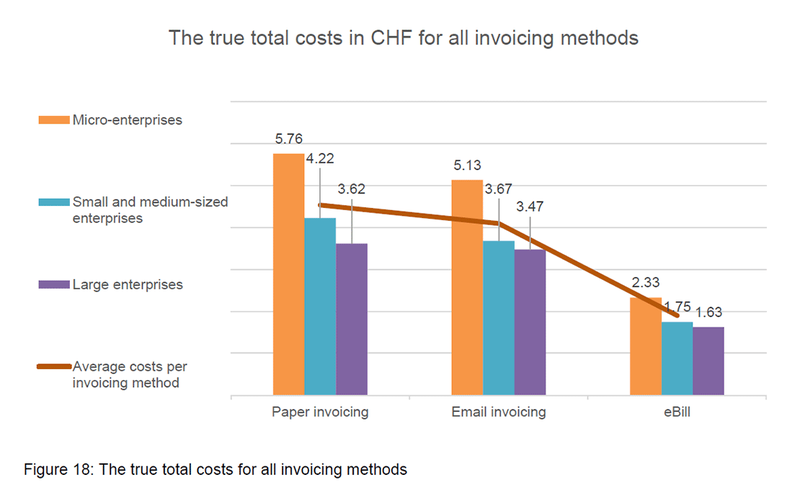
The true total costs in CHF for all invoicing methods

Starting point

Nowadays, many billing companies are changing from paper invoicing to email invoicing. The main argument for doing so is that email invoices are free of charge. Although sending email invoices seems not to generate direct costs for the biller, it has not yet been evaluated, whether there are indirect costs related to factors such as imprecise manual data entry in digital banking. Our research has the aim to identify the true costs of an email invoice and to compare these with the costs for paper invoicing and eBill.

Procedure

The authors conducted desk research and primary research. For the desk research, literature on invoicing methods and reports from reliable sources provided in-depth knowledge about the topic. Additionally, this learning enabled the authors to compare scientific information with the outcomes of the primary research.
The primary research consisted of a survey and interviews conducted by the authors. The outcome is used to conduct the quantitative and qualitative analysis and to insert it into the calculation model.

Results

The study confirms that email invoicing is not free of charge. Furthermore, eBill is the most efficient and effective invoicing method. Companies should offer paper invoicing and eBill as invoicing methods, rather than combining paper invoicing with email invoicing, due to the cost-savings and the customers preferences.

Authors: Thierry Klinkert, Taulant Gashnjani

  • The true cost of email invoicing and a comparison with alternative invoicing methods (PDF)

Social Media School of Business FHNW

School of
Business FHNW University of Applied Sciences and Arts Northwestern Switzerland

  • About the School
    • Degree Programmes
    • Continuing Education
    • Research and Services
    • News and Events
  • Social Media
    • Facebook
    • Instagram
    • YouTube
    • LinkedIn
    • TikTok
  • About FHNW
    • Organisation
    • Schools
    • Locations
    • FHNW Library
    • Media Relations
  • Support
    • IT Support
    • Inside FHNW
    • Webmail
Logo FHNW - 20 Years
Logo Swiss Universities
Logo European University Association
Logo AACSB International
© University of Applied Sciences and Arts Northwestern Switzerland (FHNW)
  • Data Protection
  • Imprint
  • Accessibility
  • EN