Skip to main contentSkip to search barSkip to navigationSkip to footer
Logo of the University of Applied Sciences and Arts Northwestern Switzerland
  • EN
  • Home
  • Degree programmes
  • Continuing education

Ten Schools One Goal

The FHNW comprises 10 schools with different specializations. Select a school to see its specific courses, study programmes and information.

Applied Psychology

Architecture, Construction and Geomatics

Art and Design

Business

Computer Science

Engineering and Environment

Life Sciences

Music

School of Education

Social Work

  • Research

    • Research fields
    • Projects
  • Updates and insights

    • News and stories
  • Events

  • Media corner

  • About the School of Engineering and Environment

    • People directory
    • Management Board
  • Institutes

    • Institute of Automation
    • Institute of Bioenergy and Resource Efficiency
    • Institute of Business Engineering
    • Institute of Electric Power Systems
    • Institute of Humanities and Social Sciences
    • Institute of Polymer Engineering
    • Institute of Mathematics and Natural Sciences
    • Institute of Polymer Nanotechnology
    • Institute of Optometry
    • Institute of Product and Production Engineering
    • Institute for Sensors and Electronics
    • Institute of Thermal and Fluid Engineering
    • Laboratories of the School of Engineering and Environment
Logo of the University of Applied Sciences and Arts Northwestern Switzerland
  • About the School
    • FHNW School of Engineering and Environment
    • Degree Programmes
    • Continuing Education
    • Collaboration in Research and Services
  • Social Media
    • LinkedIn
    • Instagram
    • Facebook
    • TikTok
    • YouTube
  • About FHNW
    • Organisation
    • Schools
    • Locations
    • FHNW Library
    • Media Relations
  • Support
    • IT Support
    • Inside FHNW
    • Webmail
  • Data Protection
  • Imprint
  • Accessibility
  • Research

    • Research fields
    • Projects
  • Updates and insights

    • News and stories
  • Events

  • Media corner

  • About the School of Engineering and Environment

    • People directory
    • Management Board
  • Institutes

    • Institute of Automation
    • Institute of Bioenergy and Resource Efficiency
    • Institute of Business Engineering
    • Institute of Electric Power Systems
    • Institute of Humanities and Social Sciences
    • Institute of Polymer Engineering
    • Institute of Mathematics and Natural Sciences
    • Institute of Polymer Nanotechnology
    • Institute of Optometry
    • Institute of Product and Production Engineering
    • Institute for Sensors and Electronics
    • Institute of Thermal and Fluid Engineering
    • Laboratories of the School of Engineering and Environment

Type a search term and search continuing education,degree programmes, events, documents and other content.

  • Engineering and Environment
  • About us
  • Institutes
  • Research Projects
Research Projects

Convergence of building automation and the IT world, FHNW School of Engineering and Environment

School of Engineering and Environment


Building automation in the era of the Internet of Things (IoT).

Project details

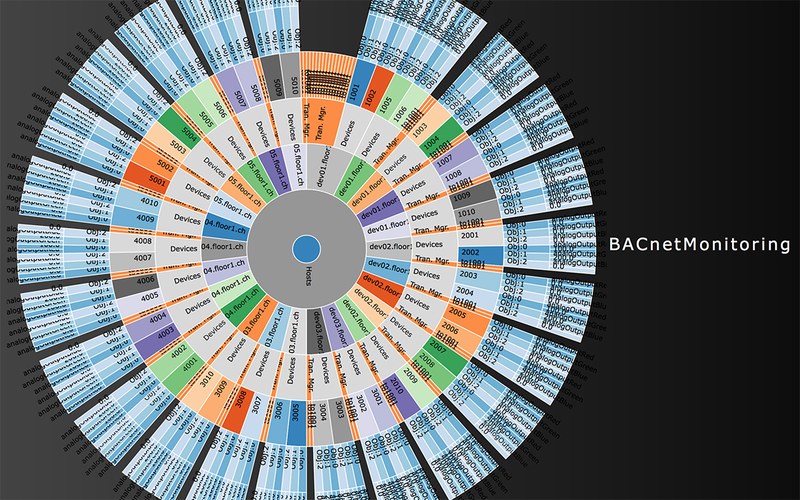
BACNet
Issues

BACnet, IoT, Java, Websockets, X.509 certificates

Objective

Pilot implementation and validation of the current emerging communication standard BACnet/IT

Starting situation

Digitalisation in controlling and monitoring heating, air conditioning and lighting in large commercial buildings is already advanced. In order for digital devices from various manufacturers to be able to communicate with each other, there are standardised bus systems with their own transmission protocols, often based on their own cables. One of them is BACnet.

One version of this, BACnet/IP, uses mass-produced standard components from Internet technology instead of its own expensive network components. In order to further reduce costs and simultaneously open up new possibilities, not only shall the same cable technology be used in the future, but also the same cable infrastructure that are used by a building's occupants for Internet access. An essential requirement for this is that the transmission protocols for future building automation must use established Internet standards in order to ensure there is no conflict with the occupants' IT network management.

Result

Together with a team of experts from Siemens Building Technologies, a group of researchers from the Institute of Mobile and Distributed Systems helped develop the BACnet/IT standard, which offers building automation devices BAC-net-compatible communication based on Internet communication protocols. While the International Standards Committee of ASHRAE was working on a definition of how BACnet devices should communicate via the Internet in the future, the project team put these definitions to the test with their own methods of implementation and measured the results with their own specially developed test tools. It was thus possible to incorporate the knowledge gained into the standardisation work.

Initially, for example, there was no intention of using a pool of websockets as transmission channels. With websockets it is possible to establish bidirectional connections through firewalls and create communication with low latency periods. The latter is important because, unlike with many IoT applications, different building automation devices must be able to communicate directly with each other, quickly and without delay. Compliance with IT network management regulations is important because, in future, building automation and office automation will use the same network infrastructure.

If devices are fundamentally accessible over the worldwide web, security must be taken explicitly into consideration. The devices must only carry out commands made by easily authenticated, trusted partners. In cooperation with researchers from the Lucerne University of Applied Sciences and Arts, a security concept was thus developed that enables end-to-end security based on X.509 certificates.

The implementation of a communication stack for the new BACnet/IT standard was programmed in Java by the Institute of Mobile and Distributed Systems and is available as an open-source project, so that it can be accessed by the industry for developing their own devices which comply with the standard (github.com/fhnw-BACnet-IT).

Project information

Client

Siemens Building Technologies, ASHRAE SSPC 135

Execution

FHNW Institute of Mobile and Distributed Systems, FHNW Institute of Automation

Partner

Hochschule Luzern - Technik & Architektur 

Funding

Kommission für Technologie und Innovation

Team

Prof. Dr. Wolfgang Weck, Prof. Dr. Jürg Luthiger, Thomas Dobler, Artem Khatchatourov

School of
Engineering and Environment FHNW University of Applied Sciences and Arts Northwestern Switzerland

  • About the School
    • FHNW School of Engineering and Environment
    • Degree Programmes
    • Continuing Education
    • Collaboration in Research and Services
  • Social Media
    • LinkedIn
    • Instagram
    • Facebook
    • TikTok
    • YouTube
  • About FHNW
    • Organisation
    • Schools
    • Locations
    • FHNW Library
    • Media Relations
  • Support
    • IT Support
    • Inside FHNW
    • Webmail
Logo FHNW - 20 Years
Logo Swiss Universities
Logo European University Association
© University of Applied Sciences and Arts Northwestern Switzerland (FHNW)
  • Data Protection
  • Imprint
  • Accessibility
  • EN