Skip to main contentSkip to search barSkip to navigationSkip to footer
Logo of the University of Applied Sciences and Arts Northwestern Switzerland
  • DE
  • EN
  • FR
  • Home
  • Degree programmes
  • Continuing education

Ten Schools One Goal

The FHNW comprises 10 schools with different specializations. Select a school to see its specific courses, study programmes and information.

Applied Psychology

Architecture, Construction and Geomatics

Art and Design

Music

Computer Science

Life Sciences

School of Education

Social Work

Engineering and Environment

Business

  • Research

    • Research fields
    • Projects
  • Updates and insights

    • News and stories
  • Events

  • Media corner

  • About the School of Engineering and Environment

    • People directory
    • Management Board
  • Institutes

    • Institute of Automation
    • Institute of Bioenergy and Resource Efficiency
    • Institute of Business Engineering
    • Institute of Electric Power Systems
    • Institute of Humanities and Social Sciences
    • Institute of Polymer Engineering
    • Institute of Mathematics and Natural Sciences
    • Institute of Polymer Nanotechnology
    • Institute of Optometry
    • Institute of Product and Production Engineering
    • Institute for Sensors and Electronics
    • Institute of Thermal and Fluid Engineering
    • Laboratories of the School of Engineering and Environment
Logo of the University of Applied Sciences and Arts Northwestern Switzerland
  • About the School
    • FHNW School of Engineering and Environment
    • Degree Programmes
    • Continuing Education
    • Collaboration in Research and Services
  • Social Media
    • LinkedIn
    • Instagram
    • Facebook
    • TikTok
    • YouTube
  • About FHNW
    • Organisation
    • Schools
    • Locations
    • FHNW Library
    • Media Relations
  • Support
    • IT Support
    • Inside FHNW
    • Webmail
  • Data Protection
  • Imprint
  • Accessibility
  • Research

    • Research fields
    • Projects
  • Updates and insights

    • News and stories
  • Events

  • Media corner

  • About the School of Engineering and Environment

    • People directory
    • Management Board
  • Institutes

    • Institute of Automation
    • Institute of Bioenergy and Resource Efficiency
    • Institute of Business Engineering
    • Institute of Electric Power Systems
    • Institute of Humanities and Social Sciences
    • Institute of Polymer Engineering
    • Institute of Mathematics and Natural Sciences
    • Institute of Polymer Nanotechnology
    • Institute of Optometry
    • Institute of Product and Production Engineering
    • Institute for Sensors and Electronics
    • Institute of Thermal and Fluid Engineering
    • Laboratories of the School of Engineering and Environment

Type a search term and search continuing education,degree programmes, events, documents and other content.

  • Engineering and Environment
  • Degree programmes
  • about-degree-programmes
  • students-projects
students-projects

Peripheral Epithelial Corneal Hyperfluorescence (PECH) in association with soft contact lens (CL) wear, FHNW School of Engineering and Environment

School of Engineering and Environment


This bachelor's thesis studies the changes in the corneal epithelium that are responsible for hyperfluorescence.
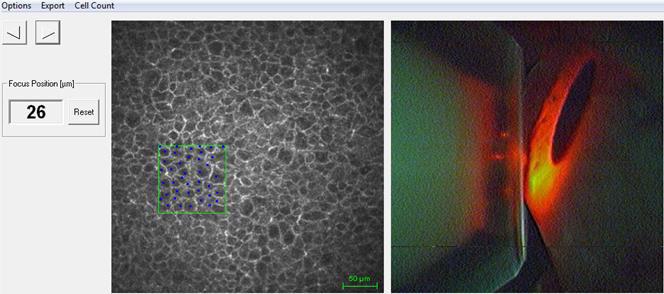
Count of the wing cell density with HEYEX-Software (Heidelberg Engineering).

Limbal epithelial hypertrophy is described as a change in the peripheral corneal epithelial layer caused by hypoxia (a result of prolonged wearing of hydrogel contact lenses) and / or mechanical stress. Due to its characteristic peripheral location on the cornea, this phenomenon was named ‘PECH’ (Peripheral Epithelial Corneal Hyperfluorescence) for the purposes of this study.

By means of a retrospective case report study, a treatment group who wore contact lenses (CLs) on a daily basis and who also showed the characteristic symptoms of PECH (PECH yes), was statistically compared to a CL control group who had no signs of PECH (PECH no). These two groups were examined using confocal microscopy with the HRT Rostock Cornea Module (Heidelberg Engineering) at the level of the epithelial wing cell layer. Additionally, significant risk factors from a previous project (P5) were analyzed specifically regarding the potential key influence for PECH. In addition, an existing selection bias was assessed by comparing the population of the P5 project with the entire contact client base of Optik Nosch in Kirchzarten, Germany.

Statistically speaking, the wing cell layer density was significantly lower in the peripheral corneal areas with PECH. The obtained results suggest that PECH is likely to be induced by hypoxia.

Project information

  • Team: Yasna Glauser, Stephan Jäggi (Bachlor students in optometry)
  • Advisor: Prof. Dr. Daniela S. Nosch

School of
Engineering and Environment FHNW University of Applied Sciences and Arts Northwestern Switzerland

  • About the School
    • FHNW School of Engineering and Environment
    • Degree Programmes
    • Continuing Education
    • Collaboration in Research and Services
  • Social Media
    • LinkedIn
    • Instagram
    • Facebook
    • TikTok
    • YouTube
  • About FHNW
    • Organisation
    • Schools
    • Locations
    • FHNW Library
    • Media Relations
  • Support
    • IT Support
    • Inside FHNW
    • Webmail
Logo FHNW - 20 Years
Logo Swiss Universities
Logo European University Association
© University of Applied Sciences and Arts Northwestern Switzerland (FHNW)
  • Data Protection
  • Imprint
  • Accessibility
  • DE
  • EN
  • FR