Skip to main contentSkip to search barSkip to navigationSkip to footer
Logo of the University of Applied Sciences and Arts Northwestern Switzerland
  • DE
  • EN
  • Home
  • Degree programmes
  • Continuing education

Ten Schools One Goal

The FHNW comprises 10 schools with different specializations. Select a school to see its specific courses, study programmes and information.

Applied Psychology

Architecture, Construction and Geomatics

Art and Design

Music

Computer Science

Life Sciences

School of Education

Social Work

Engineering and Environment

Business

  • Research

    • Research fields
    • Projects
  • Updates and insights

    • News and stories
  • Events

  • Media corner

  • About the School of Engineering and Environment

    • People directory
    • Management Board
  • Institutes

    • Institute of Automation
    • Institute of Bioenergy and Resource Efficiency
    • Institute of Business Engineering
    • Institute of Electric Power Systems
    • Institute of Humanities and Social Sciences
    • Institute of Polymer Engineering
    • Institute of Mathematics and Natural Sciences
    • Institute of Polymer Nanotechnology
    • Institute of Optometry
    • Institute of Product and Production Engineering
    • Institute for Sensors and Electronics
    • Institute of Thermal and Fluid Engineering
    • Laboratories of the School of Engineering and Environment
Logo of the University of Applied Sciences and Arts Northwestern Switzerland
  • About the School
    • FHNW School of Engineering and Environment
    • Degree Programmes
    • Continuing Education
    • Collaboration in Research and Services
  • Social Media
    • LinkedIn
    • Instagram
    • Facebook
    • TikTok
    • YouTube
  • About FHNW
    • Organisation
    • Schools
    • Locations
    • FHNW Library
    • Media Relations
  • Support
    • IT Support
    • Inside FHNW
    • Webmail
  • Data Protection
  • Imprint
  • Accessibility
  • Research

    • Research fields
    • Projects
  • Updates and insights

    • News and stories
  • Events

  • Media corner

  • About the School of Engineering and Environment

    • People directory
    • Management Board
  • Institutes

    • Institute of Automation
    • Institute of Bioenergy and Resource Efficiency
    • Institute of Business Engineering
    • Institute of Electric Power Systems
    • Institute of Humanities and Social Sciences
    • Institute of Polymer Engineering
    • Institute of Mathematics and Natural Sciences
    • Institute of Polymer Nanotechnology
    • Institute of Optometry
    • Institute of Product and Production Engineering
    • Institute for Sensors and Electronics
    • Institute of Thermal and Fluid Engineering
    • Laboratories of the School of Engineering and Environment

Type a search term and search continuing education,degree programmes, events, documents and other content.

  • Engineering and Environment
  • News and events
  • News and stories
  • All news and stories
All news and stories

Improving surfaces with electrons, FHNW School of Engineering and Environment

School of Engineering and Environment


The composition of a cable material is predetermined by the intended application. However, there are still many possibilities for improvements on the cable surface. Tailor-made proper-ties can be set with "e-grafting" and "skin-crosslinking".
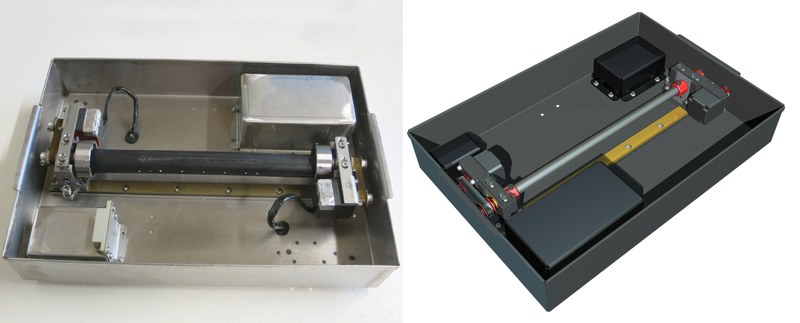
The sample holder was specially designed for the irradiation of cable samples (Photo: FHNW)

By irradiating with low-energy electrons, functional molecules can be anchored on polymer surfaces ("e-grafting") or tailored properties can be set by targeted crosslinking of the surface ("skin-crosslinking"). In a project funded by Innosuisse with our partners HUBER + SUHNER AG and COMET eBeam Technologies, these processes were developed for various applications and the modified cable surfaces were thoroughly tested.

A specimen holder is a tough nut to crack for our engineers

COMET's EBLab 200 offered ideal conditions for experiments with low-energy electrons on a laboratory scale. While the irradiation of flat samples is possible as standard, a special sample holder had to be designed for the irradiation of real cable samples. In particular, a device for clamping and rotating the cables had to be implemented in the smallest possible space, which is operated autonomously, without wiring to the outside. The radiation resistance of the materials used as well as the remote control through the lead jacket of the EBLab were further challenges that our project engineers mastered.

The versatility of modified surfaces

As the project progressed, it became apparent that the "e-grafting" strategy was not effective in achieving the desired property improvements. By means of "skin-crosslinking", however, solutions could be found for various problems:

  • When unwinding heavy cables, damage to the surface repeatedly occurs without pre-treatment when bonded areas are torn open. The stickiness of cable materials could be extremely reduced by cross-linking the outermost layer of the cable by means of electron irradiation.
  • The abrasion resistance of thin cables is critical for various applications and is determined in a rigorous testing procedure. Here, too, irradiation led to a significant improvement.
  • To achieve sufficient adhesion of seals to the finished cables, complex pre-treatments were needed in the past. Electron irradiation resulted in a significant improvement in adhesion between the seal and the cable. A single step in the pre-treatment was sufficient and critical chemicals were not even used.

The "little brother" of high-energy irradiation systems

At HUBER + SUHNER, cables are routinely cross-linked with high-energy electrons during production. The facilities for radiation protection (bunkers) as well as the know-how in handling electron beam sources are already in place. It is therefore currently being examined whether, based on the promising project results, the existing irradiation facilities will soon receive reinforcement from low-energy electron beam sources. This step would open the way to better surfaces.

We would like to express our sincere thanks to HUBER + SUHNER AG and COMET eBeam Technologies for their excellent cooperation and trust. The FHNW team included Elias Rehmann, Sebastian Wollmann, Michael Grob, Karolina Sroka, Per Magnus Kristiansen and Sonja Neuhaus.

School of
Engineering and Environment FHNW University of Applied Sciences and Arts Northwestern Switzerland

  • About the School
    • FHNW School of Engineering and Environment
    • Degree Programmes
    • Continuing Education
    • Collaboration in Research and Services
  • Social Media
    • LinkedIn
    • Instagram
    • Facebook
    • TikTok
    • YouTube
  • About FHNW
    • Organisation
    • Schools
    • Locations
    • FHNW Library
    • Media Relations
  • Support
    • IT Support
    • Inside FHNW
    • Webmail
Logo FHNW - 20 Years
Logo Swiss Universities
Logo European University Association
© University of Applied Sciences and Arts Northwestern Switzerland (FHNW)
  • Data Protection
  • Imprint
  • Accessibility
  • DE
  • EN