Skip to main contentSkip to search barSkip to navigationSkip to footer
Logo of the University of Applied Sciences and Arts Northwestern Switzerland
  • DE
  • EN
  • Home
  • Degree programmes
  • Continuing education

Ten Schools One Goal

The FHNW comprises 10 schools with different specializations. Select a school to see its specific courses, study programmes and information.

Applied Psychology

Architecture, Construction and Geomatics

Art and Design

Business

Computer Science

Engineering and Environment

Life Sciences

Music

School of Education

Social Work

  • Research

    • Research fields
    • Projects
  • Updates and insights

    • News and stories
  • Events

  • Media corner

  • About the School of Engineering and Environment

    • People directory
    • Management Board
  • Institutes

    • Institute of Automation
    • Institute of Bioenergy and Resource Efficiency
    • Institute of Business Engineering
    • Institute of Electric Power Systems
    • Institute of Humanities and Social Sciences
    • Institute of Polymer Engineering
    • Institute of Mathematics and Natural Sciences
    • Institute of Polymer Nanotechnology
    • Institute of Optometry
    • Institute of Product and Production Engineering
    • Institute for Sensors and Electronics
    • Institute of Thermal and Fluid Engineering
    • Laboratories of the School of Engineering and Environment
Logo of the University of Applied Sciences and Arts Northwestern Switzerland
  • About the School
    • FHNW School of Engineering and Environment
    • Degree Programmes
    • Continuing Education
    • Collaboration in Research and Services
  • Social Media
    • LinkedIn
    • Instagram
    • Facebook
    • TikTok
    • YouTube
  • About FHNW
    • Organisation
    • Schools
    • Locations
    • FHNW Library
    • Media Relations
  • Support
    • IT Support
    • Inside FHNW
    • Webmail
  • Data Protection
  • Imprint
  • Accessibility
  • Research

    • Research fields
    • Projects
  • Updates and insights

    • News and stories
  • Events

  • Media corner

  • About the School of Engineering and Environment

    • People directory
    • Management Board
  • Institutes

    • Institute of Automation
    • Institute of Bioenergy and Resource Efficiency
    • Institute of Business Engineering
    • Institute of Electric Power Systems
    • Institute of Humanities and Social Sciences
    • Institute of Polymer Engineering
    • Institute of Mathematics and Natural Sciences
    • Institute of Polymer Nanotechnology
    • Institute of Optometry
    • Institute of Product and Production Engineering
    • Institute for Sensors and Electronics
    • Institute of Thermal and Fluid Engineering
    • Laboratories of the School of Engineering and Environment

Type a search term and search continuing education,degree programmes, events, documents and other content.

  • Engineering and Environment
  • News and events
  • News and stories
  • All news and stories
All news and stories

New possibilities through Raman microspec-troscopy, FHNW School of Engineering and Environment

School of Engineering and Environment


With the newly acquired Horiba XploRA™ PLUS Raman microspectroscope, plastics can be examined with high precision in three dimensions.

The open Horiba XploRA™ PLUS Raman microspectroscope. (Source: Horiba)

Raman spectroscopy is a molecular spectroscopic technique that uses the interaction of light with matter to gain insight into the properties of a material. The information provided by Raman spectroscopy results from a light scattering process, while in comparison, infrared spectroscopy is based on the absorption of light. Raman spectroscopy can contribute to the understanding of a reaction based on additional information about intra- and intermolecular vibrations. Raman spectroscopy, which is equivalent to infrared spectroscopy, works with spectra that are characteristic of the specific vibrations of a molecule and are valuable for identifying a substance ("chemical fingerprint"). However, Raman spectroscopy can provide additional information about low-frequency modes and vibrations that give insight into the crystal lattice and molecular backbone structure.

The new Horiba XploRA™ PLUS is equipped with three laser types: 532 nm, 638 nm, and 785 nm. The spatial resolution in the x- and y-direction is < 500 nm, and in the z-direction < 2 μm, showing clear advantages over infrared spectroscopy. Standard objectives with magnification 5x, 10x, and 100x as well as a 60x objective for water immersion are available. The Raman microspectroscope allows the user to change samples very easily, as the mode of operation is comparable to a confocal microscope. The samples do not require any specific preparation and can be used immediately. It has no influence on whether a ground sample or fragments of a component are used. Another advantage is the coupling of the evaluation software with existing material libraries, which can be used to characterise a sample within a short time using reference spectra. In the following, we will present two practical applications of how the Raman microspectroscope is already being used in our institute.

Characterisation of multilayer systems

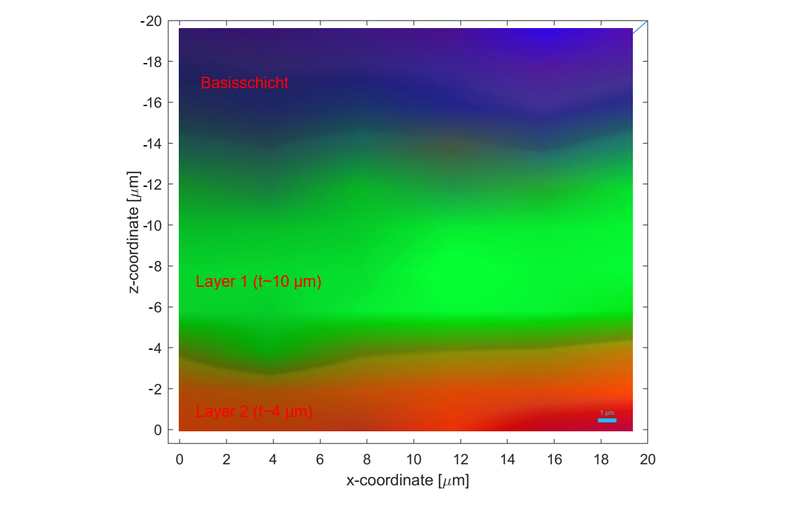
Neben der normalen Charakterisierung eines Polymers gibt es auch komplexe Methoden, welche genutzt werden können, um beispielsweise die Dicken einer mehrschichtigen Folie zu bestimmen. Hier ist anzumerken, dass es mit dem Raman Mikrospektroskop möglich ist, in Dickenrichtung Messungen durchzuführen, ohne dafür die Probe zu zerstören beziehungsweise aufzutrennen. Dies ist stark abhängig von der Transparenz, der Dicke sowie der molekularen Struktur des Materials. Nachfolgend ein Beispiel einer Messung in Dickenrichtung, wobei mittels mehrerer Spektren in x- sowie z-Richtung ein farbkodiertes Bild generiert wurde, welches verdeutlicht, an welchem Punkt die neue Schicht beginnt.
Investigation of filler content in polymers

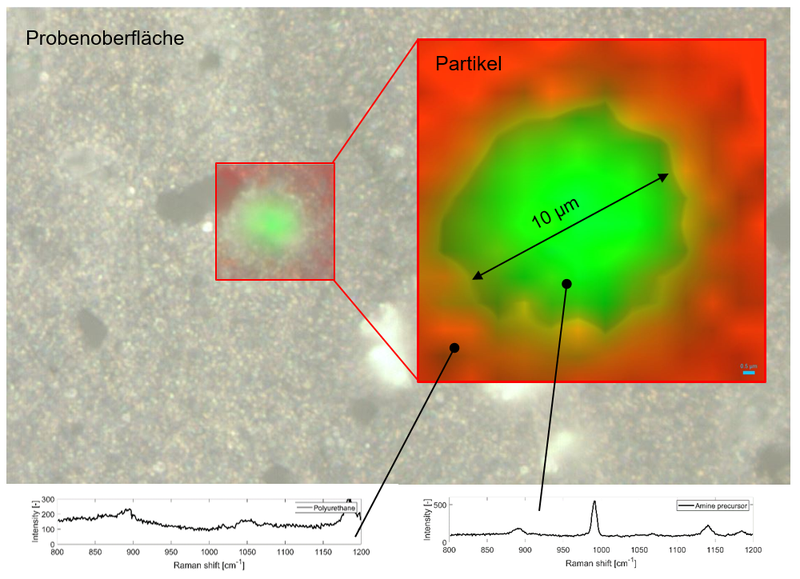
Another application is the investigation of filler fractions and particles in a polymer matrix. There are two different approaches:

  • On the one hand, it is possible to manually select an area which is then measured step by step by the Raman microspectroscope, and based on the change in the spectra, a particle can in turn be colour-coded (see image below). This provides spatially resolved information about the composition, size, and orientation of the particle.
  • On the other hand, there is the possibility of using existing software, the "ParticleFinder" from Horiba, which automatically evaluates a selected area based on an algorithm. In this way, a statistical distribution of the particles present in terms of composition, size, etc. can be determined.
School of
Engineering and Environment FHNW University of Applied Sciences and Arts Northwestern Switzerland

  • About the School
    • FHNW School of Engineering and Environment
    • Degree Programmes
    • Continuing Education
    • Collaboration in Research and Services
  • Social Media
    • LinkedIn
    • Instagram
    • Facebook
    • TikTok
    • YouTube
  • About FHNW
    • Organisation
    • Schools
    • Locations
    • FHNW Library
    • Media Relations
  • Support
    • IT Support
    • Inside FHNW
    • Webmail
Logo FHNW - 20 Years
Logo Swiss Universities
Logo European University Association
© University of Applied Sciences and Arts Northwestern Switzerland (FHNW)
  • Data Protection
  • Imprint
  • Accessibility
  • DE
  • EN