Skip to main contentSkip to search barSkip to navigationSkip to footer
Logo of the University of Applied Sciences and Arts Northwestern Switzerland
  • DE
  • EN
  • Home
  • Degree programmes
  • Continuing education

Ten Schools One Goal

The FHNW comprises 10 schools with different specializations. Select a school to see its specific courses, study programmes and information.

Applied Psychology

Architecture, Construction and Geomatics

Art and Design

Business

Computer Science

Engineering and Environment

Life Sciences

Music

School of Education

Social Work

  • Research

    • Research fields
    • Projects
  • Updates and insights

    • News and stories
  • Events

  • Media corner

  • About the School of Engineering and Environment

    • People directory
    • Management Board
  • Institutes

    • Institute of Automation
    • Institute of Bioenergy and Resource Efficiency
    • Institute of Business Engineering
    • Institute of Electric Power Systems
    • Institute of Humanities and Social Sciences
    • Institute of Polymer Engineering
    • Institute of Mathematics and Natural Sciences
    • Institute of Polymer Nanotechnology
    • Institute of Optometry
    • Institute of Product and Production Engineering
    • Institute for Sensors and Electronics
    • Institute of Thermal and Fluid Engineering
    • Laboratories of the School of Engineering and Environment
Logo of the University of Applied Sciences and Arts Northwestern Switzerland
  • About the School
    • FHNW School of Engineering and Environment
    • Degree Programmes
    • Continuing Education
    • Collaboration in Research and Services
  • Social Media
    • LinkedIn
    • Instagram
    • Facebook
    • TikTok
    • YouTube
  • About FHNW
    • Organisation
    • Schools
    • Locations
    • FHNW Library
    • Media Relations
  • Support
    • IT Support
    • Inside FHNW
    • Webmail
  • Data Protection
  • Imprint
  • Accessibility
  • Research

    • Research fields
    • Projects
  • Updates and insights

    • News and stories
  • Events

  • Media corner

  • About the School of Engineering and Environment

    • People directory
    • Management Board
  • Institutes

    • Institute of Automation
    • Institute of Bioenergy and Resource Efficiency
    • Institute of Business Engineering
    • Institute of Electric Power Systems
    • Institute of Humanities and Social Sciences
    • Institute of Polymer Engineering
    • Institute of Mathematics and Natural Sciences
    • Institute of Polymer Nanotechnology
    • Institute of Optometry
    • Institute of Product and Production Engineering
    • Institute for Sensors and Electronics
    • Institute of Thermal and Fluid Engineering
    • Laboratories of the School of Engineering and Environment

Type a search term and search continuing education,degree programmes, events, documents and other content.

  • Engineering and Environment
  • News and events
  • News and stories
  • All news and stories
All news and stories

Room lighting using inverted truncated cones, FHNW School of Engineering and Environment

School of Engineering and Environment


By connecting two plastic components, we have developed a light decoupling element that was previously thought unfeasible to manufacture.

Modern architecture and building technology are increasingly focusing on energy efficiency and sustainability. Effective insulating materials, advanced manufacturing processes and closed-loop concepts are just a few examples of the multifaceted efforts being made in this regard. Lighting technology also plays an important role in this context. After all, sophisticated systems allow room lighting to be realised most effectively with daylight and LEDs.

In cooperation with the RIF Institute for Research and Transfer e.V. and the Technical University of Dortmund, a new concept for room lighting was developed as a prototype at the Institute of Polymer Nanotechnology Applications FHNW.

As part of his dissertation at TU Dortmund, Michael Jakubowsky is developing various concepts for modern room lighting based on microstructured systems, which he is designing with the help of extensive optical simulations. One of these concepts is based on the vertical coupling of light from a 2-component light guide plate. This requires inverted truncated cones on the surface of the light guide - a seemingly impossible scenario from the point of view of manufacturability.
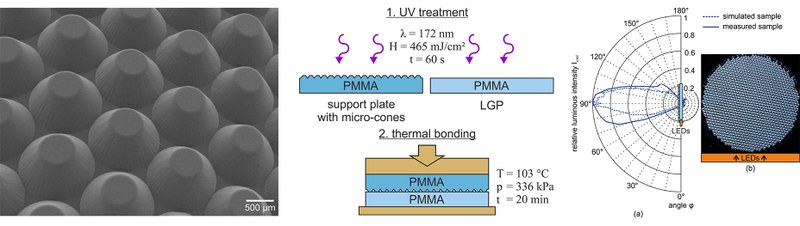

Figure 1: Injection-moulded truncated cones (left) were UV-irradiated and then thermally welded to the base light guide (centre) to realise a 2-component system with vertical light extraction (right). (Source: Courtesy of Springer Nature)
infobox_7dbb3c7b-f5b0-4884-b254-35d14d004b6a.png

Design, manufacturing and experimental validation of a bonded dual-component microstructured system for vertical light emission

Read more about this interesting collaboration in the recent publication by Springer Nature Verlag.
Read the paper

School of
Engineering and Environment FHNW University of Applied Sciences and Arts Northwestern Switzerland

  • About the School
    • FHNW School of Engineering and Environment
    • Degree Programmes
    • Continuing Education
    • Collaboration in Research and Services
  • Social Media
    • LinkedIn
    • Instagram
    • Facebook
    • TikTok
    • YouTube
  • About FHNW
    • Organisation
    • Schools
    • Locations
    • FHNW Library
    • Media Relations
  • Support
    • IT Support
    • Inside FHNW
    • Webmail
Logo FHNW - 20 Years
Logo Swiss Universities
Logo European University Association
© University of Applied Sciences and Arts Northwestern Switzerland (FHNW)
  • Data Protection
  • Imprint
  • Accessibility
  • DE
  • EN