Skip to main contentSkip to search barSkip to navigationSkip to footer
Logo of the University of Applied Sciences and Arts Northwestern Switzerland
  • DE
  • EN
  • Home
  • Degree programmes
  • Continuing education

Ten Schools One Goal

The FHNW comprises 10 schools with different specializations. Select a school to see its specific courses, study programmes and information.

Applied Psychology

Architecture, Construction and Geomatics

Art and Design

Business

Computer Science

Engineering and Environment

Life Sciences

Music

School of Education

Social Work

  • Research

    • Research fields
    • Projects
  • Updates and insights

    • News and stories
  • Events

  • Media corner

  • About the School of Engineering and Environment

    • People directory
    • Management Board
  • Institutes

    • Institute of Automation
    • Institute of Bioenergy and Resource Efficiency
    • Institute of Business Engineering
    • Institute of Electric Power Systems
    • Institute of Humanities and Social Sciences
    • Institute of Polymer Engineering
    • Institute of Mathematics and Natural Sciences
    • Institute of Polymer Nanotechnology
    • Institute of Optometry
    • Institute of Product and Production Engineering
    • Institute for Sensors and Electronics
    • Institute of Thermal and Fluid Engineering
    • Laboratories of the School of Engineering and Environment
Logo of the University of Applied Sciences and Arts Northwestern Switzerland
  • About the School
    • FHNW School of Engineering and Environment
    • Degree Programmes
    • Continuing Education
    • Collaboration in Research and Services
  • Social Media
    • LinkedIn
    • Instagram
    • Facebook
    • TikTok
    • YouTube
  • About FHNW
    • Organisation
    • Schools
    • Locations
    • FHNW Library
    • Media Relations
  • Support
    • IT Support
    • Inside FHNW
    • Webmail
  • Data Protection
  • Imprint
  • Accessibility
  • Research

    • Research fields
    • Projects
  • Updates and insights

    • News and stories
  • Events

  • Media corner

  • About the School of Engineering and Environment

    • People directory
    • Management Board
  • Institutes

    • Institute of Automation
    • Institute of Bioenergy and Resource Efficiency
    • Institute of Business Engineering
    • Institute of Electric Power Systems
    • Institute of Humanities and Social Sciences
    • Institute of Polymer Engineering
    • Institute of Mathematics and Natural Sciences
    • Institute of Polymer Nanotechnology
    • Institute of Optometry
    • Institute of Product and Production Engineering
    • Institute for Sensors and Electronics
    • Institute of Thermal and Fluid Engineering
    • Laboratories of the School of Engineering and Environment

Type a search term and search continuing education,degree programmes, events, documents and other content.

  • Engineering and Environment
  • Research and services
  • Research
  • Research fields
  • Optometry
Optometry

Binocular vision and eye-tracking, FHNW School of Engineering and Environment

School of Engineering and Environment


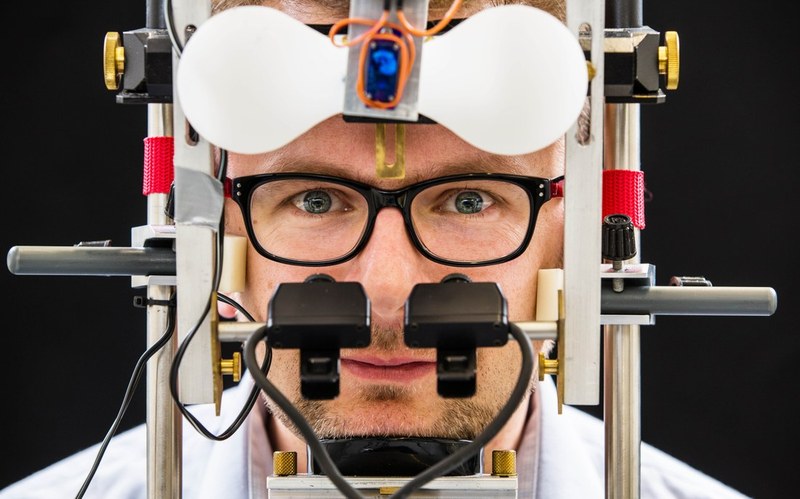
Video eye-tracking systems for investigating processes of binocular coordination and binocular advantages.

Using modern, high-resolution video eye-tracking systems, we investigate fundamental processes of binocular coordination and binocular advantages (e.g. during reading) and evaluate the effects of interventions (e.g. vergence training, refractive or prismatic corrections).

Models of binocular coordination generally describe aspects of vergence eye movements; these eye movements rotate the eyes towards each other (convergence) or away from each other (divergence). Current models need to be refined, for example by incorporating accommodation effects, i.e. the “autofocus” properties of the visual system. For this purpose, the Institute of Optometry has a specialized experimental setup that allows the simultaneous measurement of binocular eye movements and the accommodation of each eye.

When examining a skill that is indispensable in modern society – reading, i.e. the visual extraction of information from written text – it becomes evident that successful reading requires processing across multiple levels, from visual and oculomotor to cognitive processes. Within this interaction, we can describe fundamental processes of binocular coordination and information uptake in detail and comprehensively. Refractive influences on these processes can also be characterized.

Selected projects
Fixation disparity

Improved compatibility and success rates of varifocal lenses.

Contact

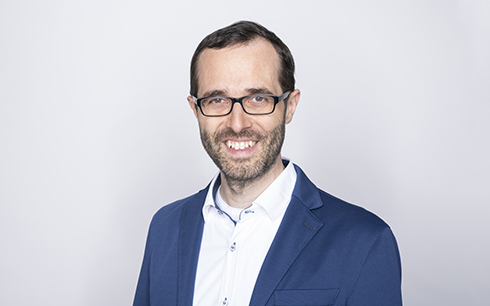
Prof. Dr. Giovanni Bertolini

Head of applied research and development, Lecturer
Phone
+41 62 957 25 86 (Direct)
E-Mail
giovanni.bertolini@fhnw.ch

School of
Engineering and Environment FHNW University of Applied Sciences and Arts Northwestern Switzerland

  • About the School
    • FHNW School of Engineering and Environment
    • Degree Programmes
    • Continuing Education
    • Collaboration in Research and Services
  • Social Media
    • LinkedIn
    • Instagram
    • Facebook
    • TikTok
    • YouTube
  • About FHNW
    • Organisation
    • Schools
    • Locations
    • FHNW Library
    • Media Relations
  • Support
    • IT Support
    • Inside FHNW
    • Webmail
Logo FHNW - 20 Years
Logo Swiss Universities
Logo European University Association
© University of Applied Sciences and Arts Northwestern Switzerland (FHNW)
  • Data Protection
  • Imprint
  • Accessibility
  • DE
  • EN