Skip to main contentSkip to search barSkip to navigationSkip to footer
Logo of the University of Applied Sciences and Arts Northwestern Switzerland
  • DE
  • EN
  • Home
  • Degree programmes
  • Continuing education

Ten Schools One Goal

The FHNW comprises 10 schools with different specializations. Select a school to see its specific courses, study programmes and information.

Applied Psychology

Architecture, Construction and Geomatics

Art and Design

Business

Computer Science

Engineering and Environment

Life Sciences

Music

School of Education

Social Work

  • Research

    • Research fields
    • Projects
  • Updates and insights

    • News and stories
  • Events

  • Media corner

  • About the School of Engineering and Environment

    • People directory
    • Management Board
  • Institutes

    • Institute of Automation
    • Institute of Bioenergy and Resource Efficiency
    • Institute of Business Engineering
    • Institute of Electric Power Systems
    • Institute of Humanities and Social Sciences
    • Institute of Polymer Engineering
    • Institute of Mathematics and Natural Sciences
    • Institute of Polymer Nanotechnology
    • Institute of Optometry
    • Institute of Product and Production Engineering
    • Institute for Sensors and Electronics
    • Institute of Thermal and Fluid Engineering
    • Laboratories of the School of Engineering and Environment
Logo of the University of Applied Sciences and Arts Northwestern Switzerland
  • About the School
    • FHNW School of Engineering and Environment
    • Degree Programmes
    • Continuing Education
    • Collaboration in Research and Services
  • Social Media
    • LinkedIn
    • Instagram
    • Facebook
    • TikTok
    • YouTube
  • About FHNW
    • Organisation
    • Schools
    • Locations
    • FHNW Library
    • Media Relations
  • Support
    • IT Support
    • Inside FHNW
    • Webmail
  • Data Protection
  • Imprint
  • Accessibility
  • Research

    • Research fields
    • Projects
  • Updates and insights

    • News and stories
  • Events

  • Media corner

  • About the School of Engineering and Environment

    • People directory
    • Management Board
  • Institutes

    • Institute of Automation
    • Institute of Bioenergy and Resource Efficiency
    • Institute of Business Engineering
    • Institute of Electric Power Systems
    • Institute of Humanities and Social Sciences
    • Institute of Polymer Engineering
    • Institute of Mathematics and Natural Sciences
    • Institute of Polymer Nanotechnology
    • Institute of Optometry
    • Institute of Product and Production Engineering
    • Institute for Sensors and Electronics
    • Institute of Thermal and Fluid Engineering
    • Laboratories of the School of Engineering and Environment

Type a search term and search continuing education,degree programmes, events, documents and other content.

  • Engineering and Environment
  • Research and services
  • Research
  • Projects
Projects

With Coatings Towards Better Batteries, FHNW School of Engineering and Environment

School of Engineering and Environment


Anode-free solid-state lithium batteries promise higher energy density, lower costs and improved safety – but they still face challenges such as uneven lithium distribution and early capacity loss. In the Nano-Argovia project BatCoat, the research team shows that ultrathin silver and protective coatings on the current collector can overcome these issues and significantly extend battery lifetime.

Background

Anode-free solid-state lithium batteries promise higher energy density, lower costs and improved safety – but they still face challenges such as uneven lithium distribution and early capacity loss. In the Nano-Argovia project BatCoat, the research team demonstrates that ultrathin silver and protective coatings on the current collector can solve these issues and significantly extend battery lifetime.
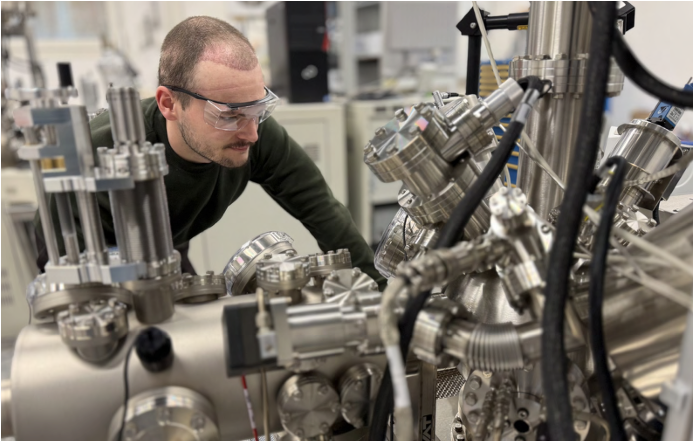
Doctoral researcher Robin Wullich uses an X-ray photoelectron spectrometer to analyse the chemical composition at the surface of the electrodes. Image source: Swiss Nanoscience Institute, University of Basel.

Goals

The Nano-Argovia project BatCoat aimed to overcome key technical barriers on the path towards reliable lithium-metal solid-state battery cells. Specifically, the researchers set out to:

  • achieve homogeneous, reversible lithium deposition on a copper surface that withstands more than 500 charge and discharge cycles while maintaining high capacity,
  • prevent harmful reactions between lithium and the solid electrolyte by applying ultrathin functional coatings made of different materials (<100 nanometres) to the copper surface,
  • investigate the advantages of 3D copper structures to mitigate the formation of lithium dendrites at the anode and thereby avoid performance and safety losses,
  • develop a concept for the industrial-scale production of nanoscale functional coatings on three-dimensional copper structures.

Results

The team demonstrated that extremely thin coatings on the current collector can significantly reduce several of these issues. For example, a silver coating enables more uniform lithium deposition, while an additional protective layer prevents harmful reactions – allowing for a very high number of charge cycles. Computer simulations also confirmed that the coatings reduce mechanical stress inside the battery and prevent crack formation. Overall, the BatCoat project shows that targeted surface coatings can substantially improve the stability and lifetime of anode-free solid-state batteries.

Project details

Type
Research project
University
Hochschule für Technik und Umwelt FHNW / Institute of Product and Production Engineering
Partner
OC Oerlikon Corporation AG, Paul Scherrer Institut PSI
Funding
NanoArgovia
Running time
24 Monate, Start 1. Januar 2024
Management
FHNW: Kaspar Löffel, PSI: Mario El Kazzi
Collaboration
Mario El Kazzi, Matthias Fankhauser, Raphael Gloor, Elischa Meier

Contact

Kaspar Löffel

Prof. Dr. Kaspar Löffel

Lecturer for Mechanical Engineering
Phone
+41 56 202 85 64
E-Mail
kaspar.loeffel@fhnw.ch

School of
Engineering and Environment FHNW University of Applied Sciences and Arts Northwestern Switzerland

  • About the School
    • FHNW School of Engineering and Environment
    • Degree Programmes
    • Continuing Education
    • Collaboration in Research and Services
  • Social Media
    • LinkedIn
    • Instagram
    • Facebook
    • TikTok
    • YouTube
  • About FHNW
    • Organisation
    • Schools
    • Locations
    • FHNW Library
    • Media Relations
  • Support
    • IT Support
    • Inside FHNW
    • Webmail
Logo FHNW - 20 Years
Logo Swiss Universities
Logo European University Association
© University of Applied Sciences and Arts Northwestern Switzerland (FHNW)
  • Data Protection
  • Imprint
  • Accessibility
  • EN
  • DE