Skip to main contentSkip to search barSkip to navigationSkip to footer
Logo of the University of Applied Sciences and Arts Northwestern Switzerland
  • DE
  • EN
  • Home
  • Degree programmes
  • Continuing education

Ten Schools One Goal

The FHNW comprises 10 schools with different specializations. Select a school to see its specific courses, study programmes and information.

Applied Psychology

Architecture, Construction and Geomatics

Art and Design

Music

Computer Science

Life Sciences

School of Education

Social Work

Engineering and Environment

Business

  • Research

    • Research fields
    • Projects
  • Updates and insights

    • News and stories
  • Events

  • Media corner

  • About the School of Engineering and Environment

    • People directory
    • Management Board
  • Institutes

    • Institute of Automation
    • Institute of Bioenergy and Resource Efficiency
    • Institute of Business Engineering
    • Institute of Electric Power Systems
    • Institute of Humanities and Social Sciences
    • Institute of Polymer Engineering
    • Institute of Mathematics and Natural Sciences
    • Institute of Polymer Nanotechnology
    • Institute of Optometry
    • Institute of Product and Production Engineering
    • Institute for Sensors and Electronics
    • Institute of Thermal and Fluid Engineering
    • Laboratories of the School of Engineering and Environment
Logo of the University of Applied Sciences and Arts Northwestern Switzerland
  • About the School
    • FHNW School of Engineering and Environment
    • Degree Programmes
    • Continuing Education
    • Collaboration in Research and Services
  • Social Media
    • LinkedIn
    • Instagram
    • Facebook
    • TikTok
    • YouTube
  • About FHNW
    • Organisation
    • Schools
    • Locations
    • FHNW Library
    • Media Relations
  • Support
    • IT Support
    • Inside FHNW
    • Webmail
  • Data Protection
  • Imprint
  • Accessibility
  • Research

    • Research fields
    • Projects
  • Updates and insights

    • News and stories
  • Events

  • Media corner

  • About the School of Engineering and Environment

    • People directory
    • Management Board
  • Institutes

    • Institute of Automation
    • Institute of Bioenergy and Resource Efficiency
    • Institute of Business Engineering
    • Institute of Electric Power Systems
    • Institute of Humanities and Social Sciences
    • Institute of Polymer Engineering
    • Institute of Mathematics and Natural Sciences
    • Institute of Polymer Nanotechnology
    • Institute of Optometry
    • Institute of Product and Production Engineering
    • Institute for Sensors and Electronics
    • Institute of Thermal and Fluid Engineering
    • Laboratories of the School of Engineering and Environment

Type a search term and search continuing education,degree programmes, events, documents and other content.

  • Engineering and Environment
  • Research and services
  • Research
  • Projects
Projects

Casting simulation and experimental validation of active air cooling of cast parts, FHNW School of Engineering and Environment

School of Engineering and Environment


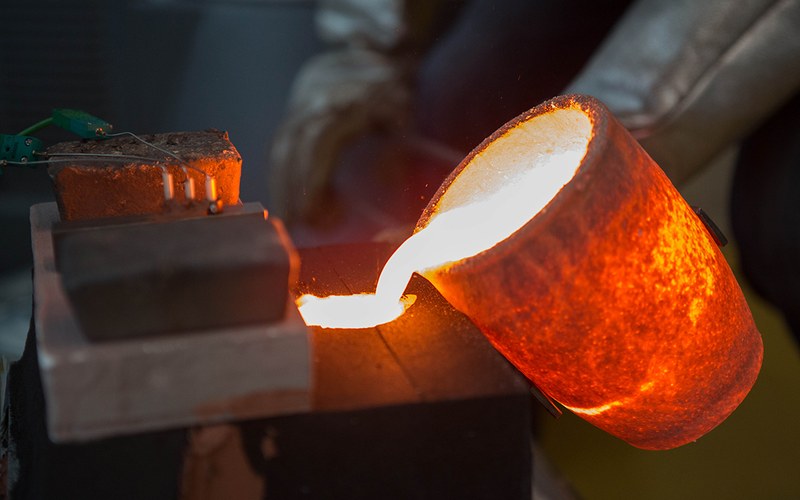
Large cast parts for gas or steam turbines or engines need days or even weeks to solidify and cool down.
Project details

Objective

The objective of the research project is to halve the cooling-down time for a large cast part in a sand mould, which is several days, with a new, controlled cooling method using air, while maintaining the cast quality.

Starting situation

To reduce the cooling-down time for cast parts, more heat must be dissipated. An active cooling procedure would be used for this. Because of this requirement, a reliable prediction of the cooling effect must be possible by means of simulation, to clarify the benefit of the additional effort of actively cooling various large cast parts in advance and of designing these parts. The thermal energy dissipated by the active system is to be mathematically predicted by cast simulation software, up to the temperature on removal from the mould.

Result

The potential of actively cooling sand castings was proven in the project on the laboratory scale and in a large casting. Through active cooling, the following improvements could be achieved in solidification and further cooling down:

  • Reduction of the cooling time up to removal from the mould by 67% by means of actively cooled iron moulds in the laboratory test
  • Active influence on the solidification process and the hot zones on the part, which means that complex geometries can be achieved more easily using casting techniques
  • Finer structure and improved mechanical characteristics
  • Reduction of casting defects

Projekt-Information

Client

Benninger Guss AG

Execution

FHNW Institute of Thermo- and Fluid-Engineering, FHNW Institute of Product and Production Engineering , Giesserei-Zentrum FHNW

Partner

MAC GmbH

Duration

3 Years

Sponsorship

Kommission für Technologie und Innovation

Team

FHNW: Prof. Dr. Norbert Hofmann, Prof. Dr. Jörg Lagemann, Erwin Eichelberger, Andreas Matt, Thomas Burbach, Christian Kähr, Ralph Amhof


Benninger: Eric von Ballmoos, Urs Augustin


MAC: Markus Albert, Dieter Jurczik

School of
Engineering and Environment FHNW University of Applied Sciences and Arts Northwestern Switzerland

  • About the School
    • FHNW School of Engineering and Environment
    • Degree Programmes
    • Continuing Education
    • Collaboration in Research and Services
  • Social Media
    • LinkedIn
    • Instagram
    • Facebook
    • TikTok
    • YouTube
  • About FHNW
    • Organisation
    • Schools
    • Locations
    • FHNW Library
    • Media Relations
  • Support
    • IT Support
    • Inside FHNW
    • Webmail
Logo FHNW - 20 Years
Logo Swiss Universities
Logo European University Association
© University of Applied Sciences and Arts Northwestern Switzerland (FHNW)
  • Data Protection
  • Imprint
  • Accessibility
  • DE
  • EN