With a newly developed, energy-efficient data logger, the FHNW – together with DuraMon AG – enables the continuous monitoring of corrosion in reinforced concrete structures. This innovative solution provides precise real-time data, helping to detect damage early and significantly reduce maintenance costs.
Introduction
Corrosion is one of the main causes of damage to bridges, tunnels, and other concrete structures. Traditional inspection methods typically provide only momentary snapshots and are associated with considerable uncertainties. In collaboration with DuraMon AG, the Institute of Sensors and Electronics at FHNW has developed an innovative wireless monitoring system that enables continuous condition assessment of reinforced concrete – making an important contribution to the safety and longevity of critical infrastructure.
Initial Situation
Traditionelle Prüfverfahren beruhen häufig auf visuellen Kontrollen oder zerstörungsfreien bzw. zerstörenden Tests. Diese Ansätze erlauben jedoch kaum verlässliche Aussagen zum zeitlichen Verlauf korrosiver Prozesse. DuraMon AG bietet deshalb eine neue Monitoringlösung an, die gleichzeitig sämtliche für die Korrosion relevanten Parameter in Stahlbetonbauwerken erfassen kann – beispielsweise pH-Wert, Chloridgehalt oder die elektrische Impedanz des Betons.
Für eine zuverlässige und langfristige Überwachung sind autonome, energieeffiziente und kommunikativ robuste Messsysteme erforderlich. Die Herausforderung besteht insbesondere darin, Messdaten auch in schwierigen Umgebungen wie Tunneln oder Parkhäusern drahtlos zu übertragen.
Objectives
The joint project between FHNW and DuraMon AG pursued the following goals:
Development of an energy-efficient data logger with an autonomous operating time of more than 10 years.
Integration of a LoRa/LoRaWAN communication system that operates reliably in complex building structures.
Implementation of highly sensitive corrosion measurement methods, including the precise detection of very small corrosion currents.
Design of a wireless firmware update system (FUOTA) to enable maintenance without on-site interventions.
Development of a modular test environment for automated quality and functionality testing before customer deployment.
Analysis of LoRa signal propagation in real environments such as parking garages and tunnels to derive general installation guidelines.
Results
Over the course of the project, an optimized data logger was developed to collect measurements from sensors embedded in concrete and transmit them via a dedicated LoRaWAN network. Key results include:
New corrosion current measurement: Precise measurement in the range of ±25 µA with a resolution below 0.01 µA and an input impedance under 20 Ω.
FUOTA-enabled firmware: A specially developed bootloader ensures secure wireless firmware updates despite the limited bandwidth of LoRa communication.
Communication analysis in real environments: Extensive field tests in tunnels and parking garages provided valuable insights into signal strength, range, and optimal gateway placement.
Modular test environment: A flexible testing platform allows the simulation of voltages, resistances, and currents, as well as the verification of power consumption and LoRa connectivity. A graphical user interface facilitates automated test sequences and documentation.
Deployment in real applications: The developed data loggers are increasingly used by customers, contributing to improved structural monitoring.
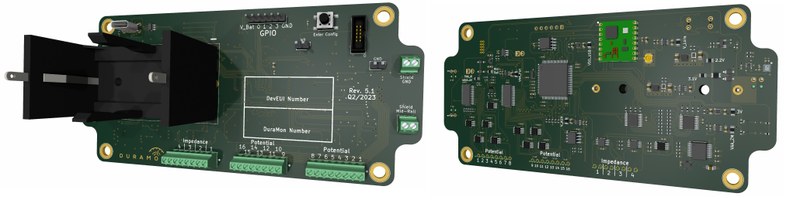
Abbildung zeigt den optimierten Datenlogger und die prinzipielle Datenkommunikationswege 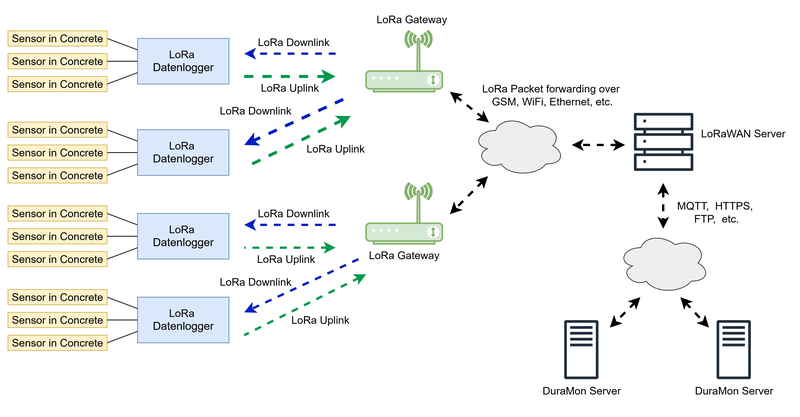
Datenlogger und LoRaWAN Netzwerk 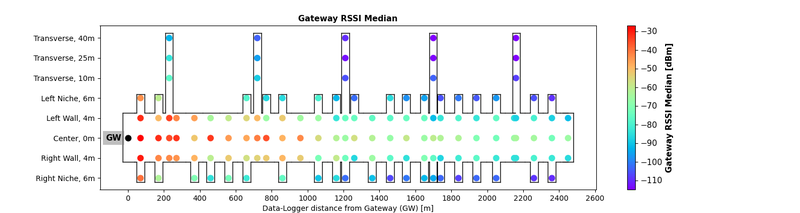
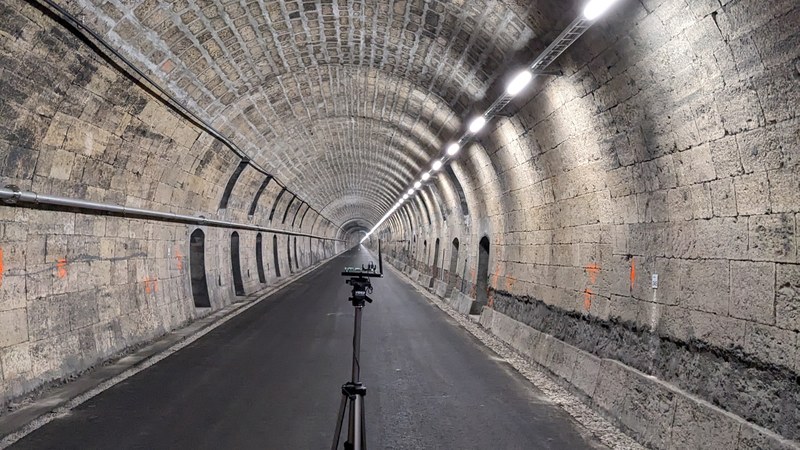
Abbildung zeigt als Beispiel das Ergebnis des stillgelegten Bözberg-Eisenbahntunnels, wo der Einfluss der Entfernung zwischen Datenlogger und Gateway oder seitlichen Korridoren und Nischen deutlich sichtbar ist.
Die farbige Punktwolke illustriert eindrücklich die Reichweiten- und Signalstärkeeffekte sowie die Bedeutung der Positionierung.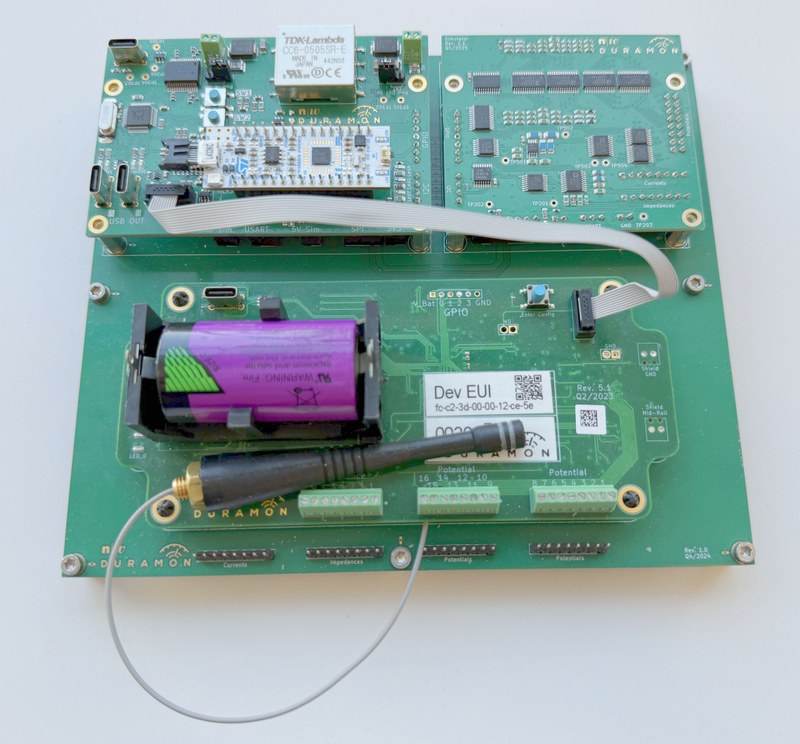
Modulare Testumgebung zum Funktionstest des Datenloggers
Outlook
The continuous corrosion monitoring system forms the basis for more advanced maintenance strategies in civil engineering. The insights gained regarding LoRa communication in complex environments enable more reliable planning for future installations. In the long term, the technology helps to:
Plan maintenance measures more precisely,
Reduce the cost of maintaining reinforced concrete structures,
And significantly extend the service life of critical infrastructure.
Projectdetails
- Type
- Research project
- Research field
- Electrical engineering
- Topics
- Technologies and engineering, Electrical engineering and measurement technology
- School
- FHNW School of Engineering and Environment / Institute for Sensors and Electronics
- Partners
- DuraMon AG
- Funding
- Innosuisse
- Duration
- 2.5 years
- Project lead
- Prof. Dr. Stefan Gorenflo
- Team
- Marco Meier, Marc Hochuli, Maya Mohajerani
Contact

Prof. Dr. Stefan Gorenflo
- Phone
- +41 56 202 87 24
- stefan.gorenflo@fhnw.ch