A newly developed, high-precision sensor system enables the dynamic measurement of track subsidence during train passage. The project makes a significant contribution to increasing railway safety and to the early detection of changes in the ground structure.
Introduction
Reliable monitoring of track infrastructure is a key factor for the safety of railway operations. Track subsidence, often caused by nearby construction work or changes in the underground, can lead to severe incidents. Together with Amberg Infra 7D AG, the FHNW is developing an innovative measurement system that captures track movements with high precision, both statically and dynamically, thereby ushering in a new era of track monitoring.
Background
Today, track subsidence is monitored predominantly in a static manner—meaning without a passing train. While this allows for reliable diagnostics, it only identifies problems once they have already reached a critical stage. Events such as the 2017 incident in Rastatt (Germany), where a railway trackbed dramatically sank due to tunneling work, highlight the importance of early-warning systems. This project addresses exactly that challenge: using a new measurement approach based on MEMS acceleration sensors, track subsidence is to be detected during regular train operations—precisely, robustly, and fully integrable into existing monitoring infrastructures.

Objectives
The project pursues the following goals:
Dynamic detection of track subsidence during train passage, with sub-millimeter accuracy.
Development of an integrable sensor system that seamlessly fits into the existing Amberg Infra 7D infrastructure.
Optimization of signal processing to minimise drift effects and reliably compute deflection values—even though noisy acceleration data must be integrated twice.
Establishing a foundation for future machine-learning methods to automatically detect track anomalies, underground changes, or deviations related to the train itself.
The system has been submitted for patenting (10 2025 142 270.2).
Results
Several key milestones have been achieved:
Sensor study & prototyping: Various MEMS acceleration sensors were evaluated, tested, and implemented in a first prototype, which was then deployed on real railway tracks.
Reference validation: Acceleration data was measured and compared using a laser tracker. Integration in the frequency domain combined with suitable filters significantly reduced drift.
Development of a custom PCB: A second prototype integrates the sensor module, microcontroller, and communication interface into a compact unit.
Embedded signal processing: The signal processing pipeline initially developed in Python was ported to the microcontroller, enabling full onboard calculation of track deflection.
Integration into existing systems: The prototype was successfully embedded into the Amberg Infra 7D measurement system and tested autonomously on railway tracks.
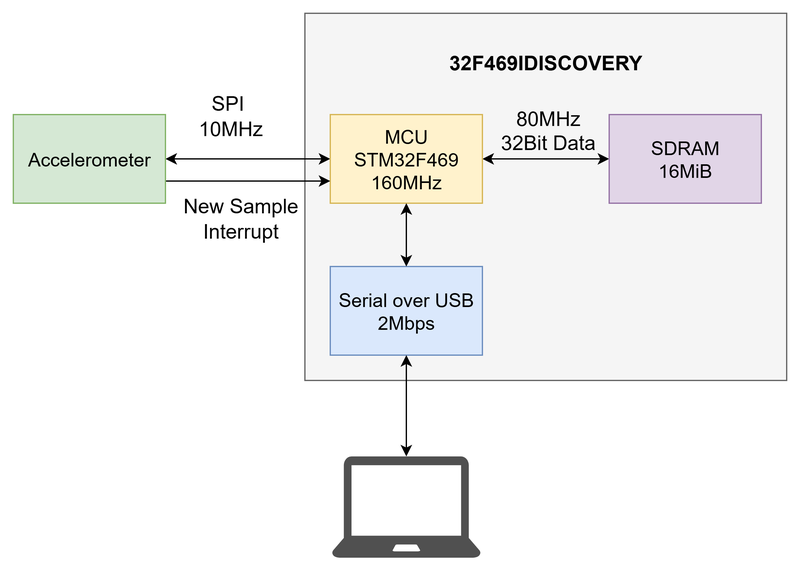
Data recording of Prototype 1: the block diagram 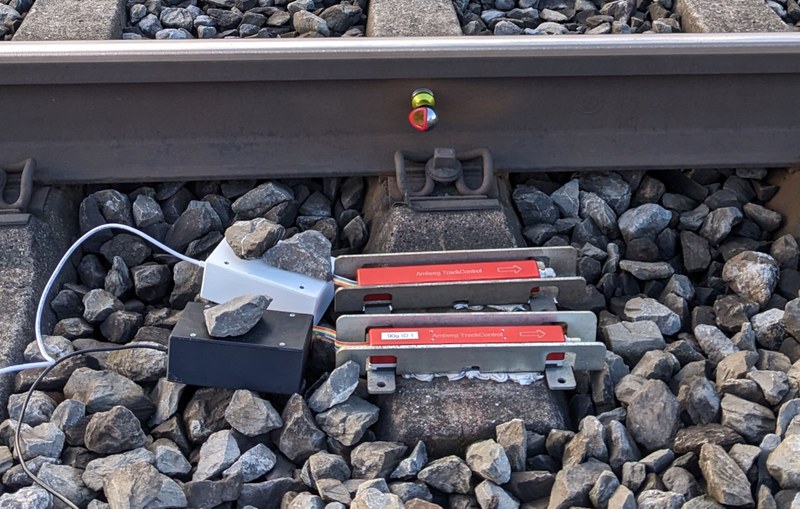
Data recording of Prototype 1: the measurement on a railway track. 
Calculated track deflection compared with a laser tracker reference measurement (image of the train: SchmalspurDVZO, Wikimedia). 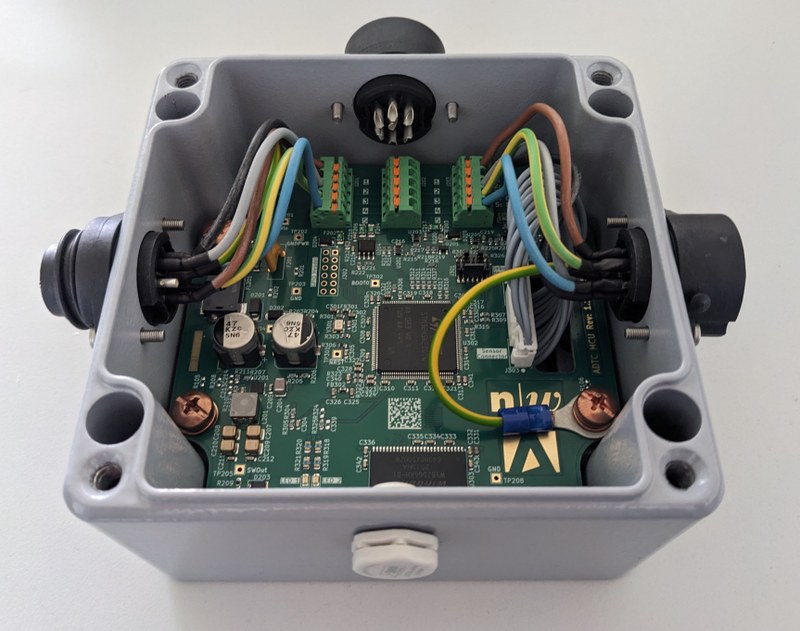
Prototype 2 in the housing, including the embedded implementation of the signal processing. 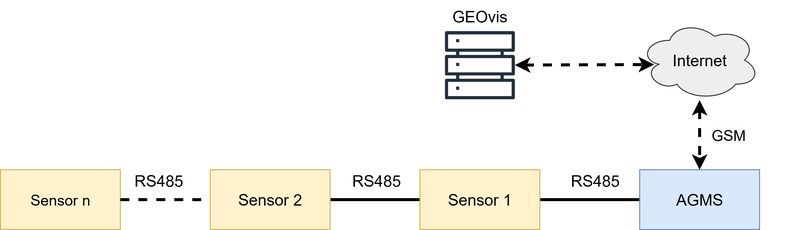
Measurement system of Amberg Infra 7D, which is also used for the new sensor. 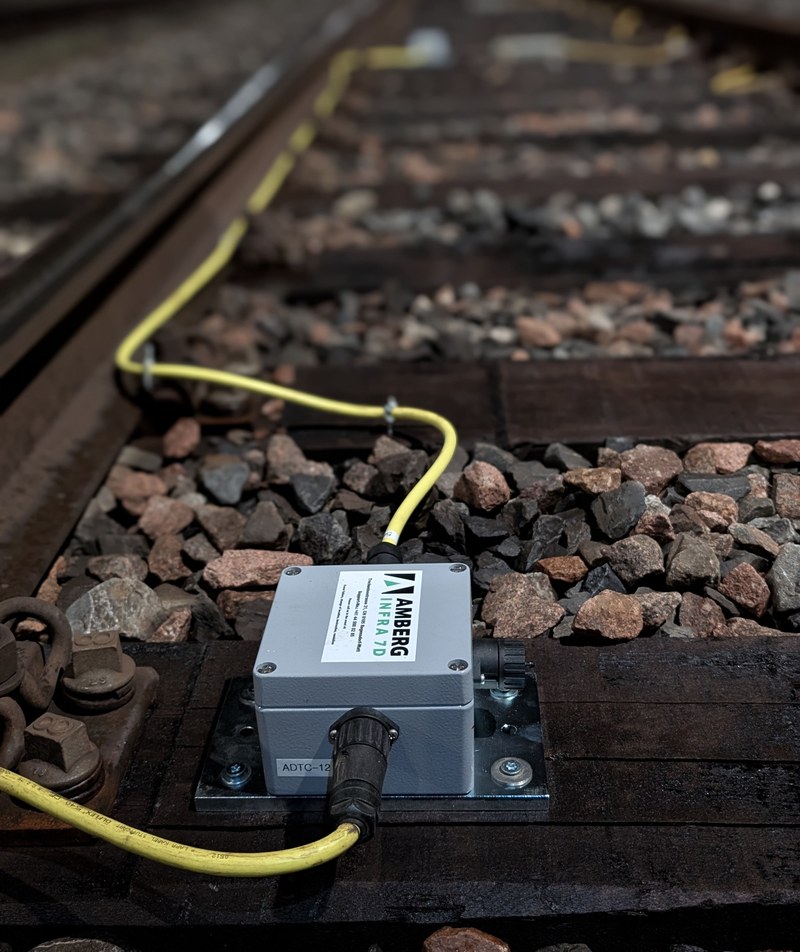
Autonomous measurement with Prototype 2 on a railway track (image: Amberg Infra 7D).
Outlook
Next steps in the project include:
Applying machine learning to automatically interpret measurement data and identify train types, underground changes, or potential anomalies.
Expanding the system with static measurement functionality to fully replace previous sensor solutions.
Further development toward series production, enabling widespread use to contribute to safer and more efficient railway operations in the future.
Project details
- Type
- Research project
- Research field
- Electrical engineering
- Topics
- Technologies and engineering, Electrical engineering and measurement technology
- School
- FHNW School of Engineering and Environment / Institute for Sensors and Electronics
- Partners
- Amberg Infra 7D AG
- Funding
- Innosuisse
- Duration
- 2 years
- Project lead
- Prof. Dr. Stefan Gorenflo
- Team
- Marco Meier,Marc Hochuli, Prof. Dr. Jürg Küffer (IPPE), Prof. Dr. Denis Jordan (HABG), Théo Reibel (HABG)
Contact

Prof. Dr. Stefan Gorenflo
- Phone
- +41 56 202 87 24
- stefan.gorenflo@fhnw.ch