How can problems in businesses be solved systematically? In collaboration with Aksena Switzerland, FHNW is developing AI-powered tools to help experts identify the root causes of problems and work towards suitable solutions. The project combines an interactive AI tutor with a team of specialised AI agents that work together to support the analysis.
Background
When problems arise in businesses, their underlying causes are often not immediately obvious. Finding sustainable solutions requires experts to gather information, understand relationships and systematically investigate possible causes.
Aksena Switzerland supports businesses in this process through its Business Improvement System (BIS), which brings together various methods for improving business processes. The company also provides knowledge and resources through its online learning platform, ProErigo. The challenge lies in applying this knowledge to specific problems encountered in day-to-day operations. This is where the joint project with FHNW comes in: artificial intelligence is intended to guide experts through the analysis and support them in applying appropriate methods.
Goals
The aim of the project was to develop AI-powered tools to guide experts through root cause analysis, from defining the problem to documenting the findings. The project investigated how an AI tutor could communicate existing methodological knowledge and how several specialised AI agents could work together to analyse a specific case.
Results
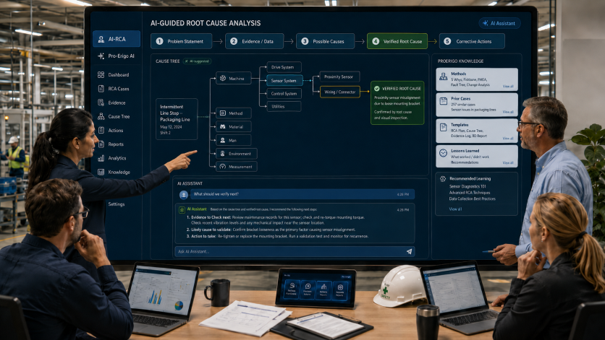
The project resulted in two complementary solutions. An interactive workspace guides users through four phases of root cause analysis. It helps them define the problem precisely, investigate possible causes and export their findings to a Word document. The integrated ProErigo AI Tutor answers questions about the methods and recommends relevant training videos, tools and templates from Aksena’s course materials.
The second solution uses several specialised AI agents that work together to analyse a case. They ask for missing information, support users in selecting and applying suitable methods, and review interim results. If an approach proves ineffective, they adapt the process. Finally, they generate a structured report.
The multi-agent system was tested on 16 reference cases and assessed by industry experts. The results demonstrate that the approach is technically feasible. Whether the tools also lead to better outcomes in real customer projects remains to be established.
Outlook
The next step is to test the developed tools with experts and pilot customers using real-world problems. These trials will show how well the AI support works in practice and what tangible benefits it can offer businesses.
Projektdetails
- Type
- Research project
- Research field
- Business processes
- Topics
- Artificial intelligence and machine learning, Digitisation and digital transformation
- School
- FHNW School of Engineering and Environment / Institute of Business Engineering
- Partners
- Aksena Schweiz GmbH
- Funding
- Hightech Zentrum Aargau
- Duration
- 1 year
- Team
- FHNW: Prof. Dr. Björn Klocke, research lead, and Khodor Kandouli, Technical AI lead and MSE master’s thesis.
Aksena: Dr. Sven H. Danielsen, project lead, Henning Baken, Jardar Iversen (Aksena’s technical lead) and Thobias Knudsen.
Contact

Prof. Dr. Björn Klocke
- Phone
- +41 56 202 73 45
- bjoern.klocke@fhnw.ch