Skip to main contentSkip to search barSkip to navigationSkip to footer
Logo of the University of Applied Sciences and Arts Northwestern Switzerland
  • DE
  • EN
  • Home
  • Degree programmes
  • Continuing education

Ten Schools One Goal

The FHNW comprises 10 schools with different specializations. Select a school to see its specific courses, study programmes and information.

Applied Psychology

Architecture, Construction and Geomatics

Art and Design

Music

Computer Science

Life Sciences

School of Education

Social Work

Engineering and Environment

Business

  • Research

    • Research fields
    • Projects
  • Updates and insights

    • News and stories
  • Events

  • Media corner

  • About the School of Engineering and Environment

    • People directory
    • Management Board
  • Institutes

    • Institute of Automation
    • Institute of Bioenergy and Resource Efficiency
    • Institute of Business Engineering
    • Institute of Electric Power Systems
    • Institute of Humanities and Social Sciences
    • Institute of Polymer Engineering
    • Institute of Mathematics and Natural Sciences
    • Institute of Polymer Nanotechnology
    • Institute of Optometry
    • Institute of Product and Production Engineering
    • Institute for Sensors and Electronics
    • Institute of Thermal and Fluid Engineering
    • Laboratories of the School of Engineering and Environment
Logo of the University of Applied Sciences and Arts Northwestern Switzerland
  • About the School
    • FHNW School of Engineering and Environment
    • Degree Programmes
    • Continuing Education
    • Collaboration in Research and Services
  • Social Media
    • LinkedIn
    • Instagram
    • Facebook
    • TikTok
    • YouTube
  • About FHNW
    • Organisation
    • Schools
    • Locations
    • FHNW Library
    • Media Relations
  • Support
    • IT Support
    • Inside FHNW
    • Webmail
  • Data Protection
  • Imprint
  • Accessibility
  • Research

    • Research fields
    • Projects
  • Updates and insights

    • News and stories
  • Events

  • Media corner

  • About the School of Engineering and Environment

    • People directory
    • Management Board
  • Institutes

    • Institute of Automation
    • Institute of Bioenergy and Resource Efficiency
    • Institute of Business Engineering
    • Institute of Electric Power Systems
    • Institute of Humanities and Social Sciences
    • Institute of Polymer Engineering
    • Institute of Mathematics and Natural Sciences
    • Institute of Polymer Nanotechnology
    • Institute of Optometry
    • Institute of Product and Production Engineering
    • Institute for Sensors and Electronics
    • Institute of Thermal and Fluid Engineering
    • Laboratories of the School of Engineering and Environment

Type a search term and search continuing education,degree programmes, events, documents and other content.

  • Engineering and Environment
  • Research and services
  • Research
  • Projects
Projects

Simulation and Optimization of High-voltage circuit breakers, FHNW School of Engineering and Environment

School of Engineering and Environment


The Pfiffner Group is working on the development of a new type of high-voltage circuit-breaker with environmentally friendly insulating gas for use in substations. A 1D simulation model is to be developed in order to optimize individual parameters of the complex system.

Technologies

Simulation and Programming language Python

Background

A circuit breaker is a complex, multi-physical system in which many manufacturing parameters can be changed without knowing the exact effects on performance. For this reason, software tools are used that employ multivariate optimization algorithms to optimize the basic design. Usually, 3D CFD simulation software is used, but this has the disadvantage of being time-consuming. One-dimensional simulation models, on the other hand, significantly reduce the time required, which means that optimization based on them can be implemented more quickly.

Objectives

A 1D simulation model is to be developed, which depicts the relevant components and their interaction with sufficient accuracy. This model will then be used to optimize the performance of the overall system (e.g. arc extinguishing capability), taking various system parameters into account.

Result

The 1D simulation model was developed using the Python programming language. The initial simulation results show that it is possible to reproduce reality with sufficient accuracy using simple partial models, which represent individual physical behavior.

The next step is to link the individual models with each other and compare them with the extensive 3D simulations. If a satisfactory level of accuracy is achieved, optimization algorithms are used to improve the design based on the 1D model.
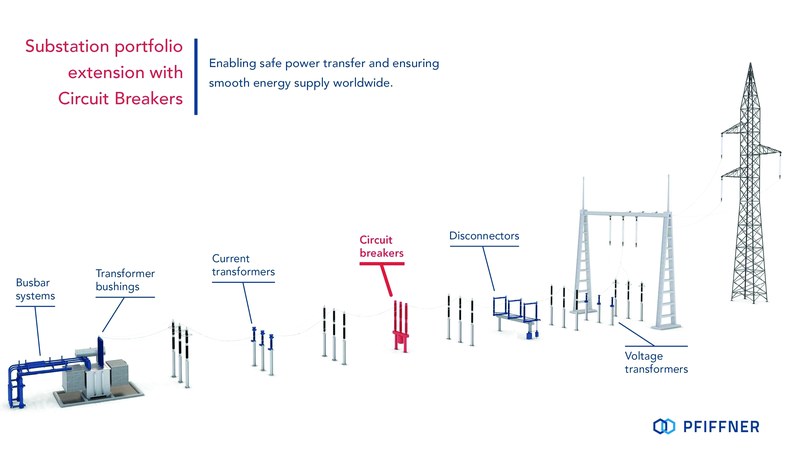
Figure: Pfiffner Group product portfolio (circuit-breaker red)

Project details

Type
Research project
Partner
Pfiffner Messwandler AG, Hirschthal
Funding
Innosuisse
Running time
1 year
Collaboration
Martin Pischtschan, Kilian Pedolin

School of
Engineering and Environment FHNW University of Applied Sciences and Arts Northwestern Switzerland

  • About the School
    • FHNW School of Engineering and Environment
    • Degree Programmes
    • Continuing Education
    • Collaboration in Research and Services
  • Social Media
    • LinkedIn
    • Instagram
    • Facebook
    • TikTok
    • YouTube
  • About FHNW
    • Organisation
    • Schools
    • Locations
    • FHNW Library
    • Media Relations
  • Support
    • IT Support
    • Inside FHNW
    • Webmail
Logo FHNW - 20 Years
Logo Swiss Universities
Logo European University Association
© University of Applied Sciences and Arts Northwestern Switzerland (FHNW)
  • Data Protection
  • Imprint
  • Accessibility
  • DE
  • EN