Skip to main contentSkip to search barSkip to navigationSkip to footer
Logo of the University of Applied Sciences and Arts Northwestern Switzerland
  • DE
  • EN
  • Home
  • Degree programmes
  • Continuing education

Ten Schools One Goal

The FHNW comprises 10 schools with different specializations. Select a school to see its specific courses, study programmes and information.

Applied Psychology

Architecture, Construction and Geomatics

Art and Design

Music

Computer Science

Life Sciences

School of Education

Social Work

Engineering and Environment

Business

  • Research

    • Research fields
    • Projects
  • Updates and insights

    • News and stories
  • Events

  • Media corner

  • About the School of Engineering and Environment

    • People directory
    • Management Board
  • Institutes

    • Institute of Automation
    • Institute of Bioenergy and Resource Efficiency
    • Institute of Business Engineering
    • Institute of Electric Power Systems
    • Institute of Humanities and Social Sciences
    • Institute of Polymer Engineering
    • Institute of Mathematics and Natural Sciences
    • Institute of Polymer Nanotechnology
    • Institute of Optometry
    • Institute of Product and Production Engineering
    • Institute for Sensors and Electronics
    • Institute of Thermal and Fluid Engineering
    • Laboratories of the School of Engineering and Environment
Logo of the University of Applied Sciences and Arts Northwestern Switzerland
  • About the School
    • FHNW School of Engineering and Environment
    • Degree Programmes
    • Continuing Education
    • Collaboration in Research and Services
  • Social Media
    • LinkedIn
    • Instagram
    • Facebook
    • TikTok
    • YouTube
  • About FHNW
    • Organisation
    • Schools
    • Locations
    • FHNW Library
    • Media Relations
  • Support
    • IT Support
    • Inside FHNW
    • Webmail
  • Data Protection
  • Imprint
  • Accessibility
  • Research

    • Research fields
    • Projects
  • Updates and insights

    • News and stories
  • Events

  • Media corner

  • About the School of Engineering and Environment

    • People directory
    • Management Board
  • Institutes

    • Institute of Automation
    • Institute of Bioenergy and Resource Efficiency
    • Institute of Business Engineering
    • Institute of Electric Power Systems
    • Institute of Humanities and Social Sciences
    • Institute of Polymer Engineering
    • Institute of Mathematics and Natural Sciences
    • Institute of Polymer Nanotechnology
    • Institute of Optometry
    • Institute of Product and Production Engineering
    • Institute for Sensors and Electronics
    • Institute of Thermal and Fluid Engineering
    • Laboratories of the School of Engineering and Environment

Type a search term and search continuing education,degree programmes, events, documents and other content.

  • Engineering and Environment
  • Research and services
  • Research
  • Projects
Projects

Improvement of additive manufactured parts by nanofibers, FHNW School of Engineering and Environment

School of Engineering and Environment


Huntsman’s Miralon material increases mechanical performance and conductivity of thermoplastics for 3D printing and injection moulding.
Project details

University
FHNW School of Engineering and Environment / School of Engineering and Environment, Institute of Polymer Engineering

Technologies

  • Nanofibers
  • Polyetherimide
  • Additive manufacturing
  • Nozzle design
  • Conductivity

Background

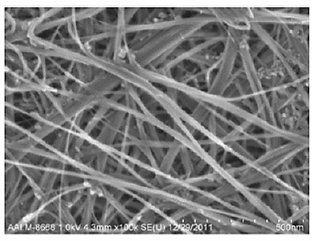
Miralon nanofibers under the microscope

Additive Manufacturing is highly used for prototyping and pre-serial manufacturing.

Huntsman's portfolio includes the novel entangled nanofibers Miralon, which exhibit a high aspect ratio. In combination with thermoplastics, Huntsman, FHNW and KATZ have developed injection moulding and filament materials for the Fused Filament Fabrication (FFF) process with improved properties.

The transverse strength of FFF parts is lower compared to the longitudinal one. By incorporating such nanofibers, this strength can be increased. Another advantage of the fibers is the high electrical conductivity.

Goals

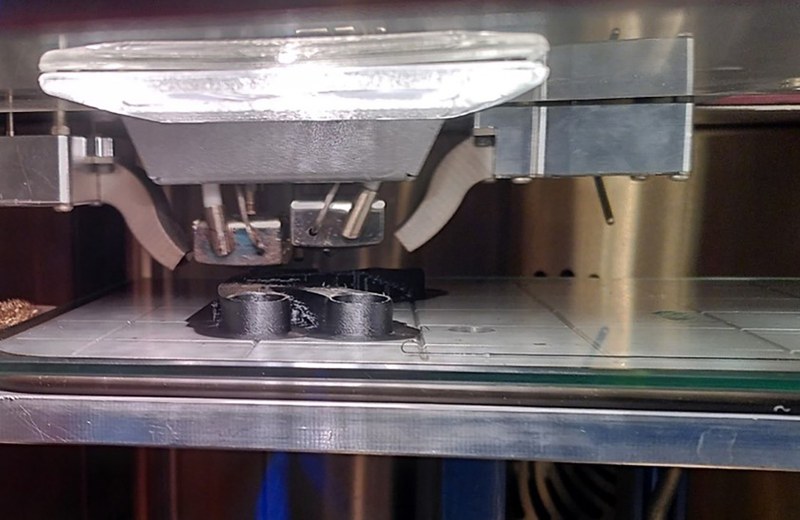
Printing a bracket in PEI with Miralon nanofibers

The main goal of this project was to improve the transverse strength of additive manufactured parts by high aspect ratio nanofibers. For that reason, different compounds with Miralon, compatibilizers and thermoplastic polymers had to be produced and characterised. One of the main challenges was the dispersion and distribution of Miralon within the thermoplastic polymer. For optimization various compounding methods had to be compared: internal mixer, twin-screw-extruder, multi-spindle-extruder and co-kneader.

A filament extrusion line had to be developed, built, and installed.

Mechanical analysis of injection moulded and printed tensile test specimens had to be performed.

Results

The project team clearly proved that adding Miralon nanotubes into technical and high-performance polymers such as PET-G, PA12 or PEI increase significantly the mechanical performance by roughly 10-30% and the conductivity by several orders of magnitude in injection moulded and of 3D-printed parts.

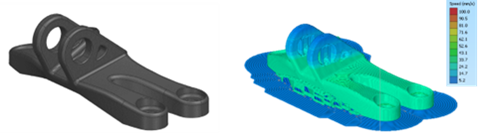
The printing process, respectively the resulting flow mechanism in the nozzle during extrusion, was simulated and investigated. Based on the resulted findings, a new nozzle geometry was elaborated and manufactured using the SLM printing process. This new nozzle geometry aims to change the direction of the Miralon nanofibers in the molten polymer while printing. In this way, the Miralon nanofibers should not align only in flow direction but also transversely to it.

The team could show with semi-crystalline and an amorphous material with and without nanofibers that a special nozzle geometry can have a positive effect on the mechanical performance in general and on the transversal strength. Additionally, the mechanical performance of printed parts with 1% Miralon nanofibers was better compared to a commercial reference with 20% carbon fibres, especially when using the specific nozzle geometry.

As a demonstrator a 3D printed bracket was shown at the JEC 2022 in Paris
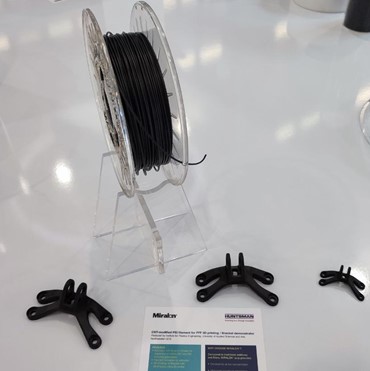
Filament and brackets made from PEI + Miralon presented at the JEC fair 2022

Project information

Client

Huntsman AG

Execution

Institute of Polymer Engineering FHNW
Kunststoff-Ausbilungs- und Technologiezentrum KATZ

Duration

2 years

Funding

Innosuisse

Project team

Institut für Kunststofftechnik FHNW: Christoph Maurer, Stephanie Wegmann, Mariona Diaz, Yara Khalaf, Christian Rytka
KATZ: Panayota Tsotra
Huntsman: Klaus Ritter, Ludovic Dumas, Alexander Langer, Florian Klunke

School of
Engineering and Environment FHNW University of Applied Sciences and Arts Northwestern Switzerland

  • About the School
    • FHNW School of Engineering and Environment
    • Degree Programmes
    • Continuing Education
    • Collaboration in Research and Services
  • Social Media
    • LinkedIn
    • Instagram
    • Facebook
    • TikTok
    • YouTube
  • About FHNW
    • Organisation
    • Schools
    • Locations
    • FHNW Library
    • Media Relations
  • Support
    • IT Support
    • Inside FHNW
    • Webmail
Logo FHNW - 20 Years
Logo Swiss Universities
Logo European University Association
© University of Applied Sciences and Arts Northwestern Switzerland (FHNW)
  • Data Protection
  • Imprint
  • Accessibility
  • DE
  • EN