Skip to main contentSkip to search barSkip to navigationSkip to footer
Logo of the University of Applied Sciences and Arts Northwestern Switzerland
  • DE
  • EN
  • Home
  • Degree programmes
  • Continuing education

Ten Schools One Goal

The FHNW comprises 10 schools with different specializations. Select a school to see its specific courses, study programmes and information.

Applied Psychology

Architecture, Construction and Geomatics

Art and Design

Music

Computer Science

Life Sciences

School of Education

Social Work

Engineering and Environment

Business

  • Research

    • Research fields
    • Projects
  • Updates and insights

    • News and stories
  • Events

  • Media corner

  • About the School of Engineering and Environment

    • People directory
    • Management Board
  • Institutes

    • Institute of Automation
    • Institute of Bioenergy and Resource Efficiency
    • Institute of Business Engineering
    • Institute of Electric Power Systems
    • Institute of Humanities and Social Sciences
    • Institute of Polymer Engineering
    • Institute of Mathematics and Natural Sciences
    • Institute of Polymer Nanotechnology
    • Institute of Optometry
    • Institute of Product and Production Engineering
    • Institute for Sensors and Electronics
    • Institute of Thermal and Fluid Engineering
    • Laboratories of the School of Engineering and Environment
Logo of the University of Applied Sciences and Arts Northwestern Switzerland
  • About the School
    • FHNW School of Engineering and Environment
    • Degree Programmes
    • Continuing Education
    • Collaboration in Research and Services
  • Social Media
    • LinkedIn
    • Instagram
    • Facebook
    • TikTok
    • YouTube
  • About FHNW
    • Organisation
    • Schools
    • Locations
    • FHNW Library
    • Media Relations
  • Support
    • IT Support
    • Inside FHNW
    • Webmail
  • Data Protection
  • Imprint
  • Accessibility
  • Research

    • Research fields
    • Projects
  • Updates and insights

    • News and stories
  • Events

  • Media corner

  • About the School of Engineering and Environment

    • People directory
    • Management Board
  • Institutes

    • Institute of Automation
    • Institute of Bioenergy and Resource Efficiency
    • Institute of Business Engineering
    • Institute of Electric Power Systems
    • Institute of Humanities and Social Sciences
    • Institute of Polymer Engineering
    • Institute of Mathematics and Natural Sciences
    • Institute of Polymer Nanotechnology
    • Institute of Optometry
    • Institute of Product and Production Engineering
    • Institute for Sensors and Electronics
    • Institute of Thermal and Fluid Engineering
    • Laboratories of the School of Engineering and Environment

Type a search term and search continuing education,degree programmes, events, documents and other content.

  • Engineering and Environment
  • Research and services
  • Research
  • Projects
Projects

Investigation of the piston running properties of large 2-stroke marine diesel engines and analysis of future lubricant concepts, FHNW School of Engineering and Environment

School of Engineering and Environment


An innovative ultrasonic reflectometry process is used to measure the oil film thickness and optimize lubrication strategies to minimize oil consumption.

Project details

Background

In international shipping, large 2-stroke marine engines are the dominant source of propulsion. Future emission regulations as well as potential future fuels for decarbonization place high demands on optimized tribological systems as well as on future lubrication strategies. These strategies need to be aligned with potential fuel types to reliably provide operational excellence.
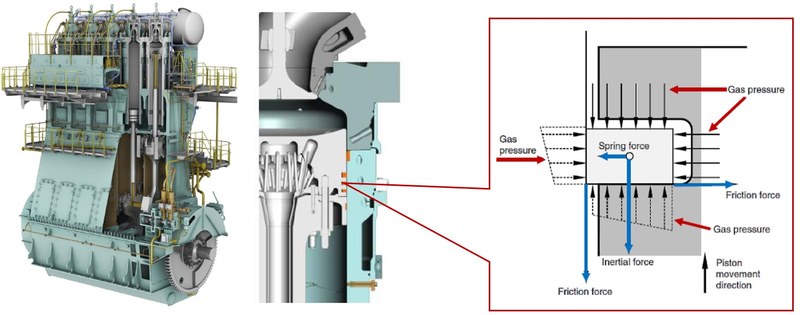
Fig.1: Schematic of an investigated tribological system of a large two stroke marine diesel engine.

Objectives

Understanding the tribological and rheological behavior based on engine operating conditions, provides the possibility to redefine lubrication strategies towards lowest possible oil consumption and at the same time most reliable operating conditions. The method of ultrasonic reflectometry is deployed to determine the lubricant film thickness at the cylinder liner – piston ring interface during engine operation.

Results

Lubricant film thickness (OFT) is determined using a novel approach of ultrasound reflectometry. Detailed investigations with WinGD and a close cooperation with the University of Sheffield leads to a new method of a crank angle resolved determination of OFT during engine operation, which leads to a much better understanding of tribological and rheological effects at the cylinder liner – piston ring interface. Elaborated results provide the basis for the development of a detailed simulation model to support the development of future lubrication strategies.
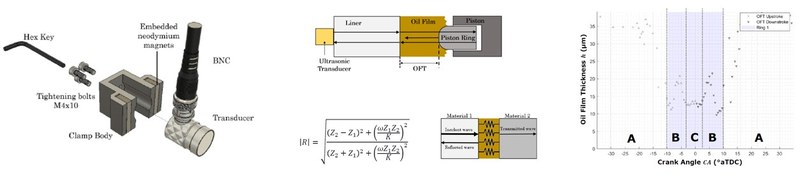
Fig.2: Methodology to obtain dynamic oil film thickness information in a fired engine.

Project information

Client
WinGD – Winterthur Gas and Diesel
Execution

FHNW Institute of Thermal and Fluid Engineering, WinGD, Universität Sheffield

Funding

Direct funding

Duration

2 years

Project team

Matthias Stark, Beat von Rotz, Simon Diggelmann, Janos Miech

School of
Engineering and Environment FHNW University of Applied Sciences and Arts Northwestern Switzerland

  • About the School
    • FHNW School of Engineering and Environment
    • Degree Programmes
    • Continuing Education
    • Collaboration in Research and Services
  • Social Media
    • LinkedIn
    • Instagram
    • Facebook
    • TikTok
    • YouTube
  • About FHNW
    • Organisation
    • Schools
    • Locations
    • FHNW Library
    • Media Relations
  • Support
    • IT Support
    • Inside FHNW
    • Webmail
Logo FHNW - 20 Years
Logo Swiss Universities
Logo European University Association
© University of Applied Sciences and Arts Northwestern Switzerland (FHNW)
  • Data Protection
  • Imprint
  • Accessibility
  • DE
  • EN