Skip to main contentSkip to search barSkip to navigationSkip to footer
Logo of the University of Applied Sciences and Arts Northwestern Switzerland
  • DE
  • EN
  • Home
  • Degree programmes
  • Continuing education

Ten Schools One Goal

The FHNW comprises 10 schools with different specializations. Select a school to see its specific courses, study programmes and information.

Applied Psychology

Architecture, Construction and Geomatics

Art and Design

Music

Computer Science

Life Sciences

School of Education

Social Work

Engineering and Environment

Business

  • Research

    • Research fields
    • Projects
  • Updates and insights

    • News and stories
  • Events

  • Media corner

  • About the School of Engineering and Environment

    • People directory
    • Management Board
  • Institutes

    • Institute of Automation
    • Institute of Bioenergy and Resource Efficiency
    • Institute of Business Engineering
    • Institute of Electric Power Systems
    • Institute of Humanities and Social Sciences
    • Institute of Polymer Engineering
    • Institute of Mathematics and Natural Sciences
    • Institute of Polymer Nanotechnology
    • Institute of Optometry
    • Institute of Product and Production Engineering
    • Institute for Sensors and Electronics
    • Institute of Thermal and Fluid Engineering
    • Laboratories of the School of Engineering and Environment
Logo of the University of Applied Sciences and Arts Northwestern Switzerland
  • About the School
    • FHNW School of Engineering and Environment
    • Degree Programmes
    • Continuing Education
    • Collaboration in Research and Services
  • Social Media
    • LinkedIn
    • Instagram
    • Facebook
    • TikTok
    • YouTube
  • About FHNW
    • Organisation
    • Schools
    • Locations
    • FHNW Library
    • Media Relations
  • Support
    • IT Support
    • Inside FHNW
    • Webmail
  • Data Protection
  • Imprint
  • Accessibility
  • Research

    • Research fields
    • Projects
  • Updates and insights

    • News and stories
  • Events

  • Media corner

  • About the School of Engineering and Environment

    • People directory
    • Management Board
  • Institutes

    • Institute of Automation
    • Institute of Bioenergy and Resource Efficiency
    • Institute of Business Engineering
    • Institute of Electric Power Systems
    • Institute of Humanities and Social Sciences
    • Institute of Polymer Engineering
    • Institute of Mathematics and Natural Sciences
    • Institute of Polymer Nanotechnology
    • Institute of Optometry
    • Institute of Product and Production Engineering
    • Institute for Sensors and Electronics
    • Institute of Thermal and Fluid Engineering
    • Laboratories of the School of Engineering and Environment

Type a search term and search continuing education,degree programmes, events, documents and other content.

  • Engineering and Environment
  • Research and services
  • Research
  • Projects
Projects

Machine Learning Approach for Induction Motor Parameter Estimation, FHNW School of Engineering and Environment

School of Engineering and Environment


A novel method was developed that enables the reliable determination of the electrical motor parameters through the use of machine learning.

Project details

University
FHNW School of Engineering and Environment / School of Engineering and Environment

Background

The electrical simulation of induction motors, for example in the Typhoon HIL Control Center, requires knowledge of the electrical parameters of its equivalent circuit. Datasheets do not provide these data directly, but various methods exist to estimate the parameters from the available catalog data. In a previous project, we implemented a method that directly calculates motor parameters from full catalog data. Within this project, we use machine learning to estimate the motor parameters for cases in which only data from the motor nameplate are known.

Goals

  • Development of a procedure for the parameter estimation of induction motors from nameplate data
  • Usage of machine learning trained with catalog data from various manufacturers
  • Identify the most suitable estimation algorithm based on a training/test data cross correlation analysis

Results

Several machine learning based regression methods for the parameter estimation of induction machines have been investigated and implemented in Python. Machine learning algorithms bring a clear advantage to the parameter estimation problem: one can freely choose the set of known machine parameters and get a useful estimate for the electrical parameters. Thus, it is possible to get a result from only a very limited number of input parameters, as for example the values printed on the motor nameplate.
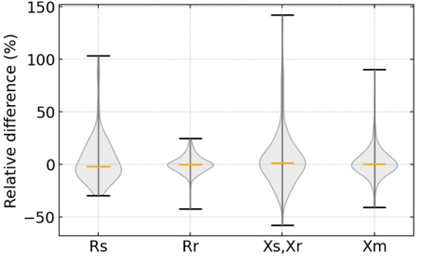
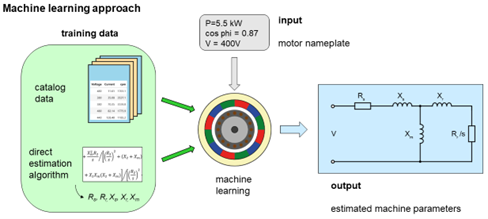
Figure 1: Violin plot of the relative differences of predicted and actual values, for motor parameters Rs, Rr, Xs(=Xr), and Xm, in %. The median of all tested values is shown as orange line, and the extrema as black lines. Shown is the nonlinear regression with a Laplacian kernel function, which gives the best match of test and training data.
Figure 2: Schematics of the machine learning based motor parameter estimation.
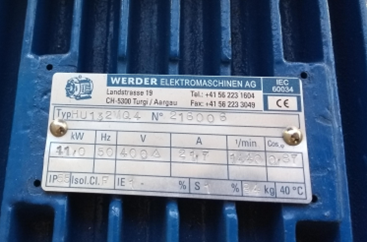
Figure 3: Type plate of an asynchronous machine

Project information

Client

Typhoon HIL

Execution

FHNW Institute of Electric Power Systems

Duration

6 months, from March to August 2022

Funding

Hightech Zentrum Aargau AG, Peter Morf and Beat Dobmann

Project team

Christian Stamm, Georg Traxler-Samek (FHNW)
Petar Gartner, Christoph Schaub, Jelena Trickovic (Typhoon HIL)

School of
Engineering and Environment FHNW University of Applied Sciences and Arts Northwestern Switzerland

  • About the School
    • FHNW School of Engineering and Environment
    • Degree Programmes
    • Continuing Education
    • Collaboration in Research and Services
  • Social Media
    • LinkedIn
    • Instagram
    • Facebook
    • TikTok
    • YouTube
  • About FHNW
    • Organisation
    • Schools
    • Locations
    • FHNW Library
    • Media Relations
  • Support
    • IT Support
    • Inside FHNW
    • Webmail
Logo FHNW - 20 Years
Logo Swiss Universities
Logo European University Association
© University of Applied Sciences and Arts Northwestern Switzerland (FHNW)
  • Data Protection
  • Imprint
  • Accessibility
  • DE
  • EN